Scope Parallax Explained: What It Is and How to Adjust It
Parallax error depends only on the objective diameter and on how far the setting misses the distance. The formula, worked examples, the eye-movement test, and why a sharp picture does not prove parallax is gone.
Parallax in a scope is the situation where the target image and the reticle do not lie in the same plane. The consequence: move your eye behind the eyepiece and the target jumps relative to the crosshair, although neither the rifle nor the target moved.
This article covers where that comes from, what it actually costs — because it can be computed — and how to set parallax so that it stops costing anything.
Where the error comes from
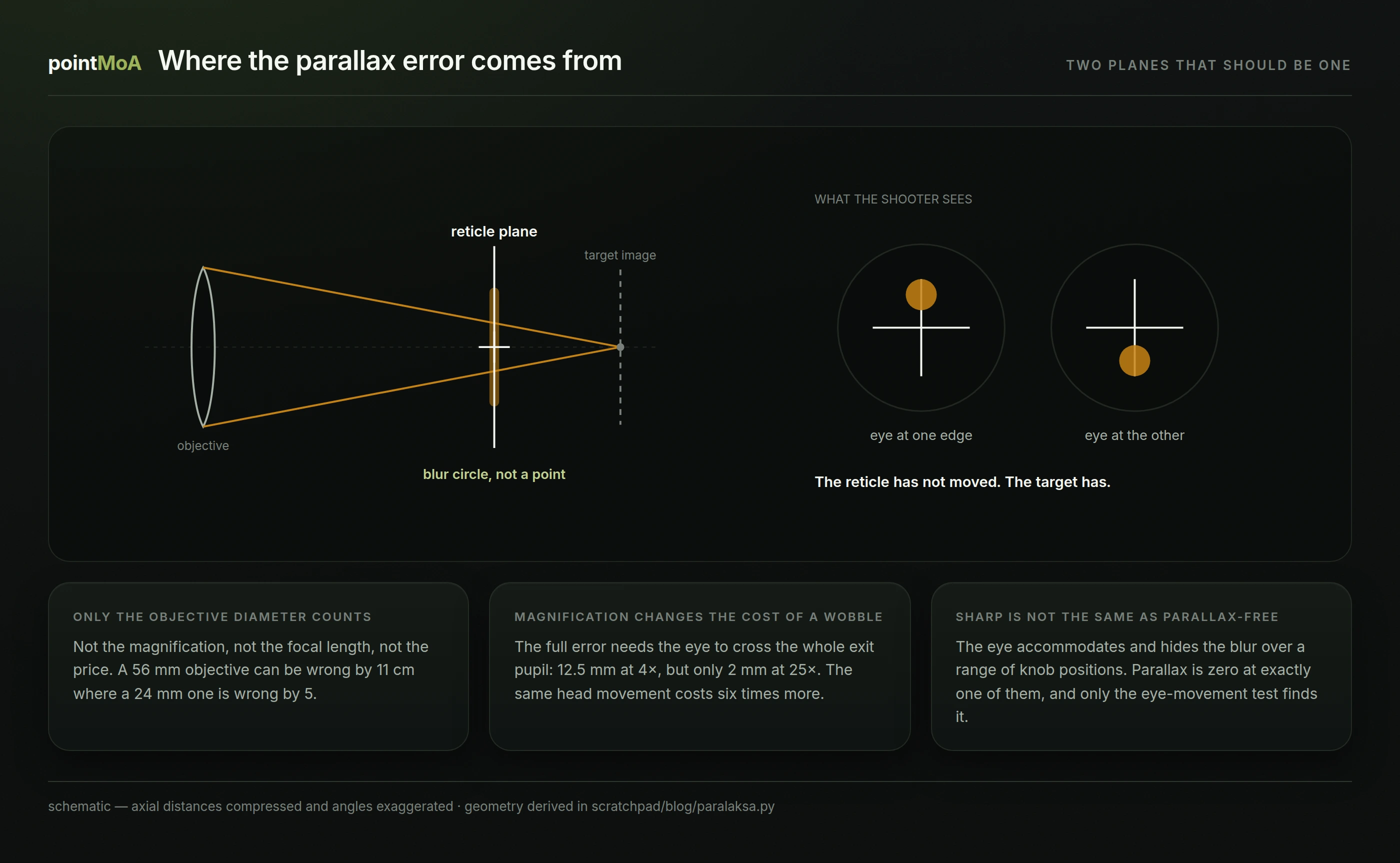
The objective forms an image of the target in a plane whose position depends on the distance. The reticle sits in a fixed plane — the one parallax is set to.
When the two coincide, rays from a single point on the target meet on the reticle at a point, and the image is pinned to the crosshair. When they do not, the same bundle crosses the reticle plane as a circle, not a point. An eye at one edge of the exit pupil picks one side of that circle; at the other edge, the other side.
What it costs
That geometry gives a formula simpler than you might expect:
error on target = objective diameter × |1 − distance ÷ parallax setting|
We derived it and checked it against exact ray tracing through a thin lens, with no small-angle approximations. It agrees with the exact calculation to 0.000 mm at distances from 25 to 500 m.
It is worth pausing on, because it lacks the things you might expect: no magnification, no focal length, no glass quality. We checked that separately — for focal lengths of 80, 100, 150 and 300 mm the answer comes out identical.
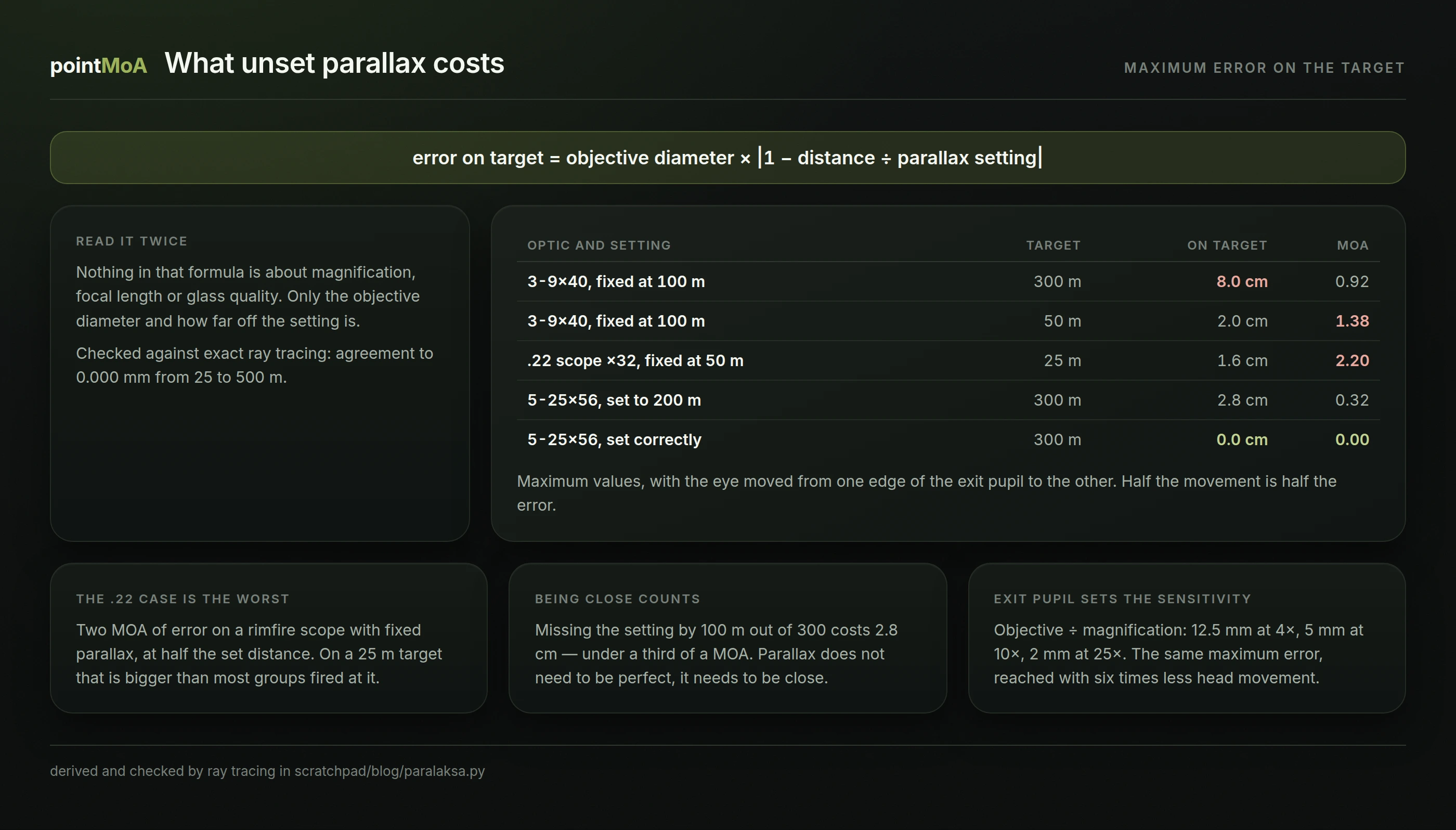
Several things show up immediately.
The rimfire scope comes off worst — fixed at 50 m and shot at 25, it gives 2.2 MOA of error. That is more than most groups fired at that distance, so parallax can be the main source of dispersion there.
The setting does not have to be exact. Missing by 100 m out of 300 costs 2.8 cm, under a third of a minute. Parallax needs to be close, not accurate to the metre.
A big objective is a liability here, not an asset. At the same setting a 56 mm objective is wrong by 11 cm where a 24 mm one is wrong by 5.
Magnification changes the cost of a wobble
Magnification is not in the formula, but it is in the exit pupil — the objective diameter divided by the magnification:
| Magnification | Exit pupil (50 mm objective) |
|---|---|
| 4× | 12.5 mm |
| 10× | 5.0 mm |
| 25× | 2.0 mm |
The full error needs the eye to cross the whole exit pupil. At 4× that takes 12.5 mm of head movement; at 25×, 2 mm is enough.
So magnification does not change the maximum error, it changes how easily you reach it. At high magnification the same sloppy cheek weld costs several times more.
Parallax is not focus
This distinction is worth making once and properly, because confusing the two is the commonest reason people "set the parallax" and still have it.
The diopter ring (on the eyepiece) focuses the reticle for your eye. You do it once, against the sky or a blank wall, in short glances so the eye does not have time to accommodate.
The parallax knob (side focus or an adjustable objective) moves the target's image plane onto the reticle plane. You do it whenever the distance changes much.
The trouble is that the eye accommodates and can sharpen the target image across the whole range of settings — the picture looks right while the planes still do not coincide. A sharp image is necessary but not sufficient. The only reliable check is eye movement.
The eye-movement test, step by step
- Support the rifle solidly — bags, a bipod, anything, as long as nothing moves. This is the critical condition: if the rifle wobbles, the test means nothing.
- Put the crosshair on a distinct point on the target.
- Move your eye behind the eyepiece: up and down, then left and right. Move your head, not the rifle.
- Watch whether the crosshair swims across the target. If it does, you have parallax.
- Turn the parallax knob and repeat. You are looking for the setting where the crosshair sits as if nailed down, despite the head movement.
- Only at the end check whether the picture happens to be sharp. If it is not, check the diopter — that is its business, not parallax's.
The distance scale on the knob is a hint, not a measurement. Manufacturers calibrate it roughly and it can be tens of metres out. Trust what the test shows, not the number on the drum.
Optics without adjustment
Not every scope has a parallax knob. Those without have a factory setting — typically 100 m for centrefire scopes and 50 m for rimfire, though the value depends on the model and is worth checking in the manufacturer's data.
That leaves three things to do:
- A repeatable cheek weld. If the eye always lands in the same place in the exit pupil, parallax stops being dispersion and becomes a fixed offset — and a fixed offset goes into the zero.
- Awareness of the distance you are shooting. With a 100 m setting, a shot at 300 m carries up to 8 cm of risk; a shot at 100 m carries none.
- More magnification means less tolerance. See the exit-pupil table above.
Red dots are a separate case: their reticle is collimated at infinity, so there is no parallax setting and nothing to adjust. What remains is a geometric limit — moving the eye across the window shifts the target relative to the dot by as much as the eye moved. For a 25 mm window that is up to 2.5 cm on the target, regardless of distance: 2.5 MRAD at 10 m and 0.25 MRAD at 100 m. Which is why a red dot is "parallax-free" where it is used, and can be fussy at a few metres.
What parallax does to a group
It depends on whether your cheek weld is repeatable.
If it is not, every shot has a different point of aim within the parallax error. The group grows. With a 3-9×40 fixed at 100 m and fired at 300 m that is up to 8 cm — 0.9 MOA of added dispersion, as much as the entire group of a decent setup.
If it is repeatable, the error does not grow shot to shot — it sits in one place and moves the whole group centre. That is worse in a different way: you zero it in. A zero computed with parallax present is correct only for that one head position, at that one distance. Hence parallax's place on the pre-zeroing checklist in the zeroing guide.
How to tell the two apart on paper: dispersion from parallax is random in every direction, exactly like ordinary dispersion, so a single group will not settle it. The eye-movement test settles it, done before shooting. How to measure group size so the numbers mean something is in the guide to measuring groups.
Common mistakes
Setting parallax by sharpness. The image can be sharp across the whole range. Look for a still crosshair, not a pretty picture.
Testing with an unsupported rifle. If the rifle swims, everything swims and the test says nothing.
Trusting the scale on the drum. It is a hint, not a measurement.
Setting the diopter to the target instead of the reticle. The diopter is for the reticle. Set to the target it masks parallax rather than removing it.
Zeroing without checking parallax. The most expensive one on this list, because the error goes into the zero and comes back every time you shoot.
The short version
- Parallax is two planes that fail to coincide, not "loose optics".
- The error on target is objective diameter × |1 − distance ÷ setting| — no magnification, no focal length.
- A sharp picture proves nothing; only the eye-movement test with a supported rifle does.
- The setting needs to be close, not exact: missing by 100 m out of 300 is under a third of a MOA.
- With fixed parallax, a repeatable cheek weld is the fix — it stops the error being dispersion.
Frequently asked questions
What is the difference between side focus and an adjustable objective? Only where the control sits. Side focus is on the side, by the turrets, and can be worked without coming off the stock; an AO is a ring on the objective bell. Optically they do the same thing.
Does parallax change the zero? Not by itself. But a zero established with parallax present carries that error inside it — and it comes back at any other head position or distance.
What distance should I set parallax to when the ranges vary? To the one where the shot is hardest, usually the longest. The error grows with how far the setting is off, and the most distant target is usually both the smallest and the least forgiving.
Is a scope without parallax adjustment worse? Not if you shoot near its factory setting and have a repeatable cheek weld. It gets worse when the distance departs far from that setting — see the table above.
Do red dots have parallax? They have no setting and practically no error at the distances they are used at. What remains is a geometric limit on the order of the window diameter — a few centimetres on the target, which is a lot at 10 m and disappears into the dispersion at 100 m.
Does parallax spoil a group-size measurement? Yes, if head position varies between shots. Which is why the eye-movement test is done before the string, not after looking at the target.
If you run several setups, record the parallax setting alongside the optic's configuration in the pointMoA app — together with the sight height and the click value. Groups fired from the same configuration can then be compared in the target analysis, instead of guessing whether a difference came from the ammunition or from parallax being set one day and not the next.