How to Calculate Group Size in MOA: Formula, Examples and Pitfalls
Converting a measured group to MOA takes one division. The formula, a worked example at an awkward distance, and how much that number is actually worth — with the error budget computed.
Converting a measured group to MOA is one division:
group [MOA] = group [in] ÷ (0.01047 × distance [yd])
or, in metric:
group [MOA] = group [mm] ÷ (0.29089 × distance [m])
A 1.00 in group shot at 100 yd is therefore 1.00 ÷ 1.047 = 0.96 MOA.
The difficulty lies elsewhere: in what you put on top, how well you know the bottom, and how many digits you are then entitled to write down. Those three decide whether the number means anything. The division itself is never the problem.
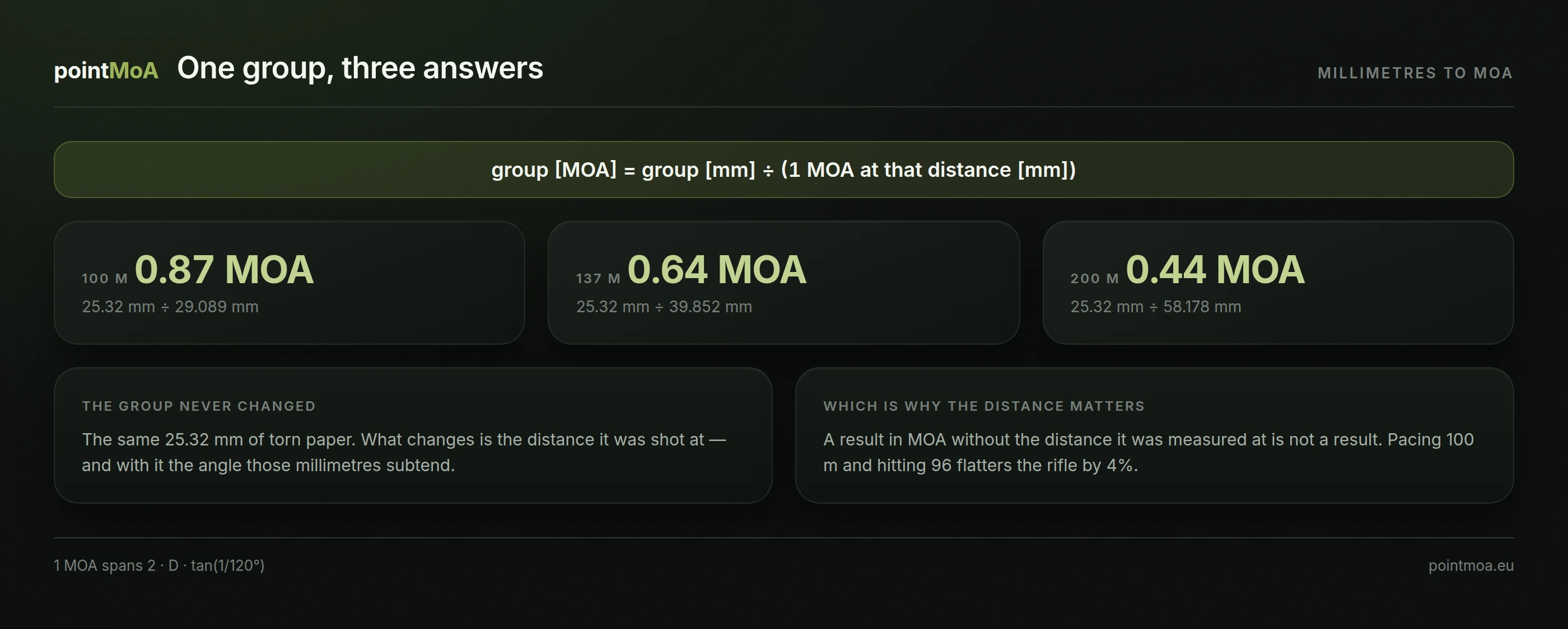
Where 1.047 and 0.29089 come from
They are the span of one minute of angle per unit of distance: 1.047 in per 100 yd, and 0.29089 mm per metre. At 100 m that gives 29.089 mm; at 300 yd, 3.14 in.
Where those numbers come from, and why one minute is not exactly one inch at 100 yards, is covered in MOA and MRAD explained. That article also carries the table of 1 MOA at common distances, so this one does not repeat it.
For mental arithmetic, 1 inch per 100 yards is fine. It overstates the result by 4.7% — you divide by slightly too little — which is negligible against the uncertainties below. Use the exact figure when you write the number in a logbook.
Step by step
- Measure the group centre to centre. How to do it properly, and which measure to pick, is in the guide to measuring groups.
- Establish the distance. Not "about a hundred". A rangefinder or a tape.
- Work out the denominator: 0.01047 × distance in yards.
- Divide, and round to two significant figures.
A worked example at a distance you do not know by heart
The berm happens to sit at 150 yd, and the group measures 1.00 in.
- denominator: 0.01047 × 150 = 1.5705 in
- result: 1.00 ÷ 1.5705 = 0.6367
- written down: 0.64 MOA
At 100 yd the same group would be 0.96 MOA. The difference has nothing to do with the rifle and everything to do with the distance — which is why a result in MOA without the distance is not a result.
What exactly are you converting
This is where the most common and most flattering mistake happens. "My rifle shoots 0.30 MOA" sounds superb until it turns out the mean radius was converted rather than the extreme spread.
For the group in the illustration:
| What you convert | Linear | MOA at 100 m |
|---|---|---|
| Extreme spread | 25.32 mm | 0.87 MOA |
| Mean radius | 8.60 mm | 0.30 MOA |
Both figures are correct and both describe the same group. Quoting the second without naming the measure inflates the rifle by a factor close to three. When somebody says "a group in MOA" with no adjective, they almost always mean extreme spread — quote it that way unless you say otherwise explicitly.
Where the error in the result comes from
The conversion is exact. The inputs are not. Here is the error budget for a 1.00 in group at 100 yd.
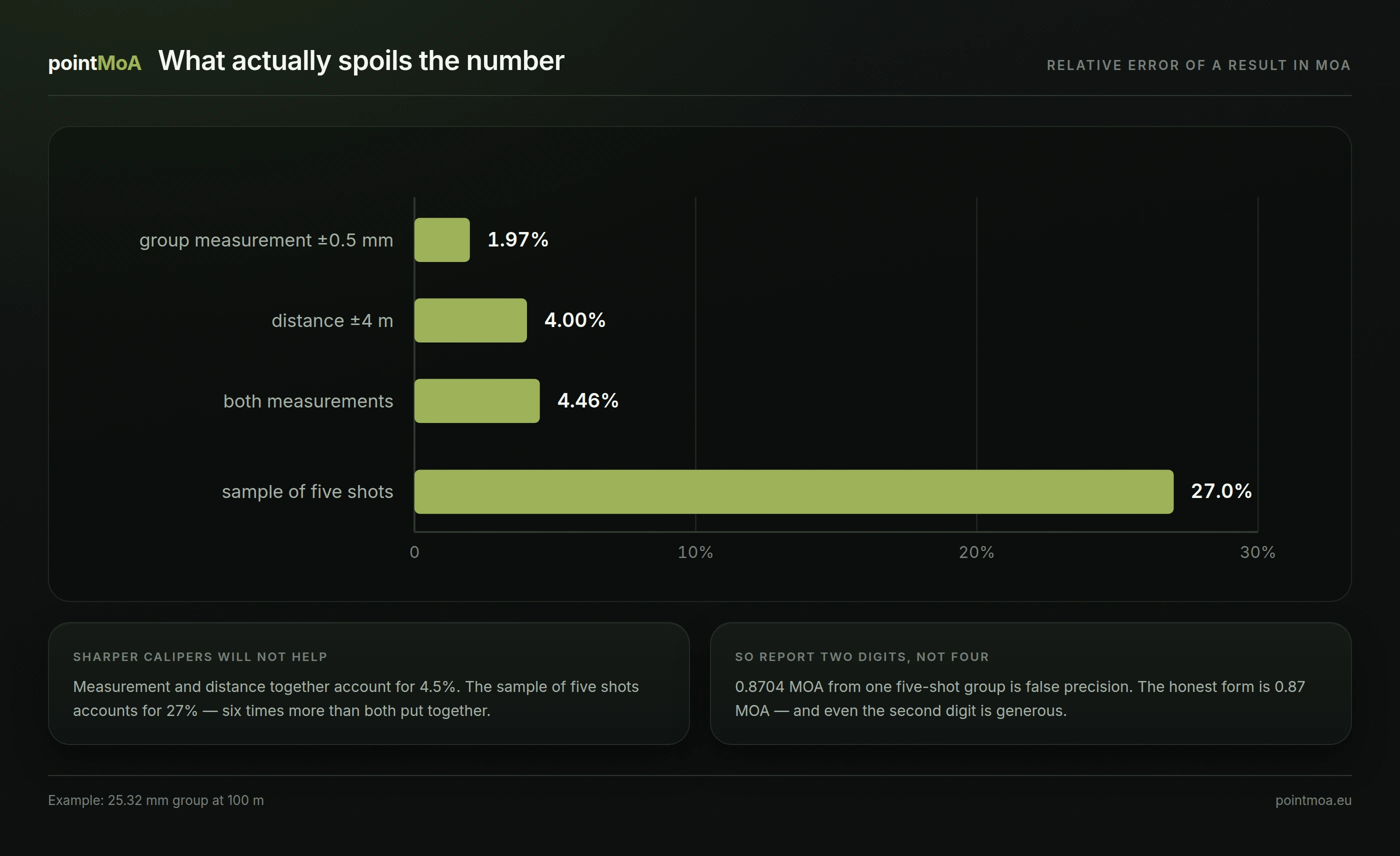
Measuring the group. A caliper read to ±0.02 in on a 1 in group is about 2%.
Distance. Four yards out of a hundred is 4% — twice the measurement error. Pacing it out makes that the norm, not the exception. Worse, it is one-sided in practice: an overstated distance understates the MOA figure, which flatters the rifle.
Both together (root sum of squares): 4.5%.
The sample. Here it gets uncomfortable. A five-shot group has a coefficient of variation on extreme spread of 27% — that is the result of the simulation described in the guide to measuring groups. It is six times the two measurement errors combined.
The practical conclusion runs against instinct: a better caliper will not improve your assessment of the rifle. Only more shots will.
How many digits you are entitled to
The calculator will show 0.9551 MOA. Four significant figures imply you know this group to a ten-thousandth of a minute of angle. You do not.
- from the measurements alone: 0.96 ± 0.04 MOA,
- including the five-shot sample: 0.96 ± 0.26 MOA.
The honest form is 0.96 MOA, and with a single group even the second digit is generous. The third and fourth are decoration, not precision.
Write "0.96 MOA, extreme spread, 5 shots, 100 yd" rather than "0.9551 MOA". The first can be compared with something later. The second only looks serious.
If you prefer MRAD
The milliradian reduces the arithmetic to moving a decimal point: 1 MRAD spans exactly 1/1000 of the distance — 3.6 in at 100 yd, or 100 mm at 100 m.
group [MRAD] = group [mm] ÷ (distance [m] × 100)
The 25.32 mm group is 25.32 ÷ 100 = 0.25 MRAD. Between units, 1 MOA = 0.29089 MRAD. Which to choose is covered in MOA and MRAD.
Common pitfalls
Mixed units. Group in centimetres, distance in metres, formula written for millimetres. The result comes out ten times too small and nobody notices, because it reads magnificently.
Distance by eye. The largest single source of measurement error, and the only one you can remove for free — with a tape.
Measuring the inside edges. Understates the group by a full bullet diameter before you divide anything.
Comparing groups of different shot counts. A three-shot 0.5 MOA group and a ten-shot 0.5 MOA group are not the same result — the second is clearly better.
Confusing MOA with inches. "3 MOA of correction" and "3 inches of correction" are different quantities: the first scales with distance, the second does not.
The short version
- Divide the measured group by 0.01047 × distance in yards (or 0.29089 × distance in metres).
- Always state which measure you converted, how many shots, and at what distance.
- Distance contributes more error than the caliper, and the shot count contributes six times more than both.
- Two significant figures is the most a single group can support.
Frequently asked questions
Can I just divide by one inch at 100 yards? Yes, for mental arithmetic. The shortcut overstates the result by 4.7%, which is nothing against 27% of sampling uncertainty. Use the exact figure for the logbook.
A 0.8 in group at 50 yd — how many MOA? Denominator: 0.01047 × 50 = 0.5235 in. Result: 0.8 ÷ 0.5235 = 1.53 MOA. Note that at a shorter distance the same linear group yields a larger angular figure.
Does a group offset convert the same way? Yes — the distance from the group centre to the point of aim is the same kind of angle as group size, and it divides by the same number. Just do not quote one in place of the other: the difference is covered in POA vs POI.
Is MOA calculated differently for a pistol? No. An angular unit does not know what fired the shot. Only the typical distance and the typical group size change.
Why does my result differ from the manufacturer's? Usually for three reasons: they quote the best group rather than the average; they shoot from a test fixture rather than a shoulder; and they often quote three-shot groups. Each of those on its own improves the number.
Is it worth computing MOA for a single group? Worth recording, not worth drawing conclusions from. Comparing loads takes several groups — how many exactly is worked out in the guide to measuring groups.
If you would rather not divide by hand: in the pointMoA app you mark the hits on a photo of the target, enter the distance, and extreme spread and mean radius appear straight away in millimetres and in MOA — each under its own name, so there is no mixing them up.