Ballistic Calculator: How It Works and What Data It Needs
What a ballistic calculator computes, which inputs it really needs, and which one wrecks the answer hardest. With a computed ranking of every input and a procedure for checking the table on the range.
A ballistic calculator integrates the equations of motion for a bullet and hands back a table: where the bullet will be at each distance, how much to dial, and how fast it will get there.
What it does not do is guarantee a hit. It returns a model's forecast fed on your data, and it is exactly as good as the worst of that data. This article is mostly about which input is the worst one.
What the calculator returns
The portal's calculator computes, for every distance in the table step:
| Column | What it means |
|---|---|
| Drop | how far below the line of sight the bullet is |
| Elevation | how much to dial on the turret, in MOA or MRAD |
| Drift | how far the wind has pushed the bullet sideways |
| Windage | the same, in turret units |
| V | the bullet's velocity at that distance |
| E | kinetic energy |
| Time | time of flight |
| Mach | velocity relative to the speed of sound |
The last two get skipped and they matter: time of flight is what the wind works on — the longer the bullet is out there, the longer it gets pushed — and the Mach figure tells you whether the bullet is entering the transonic region, where dispersion usually grows.
Which inputs actually matter
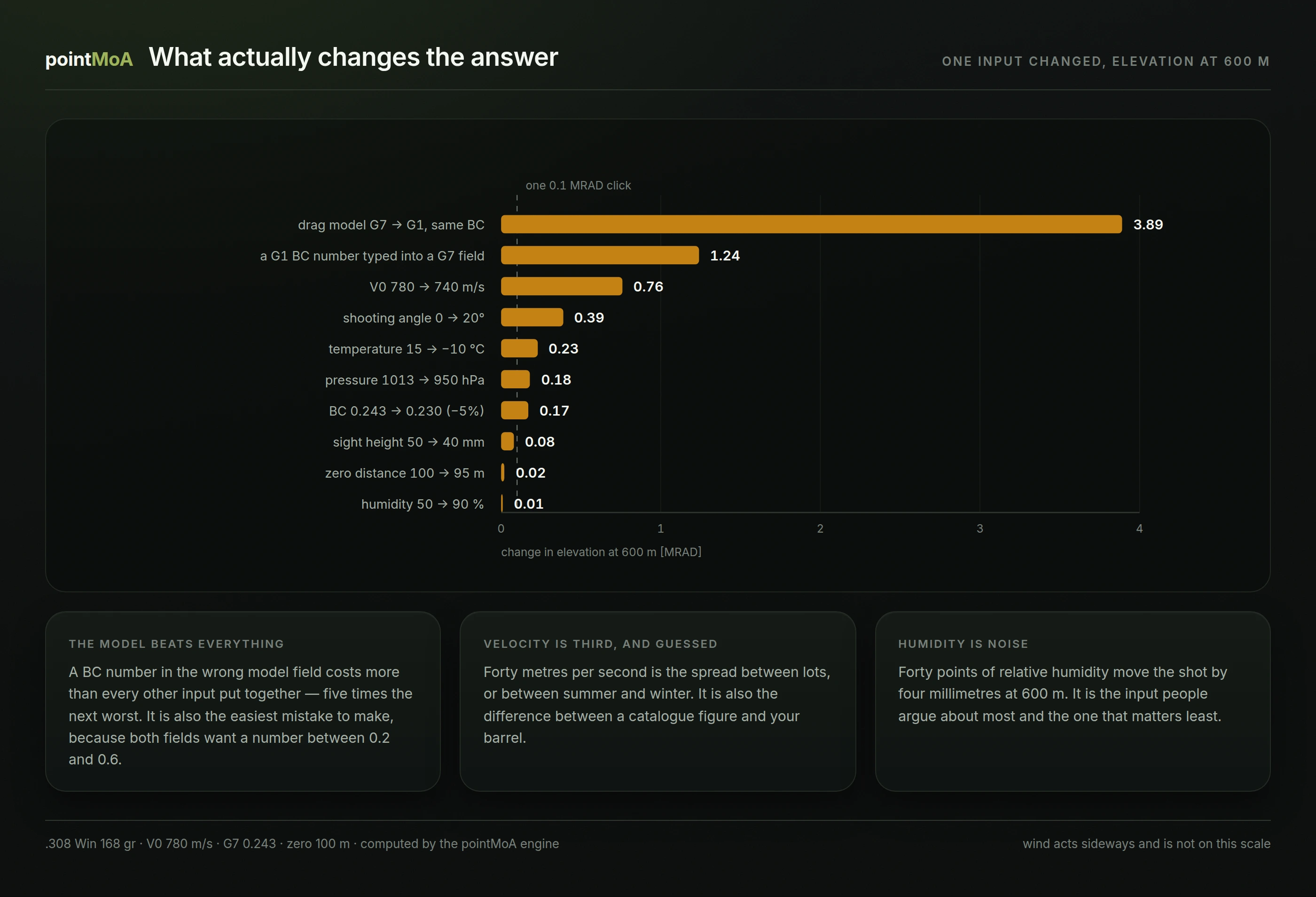
This is the part worth seeing once and remembering. We took a reference setup — .308 Winchester, 168 gr bullet, 780 m/s muzzle velocity, BC 0.243 in the G7 model, 50 mm sight height, 100 m zero, standard conditions — and changed one input at a time, watching what happened to the elevation at 600 m.
Three things are worth saying out loud.
The drag model beats everything else put together. Typing the same BC number against the wrong model costs 3.89 MRAD at 600 m — five times the second entry on the list. It is also the easiest mistake to make, because both fields accept a number from the same range and nothing objects.
Muzzle velocity is third, and almost always a guess. Forty metres per second is the spread between ammunition lots, between summer and winter, or between the manufacturer's test barrel and yours.
Humidity is noise. Forty percentage points move the shot by four millimetres at 600 m. It is the input the internet argues about most and the one that matters least.
Wind is deliberately absent from the chart because it works in the other axis: 4 m/s from three o'clock pushes this bullet 94 cm at 600 m without moving the elevation by a single click.
Rifle and optic data
Sight height — the distance from the bore axis to the optical axis. It mostly affects short range, because it sets how steeply the path climbs to the line of sight. Ten millimetres of error is 5 cm at 600 m; measure it once, properly.
Zero distance — the one you actually set. Five metres of error is one centimetre at 600 m, which is nothing. Entering 100 when you zeroed at 50 is a different story and a different curve.
Turret unit and click value — these do not enter the physics, only the conversion of the answer into what you dial. If the scope is in MRAD, run everything in MRAD; mixing units is a classic. The difference is covered in MOA and MRAD.
Ammunition data
Bullet mass in grains and muzzle velocity in metres per second. The catalogue velocity was measured on the manufacturer's barrel, and yours is usually different. The portal's calculator can estimate it for your barrel length, but a chronograph beats every estimate.
Ballistic coefficient and drag model — separately, below, because that is the most expensive mistake in the whole form.
Drag model: G1 or G7
A ballistic coefficient is not a number in its own right. It is the ratio of your bullet's drag to a standard bullet's — and there are two standards:
- G1 — a short flat-based bullet with a blunt nose, a shape from the end of the nineteenth century;
- G7 — a long boat-tailed bullet, close in shape to today's long-range projectiles.
The same bullet has different BC numbers in the two models. For our .308 168 gr it works out that G1 ≈ 0.482 produces the same path as G7 0.243 — a ratio of about 1.98. We checked it across the range: matched at 600 m, the two curves agree to the millimetre at 200, 300, 400 and 500 m as well.
Note: that ratio is not universal. It comes out of this particular bullet's shape. A bullet with a different profile gives a different ratio, which is why "multiply by two" is an impression, not a conversion.
Hence the only safe rule: take the number and the model from the same source and enter them together. Manufacturers usually publish G1; if your calculator is set to G7, switch the model rather than converting the number by eye.
Environmental data
Temperature and pressure set the air density, and density sets the drag. Dropping from 15 to −10 °C is 0.23 MRAD at 600 m; a pressure drop of 63 hPa (roughly 540 m higher above sea level) is 0.18 MRAD the other way. Both are within a single day in the mountains.
Enter the station pressure, not the one from the weather forecast. The forecast quotes pressure reduced to sea level, which at 800 m differs from the real one by more than 90 hPa.
Humidity — put in anything sensible. As the chart above shows, it does not change the answer by an amount you could dial.
Shooting angle, up or down, reduces the effective drop. Twenty degrees is 0.39 MRAD at 600 m — more than temperature and pressure combined.
Wind
Wind goes in as a speed and a clock direction: 3 is wind from the right, 9 from the left, 12 head-on. Head and tail winds do almost nothing; a crosswind does everything.
The scale for our setup: 4 m/s from three o'clock pushes the bullet 94 cm at 600 m. That is ten times anything temperature will do to it.
Wind is also the one input you cannot measure once. It changes between the firing point and the target, and the calculator takes a single value for the whole path — a simplification worth remembering when you read the drift column. Where drift comes from, how to read the wind clock and why the correction grows faster than the distance is covered in the wind drift guide.
Step by step in the pointMoA calculator
The portal's calculator runs in the browser, on your device — the data never leaves it.
- Ammunition. Calibre, bullet mass, muzzle velocity, BC and drag model. The "pick from the database" button fills this in for common cartridges.
- Optic and zero. Sight height, turret unit, optionally the click value, and the zero distance.
- Conditions. Temperature, station pressure, humidity, wind and shooting angle.
- Table. Maximum distance and step. The portal's engine computes to 600 m.
- Compute. The table and chart appear below the form; columns can be toggled and the whole thing saved as a PDF.
The pointMoA app does the same with the same engine, with one difference: it keeps profiles for the rifle, the optic and the ammunition, so you do not retype everything before each range trip.
A worked example
Demonstration data — not a description of any particular rifle or lot of ammunition, simply the portal calculator's defaults:
.308 Winchester, 168 gr bullet, 780 m/s, BC 0.243 in the G7 model, 50 mm sight height, 100 m zero, 15 °C, 1013.25 hPa, 50% humidity, no wind.
| Distance | Drop | Elevation | V | E | Time | Mach |
|---|---|---|---|---|---|---|
| 100 m | 0 cm | 0.00 MRAD | 720 m/s | 2820 J | 0.133 s | 2.11 |
| 200 m | −14 cm | 0.70 MRAD | 662 m/s | 2387 J | 0.278 s | 1.94 |
| 300 m | −50 cm | 1.68 MRAD | 608 m/s | 2009 J | 0.436 s | 1.78 |
| 400 m | −114 cm | 2.84 MRAD | 555 m/s | 1679 J | 0.608 s | 1.63 |
| 500 m | −208 cm | 4.17 MRAD | 505 m/s | 1389 J | 0.797 s | 1.48 |
| 600 m | −342 cm | 5.70 MRAD | 457 m/s | 1137 J | 1.005 s | 1.34 |
Two things to read out of that table. First, drop is not linear: 14 cm between 100 and 200 m, and 134 cm between 500 and 600 m. Where that comes from, and why the school formula ½gt² is not enough here, is covered in the bullet drop guide. Second, this bullet stays supersonic across the whole range (still Mach 1.34 at 600 m), so transonic trouble starts further out than the portal's calculator reaches.
With a 100 m zero the apex of the path sits 0.4 cm above the line of sight at 80 m — flat, in other words. That is why a 100 m zero looks like "no elevation", and why the choice of zero distance is a separate decision, covered in the zeroing guide.
How to check the table on the range
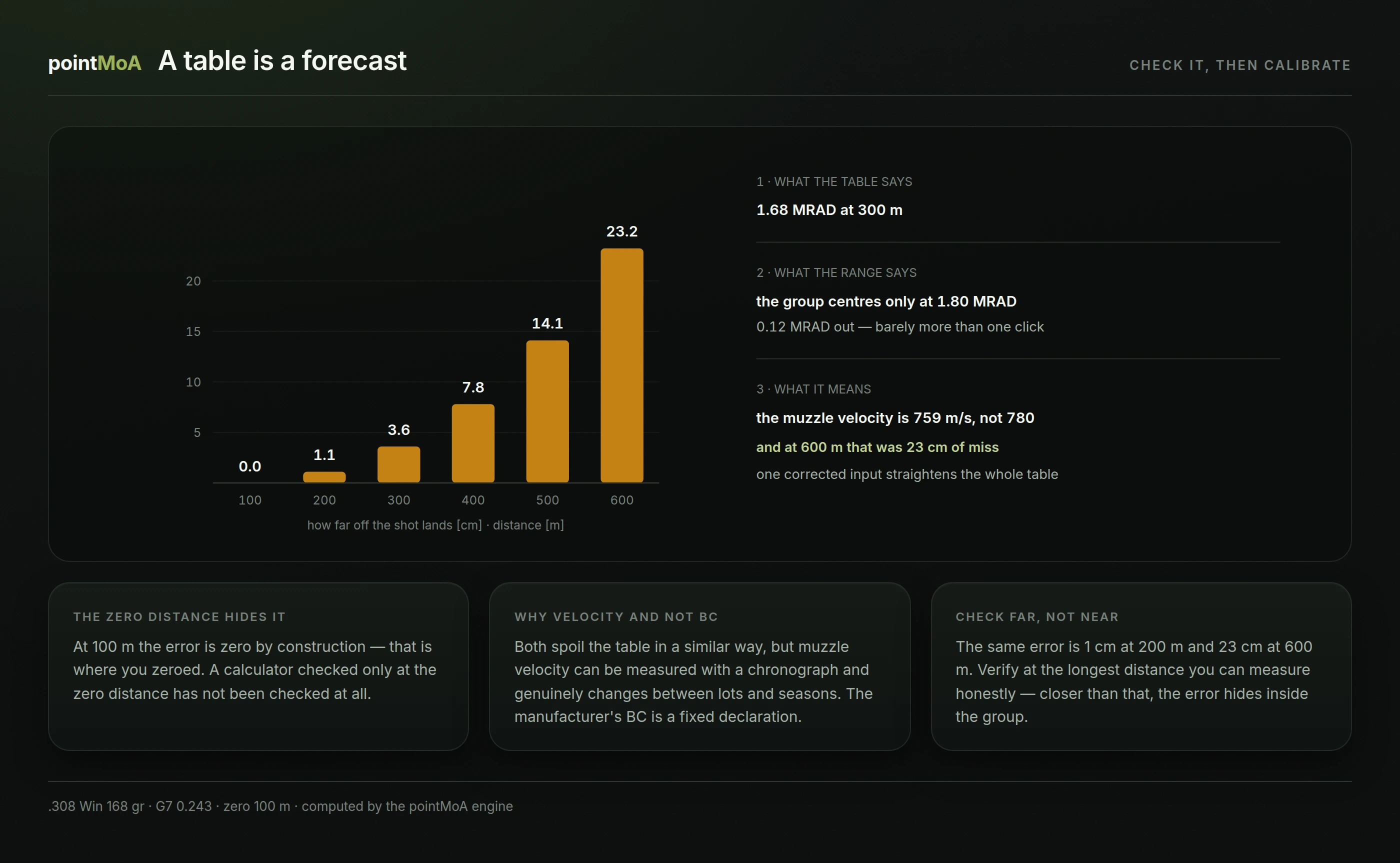
The table is a forecast. Before you adopt it, verify it with shots — and do it far out, not at the zero distance.
The procedure has three steps:
- Zero the rifle and confirm the zero really sits where it should.
- Dial the correction from the table for a chosen longer distance and fire a group. A group, not a shot — why, is in the guide to measuring groups.
- Compare the group centre with the point of aim and work out how much correction was actually needed.
The example from the board: the table predicts 1.68 MRAD at 300 m, and the group only centres after dialling 1.80. The difference is 0.12 MRAD — barely more than one click, easy to write off as chance. It is not chance: that gap is what a muzzle velocity of 759 m/s rather than 780 produces. Correct it and the whole table straightens out; at 600 m the elevation goes from 5.70 to 6.09 MRAD, which is 23 cm of hit.
Why calibrate velocity rather than BC? Both spoil the table in a similar way, but velocity can be measured with a chronograph and genuinely changes between lots and seasons. The manufacturer's ballistic coefficient is a fixed declaration — if it is wrong, it is wrong always.
Common mistakes
Catalogue velocity instead of a measured one. Third on the influence chart, and the figure most often copied off the box.
A BC from one model with the other model selected. First and second on that same chart. Take the number and the model together, from one source.
Pressure from the weather forecast. The forecast reduces it to sea level. The calculator wants station pressure.
Sight height by eye. Measure from the bore axis to the optical axis, not from the rail and not from the top of the receiver.
Mixing units. A correction computed in MOA and dialled on a MRAD turret. The result looks plausible and is off by a factor of 3.4.
Conditions from three months ago. A table computed in July and dialled in January is a different table — for our setup, 0.23 MRAD at 600 m from temperature alone.
Calling the table verified because it agrees at 100 m. At the zero distance it always agrees, by construction.
The short version
- A calculator returns a model's forecast, not a promise of a hit.
- The most expensive mistake is a ballistic coefficient entered against the wrong drag model — five times worse than the next item on the list.
- Muzzle velocity is worth measuring rather than copying off the box.
- Humidity is irrelevant; a crosswind matters more than anything else.
- Verify the table at a long distance, and cancel the discrepancy by calibrating the muzzle velocity.
Frequently asked questions
Does a calculator replace shooting at distance? No. It shortens the path to a hit and lets you start at an unfamiliar distance from a sensible place, but the inputs cannot be checked any way other than with shots.
Where do I get the ballistic coefficient? From the bullet manufacturer's product sheet — together with the model it was quoted in. The portal calculator's database carries it for common cartridges.
Can I use a G1 BC with the calculator set to G7? Not without switching the model. The same number in the other model describes a completely different bullet — the most expensive mistake on the whole influence chart.
How far does the portal's calculator compute? To 600 metres, in steps of 1 to 100 m. The range comes from the engine, the same one the app runs.
Why does my table only drift apart at long range? Because an input error accumulates with time of flight. The same overstated muzzle velocity is 1 cm of miss at 200 m and 23 cm at 600 m.
Do I have to enter the shooting angle? Shooting across the flat, no — zero will do. In the mountains, yes: twenty degrees is more than temperature and pressure combined.
Compute your own table in the pointMoA calculator — everything runs in your browser, with nothing sent to a server, and the finished table saves to PDF or carries straight over to the zeroing target.