Bullet Drop Explained: What Affects It and How to Calculate It
The school formula ½gt² is both correct and misleading. Four different numbers all called drop, why a zero does not mean no drop, and what the drop column in a ballistic table actually measures.
A bullet starts falling the moment it leaves the barrel. Nothing holds it up — it flies an arc, because gravity works on it exactly as it works on a stone. At 780 m/s that arc is simply very flat for the first few hundred metres.
That is everything simple about it. The rest of this article is about why the word "drop" covers four different numbers, and why the school formula for free fall is correct and misleading at the same time.
The school formula, and why it is not enough
From secondary-school physics: a falling body drops ½gt². For a bullet travelling 600 m at 780 m/s that gives a time of 0.769 s and a drop of 290 cm.
That number is untrue, but not because the formula is wrong. The formula is fine — it is being fed the wrong time.
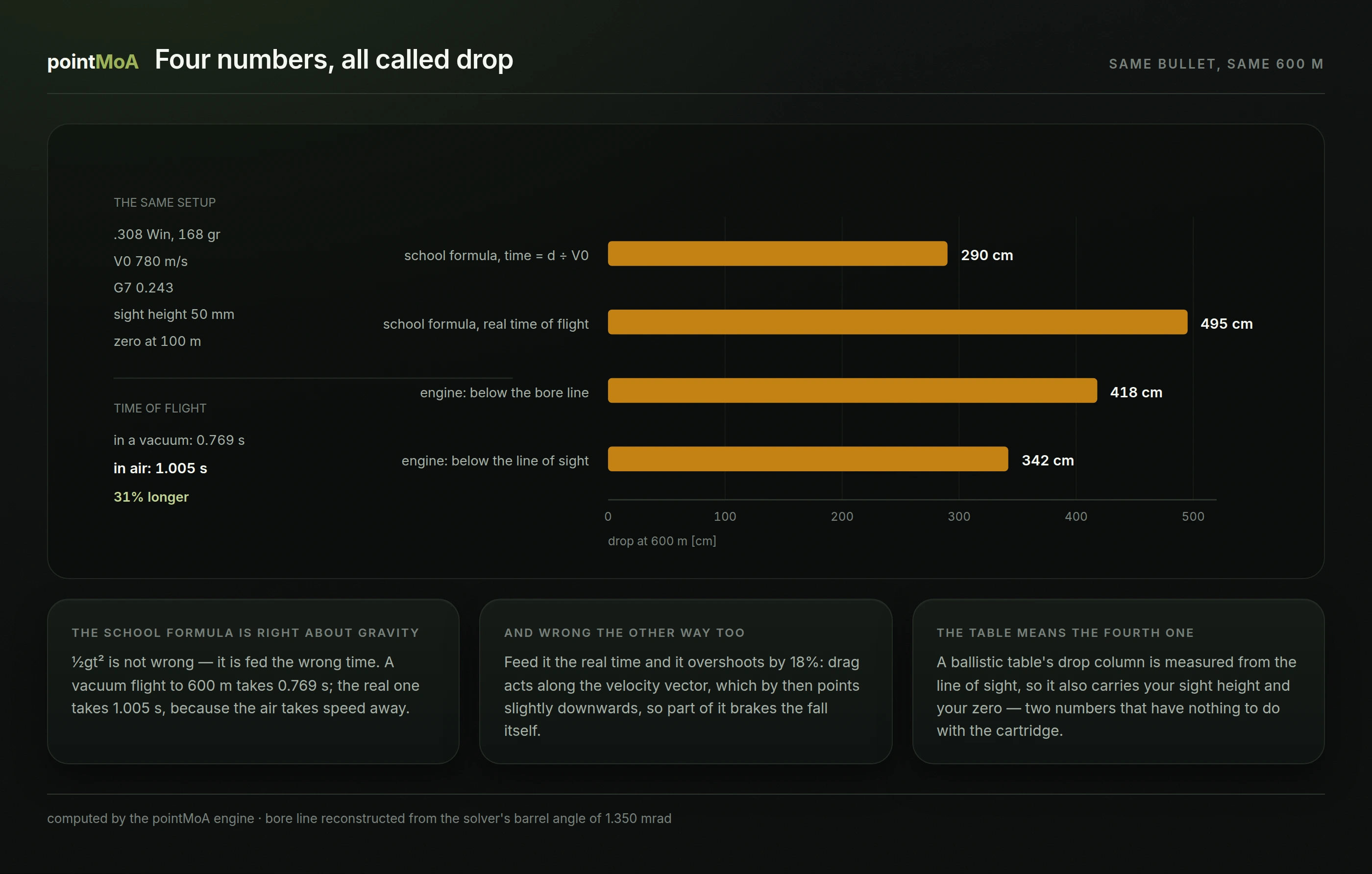
The real flight to 600 m takes 1.005 s, not 0.769 — the air takes speed away, so the bullet is up there 31% longer. Put that time into the school formula and you get 495 cm.
That is not true either, this time in the other direction. The ballistic engine gives 418 cm below the bore line, 18% less. The reason: drag acts along the velocity vector, and by then that vector points slightly downwards, so part of the drag brakes the fall itself.
Hence a conclusion worth keeping: the school formula is good for understanding the mechanism and useless for computing a correction. A table comes from a solver integrating the motion step by step — which is exactly what a ballistic calculator does.
Four things called drop
Before comparing two numbers, it is worth checking whether they measure the same thing.
Drop below the bore line — how much lower the bullet is than it would be flying straight along the barrel's axis. This is "drop" in the physical sense, and the only one of the four that does not depend on your optic.
Drop below the line of sight — how much lower the bullet is than the point you are looking at. This is the "drop" column in a ballistic table. It depends on your sight height and your zero distance, two things that have nothing to do with the cartridge.
Free fall, ½gt² — a model without air. Useful for explaining, harmful for arithmetic.
The correction you dial — the same drop expressed as an angle. More on that below.
When somebody says "this load drops three metres at 600", they almost always mean the second one — and they are also, without knowing it, telling you their scope height and their zero.
Why a zero does not mean no drop
The barrel is never parallel to the line of sight. It has to be angled slightly upwards so that the bullet, which starts falling from the first metre, crosses the line of sight at the chosen distance.
For our setup with a 100 m zero that angle is 1.350 mrad — under a tenth of a degree. The bullet leaves the muzzle 5 cm below the line of sight (because that is the sight height), climbs, crosses the line of sight at 100 m and falls away after that.
So a zero does not stop the falling. A zero is one point on the curve where the path crosses the line of sight. How to choose that point, and what happens either side of it, is covered in the zeroing guide.
Drop is not a property of the cartridge
This is the most practical conclusion in the article, and the easiest to see in figures.
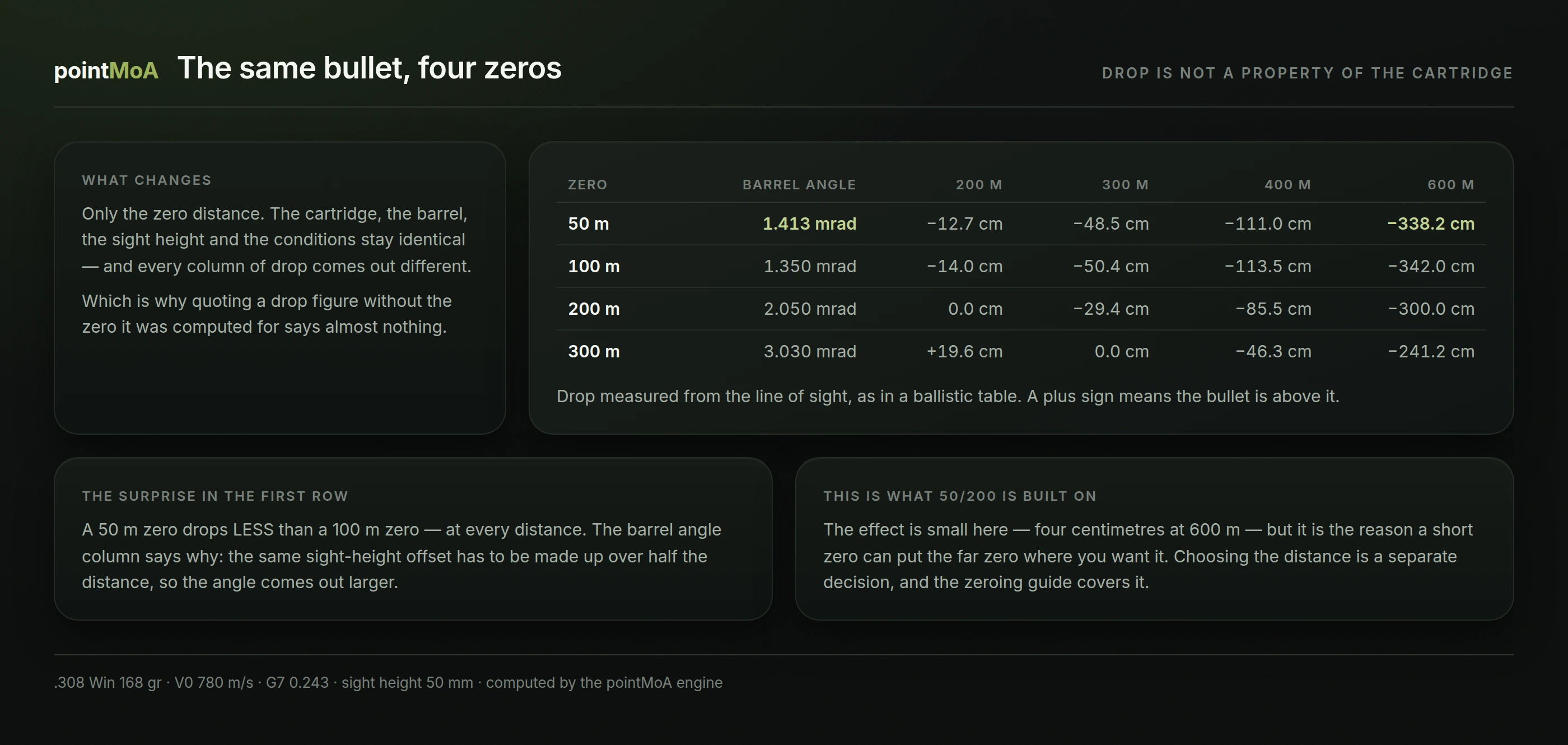
The same cartridge, the same barrel, the same optic — and four different drop columns, because only the zero distance changed.
The first row is worth a pause: a 50 m zero drops less than a 100 m zero, at every distance. It looks like an error and it is not. The answer is in the barrel-angle column: with a 50 m zero the same sight-height offset has to be made up over half the distance, so the angle comes out larger — 1.413 rather than 1.350 mrad. That mechanism is what the popular 50/200 zero is built on.
What drop depends on
Muzzle velocity. A hundred and twenty metres per second more (780 → 900) takes 99 cm off the drop at 600 m. Eighty less (780 → 700) adds 100 cm.
Ballistic coefficient. BC 0.350 instead of 0.243 takes off 48 cm; BC 0.180 adds 71 cm. A sleeker bullet loses speed more slowly, so it spends less time in the air.
Distance — more than quadratically. In a vacuum drop grows exactly with the square of distance. In air, for our setup, it grows as distance to the power 2.2, because the time of flight also grows faster than linearly.
Shooting angle. Thirty degrees uphill takes 53 cm off the drop at 600 m; thirty degrees downhill takes 59 cm. The familiar rule says the sign does not matter because only the horizontal projection counts; the solver says it almost does not — the difference here is 5 cm at 600 m.
Atmosphere. Temperature and pressure change air density, and density changes drag. This is the weakest item on the list — by how much exactly is in the influence ranking in the calculator guide.
What is not on the list: bullet weight by itself. A heavier bullet in the same calibre usually drops less, but because it is sleeker, not because it is heavy. Gravity accelerates every body the same.
In centimetres or in angles
Drop in centimetres says where the bullet is. Drop in MOA or MRAD says how much to dial — and only the second is any use on a turret.
| Distance | Drop | MRAD | MOA |
|---|---|---|---|
| 100 m | 0 cm | 0.00 | 0.00 |
| 200 m | −14 cm | 0.70 | 2.41 |
| 300 m | −50 cm | 1.68 | 5.78 |
| 400 m | −114 cm | 2.84 | 9.75 |
| 500 m | −208 cm | 4.17 | 14.33 |
| 600 m | −342 cm | 5.70 | 19.59 |
Note that the angular correction grows with distance, and faster than the distance itself. Between 100 and 300 m it adds 1.68 MRAD; between 400 and 600 m, 2.86. What both units are is covered in MOA and MRAD.
How to read a trajectory table
Three things to check before you adopt a table:
- Which zero it was computed for. Without that the drop column means nothing — see the table above.
- What sight height it assumed. That goes into the same column.
- In what conditions. A July table dialled in January is a different table.
And one thing to do: check it with shots at a long distance. The procedure is in the calculator guide — briefly: if the table asks for less correction than you actually need, the muzzle velocity is usually the culprit.
The short version
- ½gt² describes gravity correctly, but in air the bullet flies longer, so the formula fed with a vacuum time understates the drop by a third.
- Fed the real time, it overshoots by 18%, because drag brakes the fall too.
- The "drop" column in a table is measured from the line of sight, so it carries your sight height and your zero.
- The same cartridge with a different zero has a different drop at every distance.
- In air, drop grows as distance to the power 2.2, not 2.
Frequently asked questions
How much does a bullet drop at 300 m? For the setup in this article — 50 cm below the line of sight with a 100 m zero. With a 200 m zero it is 29 cm, and with a 300 m zero it is nothing. The question has no single answer without a zero.
Does a heavier bullet fall more slowly? Not because of its mass. Gravity accelerates every body equally; heavier bullets in a given calibre are usually sleeker, so they hold velocity longer and fly for less time.
Can I compute drop from ½gt²? For understanding — yes. For dialling a correction — no. You need a time of flight that accounts for drag, and only a solver gives that.
Why does the bullet go up first? Because the barrel is angled upwards relative to the line of sight — it has to be, so the path crosses that line at the zero distance. The bullet falls throughout the flight; over the first stretch it simply falls more slowly than the barrel angle lifts it.
Does drop depend on the shooting angle? Yes, noticeably: thirty degrees uphill takes 53 cm off at 600 m, downhill 59 cm. So "only the horizontal projection counts" is a good approximation, not an identity — the difference between up and down is 5 cm here.
Why do different manufacturers' tables give different figures for the same cartridge? Usually because they assumed a different sight height, a different zero or a different muzzle velocity. Three inputs that are rarely printed next to the table.
Compute the drop for your own setup in the pointMoA calculator: enter the cartridge, the sight height and the zero distance, and the table gives the drop in centimetres and the correction in your turret's unit — for your zero, not somebody else's.