Wind Drift Explained: Corrections in MOA and MRAD
Why wind moves a bullet further than instinct suggests, how to read direction off the clock face, and where the correction comes from. With a computed wind clock and a formula that matches the calculator to 0.005%.
Wind is the one input in a ballistic solution that cannot be measured once and saved in a profile. It changes between shots, between the firing point and the target, and with height. It is also — after the drag model — the thing that most often decides a miss at distance.
This article covers where drift comes from, how to compute it, and what gets said about it that is not true.
Wind does not push the bullet sideways
The mental image is: the bullet flies, the wind blows on it, the bullet slides sideways. That explanation leads to wrong expectations, because it suggests drift grows in step with distance.
The real mechanism is different. A bullet does not drift through the air like a boat — it turns its nose into the airflow, rotating slightly towards the side the wind comes from. From that moment part of the drag force acts sideways. How much depends on how long the bullet is in the air and how much it has slowed down.
Hence a formula that looks odd until you understand it:
drift = wind speed × (time of flight − distance ÷ muzzle velocity)
The bracket is the lag time: how much later the bullet arrives than it would have if nothing had slowed it. The wind works on that lag, not on the whole time of flight. The same quantity governs drop — and misleads in the same way when fed to the school formula (bullet drop guide).
We checked the formula against the calculator's engine at distances from 25 to 600 m. It agrees to 0.005% — not a rough approximation, the same number.
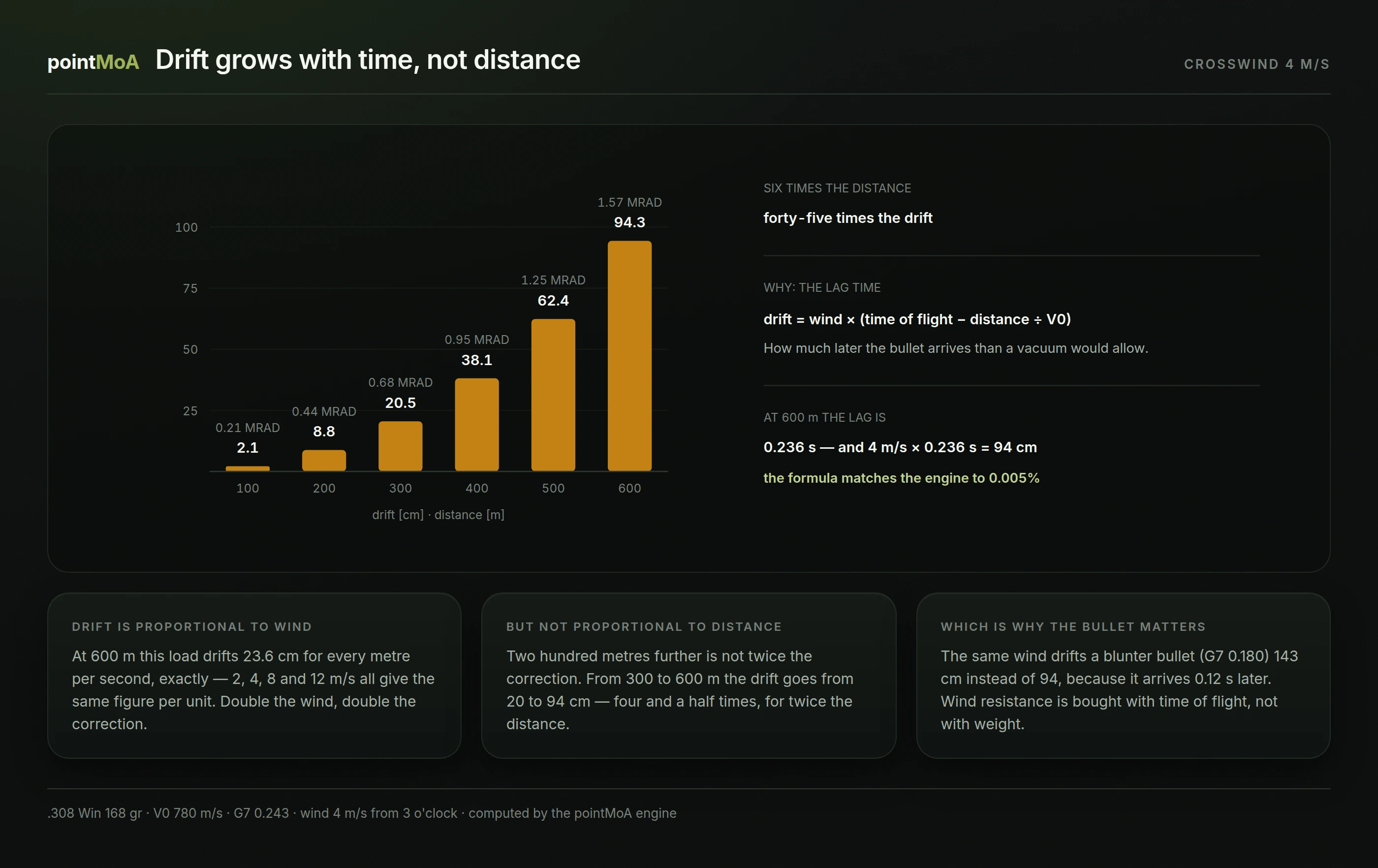
The practical consequence: twice the distance is not twice the correction. From 300 to 600 m the drift goes from 20 to 94 cm — more than four times.
The wind clock
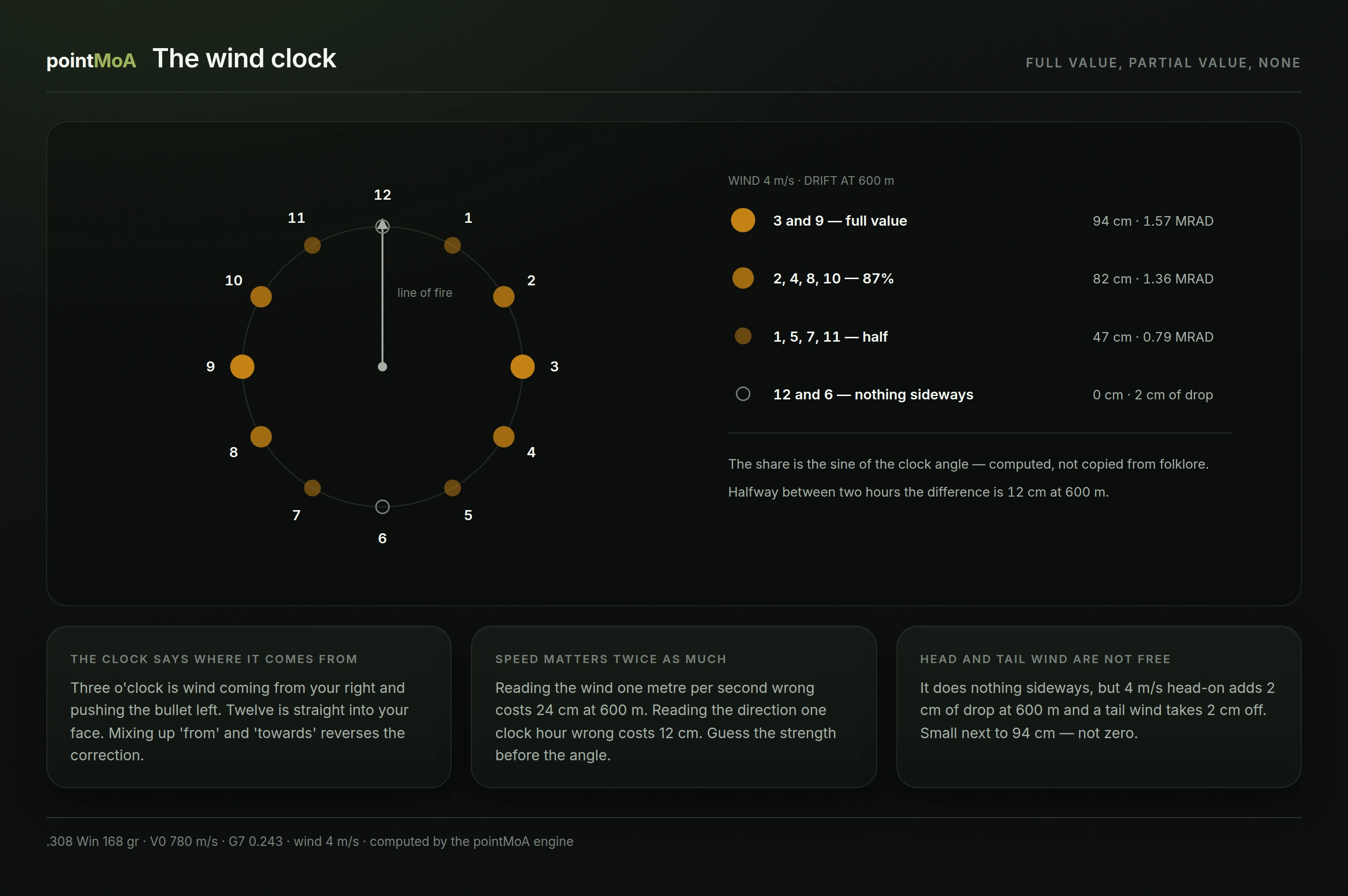
Direction is given as an hour on a clock face where twelve is in front of you, towards the target. The hour says where the wind comes from: three o'clock is wind from the right, pushing the bullet left.
| Hour | Share | Drift at 600 m |
|---|---|---|
| 3, 9 | 100% | 94 cm |
| 2, 4, 8, 10 | 87% | 82 cm |
| 1, 5, 7, 11 | 50% | 47 cm |
| 12, 6 | 0% | 0 cm |
Those shares are not a rule of thumb copied off a forum — they are the sine of the clock angle, checked against the calculator's engine. The symmetry is not quite perfect (one o'clock gives 50.3% and five gives 49.7%), because the head and tail components slightly change the time of flight. The difference is under half a percentage point — below the resolution of a turret.
A head wind is not free
Twelve and six produce no sideways drift, but they are not without effect. Four metres per second head-on adds 2 cm of drop at 600 m, and a tail wind takes the same off. Small against 94 cm of drift — but not zero, and worth knowing when the shot is marginal.
What sets the size of the drift
Wind speed — directly proportional. Twice the wind is twice the correction. For our setup that comes to 23.6 cm at 600 m for every metre per second, and the figure is identical at 2, 4, 8 and 12 m/s.
Distance — more than linearly. The second two hundred metres cost more than the first, because the lag builds up over every metre the bullet spends slowing down.
The bullet — through that same time of flight. The same wind drifts a blunter bullet (G7 0.180) 143 cm instead of 94, because it arrives at 600 m 0.12 s later. Wind resistance is bought with time of flight, not with weight — a heavier bullet helps only when it is also sleeker.
Muzzle velocity — indirectly. The same bullet launched at 900 instead of 780 m/s drifts 75 cm rather than 94.
⚠️ These are figures for one specific setup — .308 Winchester, 168 gr bullet, 780 m/s, BC 0.243 in the G7 model. Another cartridge gives different ones, and there is no universal wind table despite the many that circulate. Compute your own.
The correction in MOA and MRAD
Drift in centimetres is useless until you turn it into something you can dial. The calculator does that for you, but the two columns are worth seeing side by side:
| Distance | Drift | MRAD | MOA | 0.1 MRAD clicks | 1/4 MOA clicks |
|---|---|---|---|---|---|
| 100 m | 2.1 cm | 0.21 | 0.72 | 2 | 3 |
| 200 m | 8.8 cm | 0.44 | 1.51 | 4 | 6 |
| 300 m | 20.5 cm | 0.68 | 2.35 | 7 | 9 |
| 400 m | 38.1 cm | 0.95 | 3.28 | 10 | 13 |
| 500 m | 62.4 cm | 1.25 | 4.29 | 13 | 17 |
| 600 m | 94.3 cm | 1.57 | 5.40 | 16 | 22 |
Note that the angular correction grows with distance too — unlike a plain zero offset, which stays constant in MOA. What both units are and how to convert between them is in MOA and MRAD.
In practice wind corrections are more often held in the reticle than dialled: with a shifting wind, turning a turret between shots costs more time than it is worth.
What the calculator cannot do
Here are the honest limits, worth knowing before you trust a number from the table.
The calculator takes one wind value for the whole path. We checked this in the engine's code: the wind vector is built once, from a speed and an hour, and does not change along the trajectory. Real wind changes in both speed and direction — between the firing point, the dip halfway down and the berm.
Wind near the muzzle counts for more. That follows directly from the lag formula: a disturbance early in the flight has the whole remaining distance to grow. A gust right at the target moves the impact far less.
A weather forecast does not describe your range. It gives an area average, usually at 10 m above the ground. Between trees, in a valley or behind a berm the wind is different — sometimes the other way round.
The practical conclusion: treat the calculator's figure as a starting point for observation, not as a reading. Record how much correction was actually needed in what conditions — after a few range trips that is your own wind table, worth more than anyone else's.
In the pointMoA calculator
The portal's calculator has two fields: wind speed in metres per second and direction as an hour from 1 to 12. The result appears in two columns — drift in centimetres and the windage correction in your turret's unit.
What to do when you do not know the speed: compute two cases, a low one and a high one — say 3 and 6 m/s. The gap between them is the width of your uncertainty, and it shows immediately whether it is even worth worrying about at that distance.
What else the calculator needs, and which input wrecks the answer hardest, is covered in the calculator guide.
Common mistakes
Confusing "from" with "towards". The clock hour says where the wind comes from. Getting it backwards reverses the correction, which doubles the miss.
Counting a head wind as half value. Twelve and six give zero sideways, not half. Half comes from one, five, seven and eleven.
Scaling drift linearly with distance. "It was 20 cm at 300 m, so 600 will be 40" — it will be 94.
One wind table for everything. Drift depends on time of flight, so on the cartridge and the barrel. Your neighbour's table describes your neighbour's rifle.
A correction from the forecast, without looking at the range. The grass, the flag and the mirage on your own range know more than a weather app.
The short version
- Wind does not push the bullet — it works on the lag time, on how much the bullet has slowed.
- Drift grows faster than distance: six times the distance is forty-five times the drift.
- The clock hour says where the wind comes from; the crosswind share is the sine of its angle — 100%, 87%, 50% or 0.
- Drift is directly proportional to wind speed, so doubling the wind doubles the correction.
- Misjudging the speed by one metre per second costs twice what misjudging the direction by an hour does.
Frequently asked questions
How much is the wind correction at 300 m? For the setup in this article — 20.5 cm, or 0.68 MRAD, in a 4 m/s full-value wind. For your cartridge it will be different: it depends on time of flight, and that on muzzle velocity and ballistic coefficient.
Is a heavier bullet less affected by wind? Not because of the weight, but because heavier bullets in a given calibre are usually sleeker and hold velocity longer. What counts is time of flight, not grains.
How do I judge wind speed without a meter? By what you can see — the Beaufort scale exists for exactly this. Wind felt on the face and leaves rustling: 2–3 m/s. Small twigs in constant motion, a light flag extended: 3.5–5 m/s. Dust and loose paper raised, small branches moving: 5.5–8 m/s. Small trees beginning to sway: 8–10 m/s. That is an estimate, not a measurement — which is why it pays to compute a low and a high case.
Does a head wind change the zero distance? It does not change the zero, but it slightly increases drop at long range. For our setup, 4 m/s head-on is 2 cm at 600 m.
Why does my wind correction never quite work? Because the wind you measure at the firing point is not the wind the bullet flies through. The calculator takes one value for the whole path, and reality does not have one.
Hold in the reticle or dial the turret? With a shifting wind, hold. A turret is good for a steady elevation correction; wind is rarely steady long enough to make turning it worthwhile.
Compute your own correction in the pointMoA calculator: enter the wind speed and clock hour, and the drift and windage correction arrive in the same table as the drop — in centimetres and in your turret's unit.