MOA and MRAD — what they are and how to convert them to centimetres
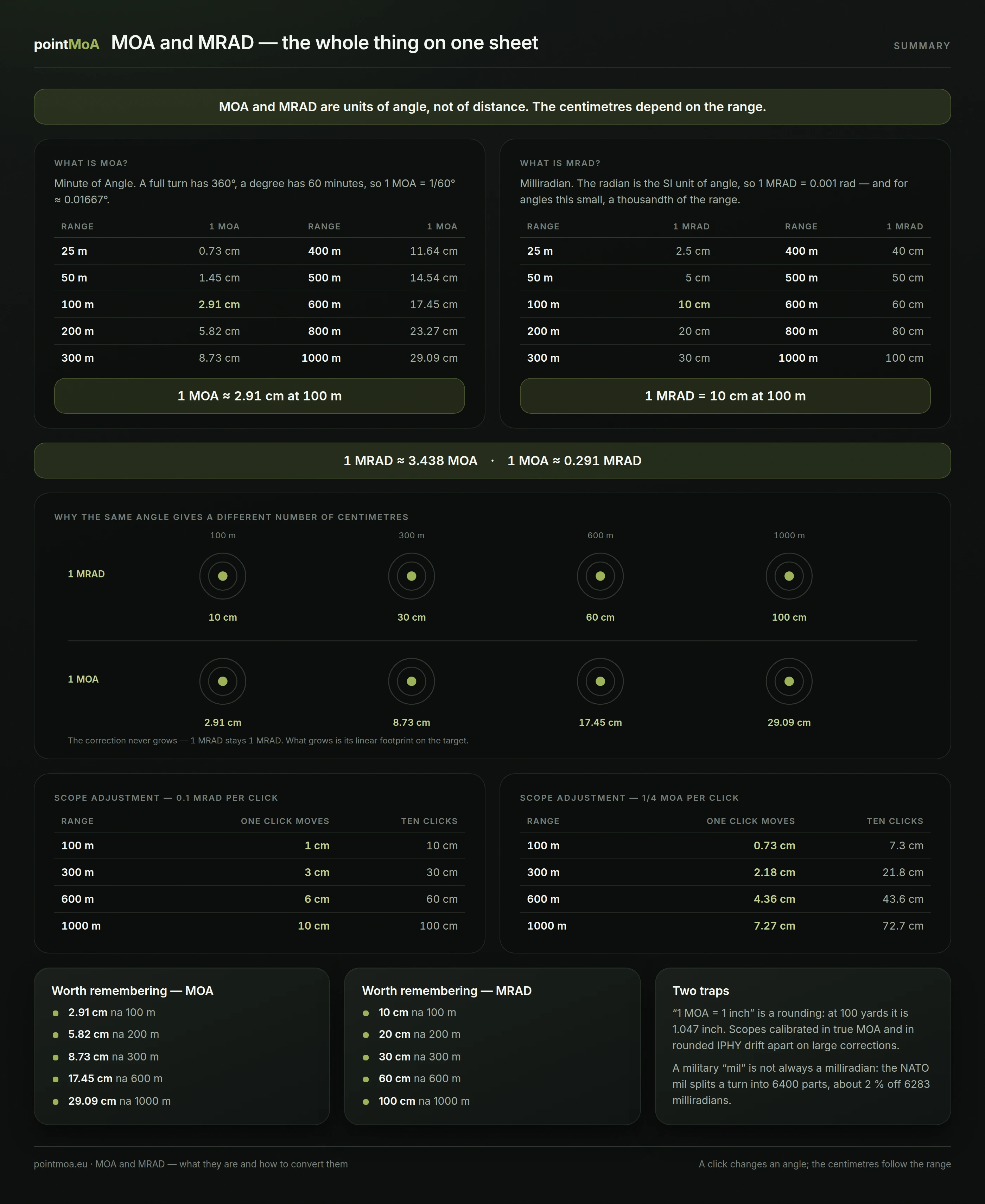
MOA and MRAD are units of angle, not distance. What a minute of angle and a milliradian come to in centimetres at every range, how to convert one into the other, and how far a single turret click really moves the shot.
MOA and MRAD are the two angular units you meet most often in shooting. They appear in scope specifications, on reticles, on turret markings and anywhere precision is discussed.
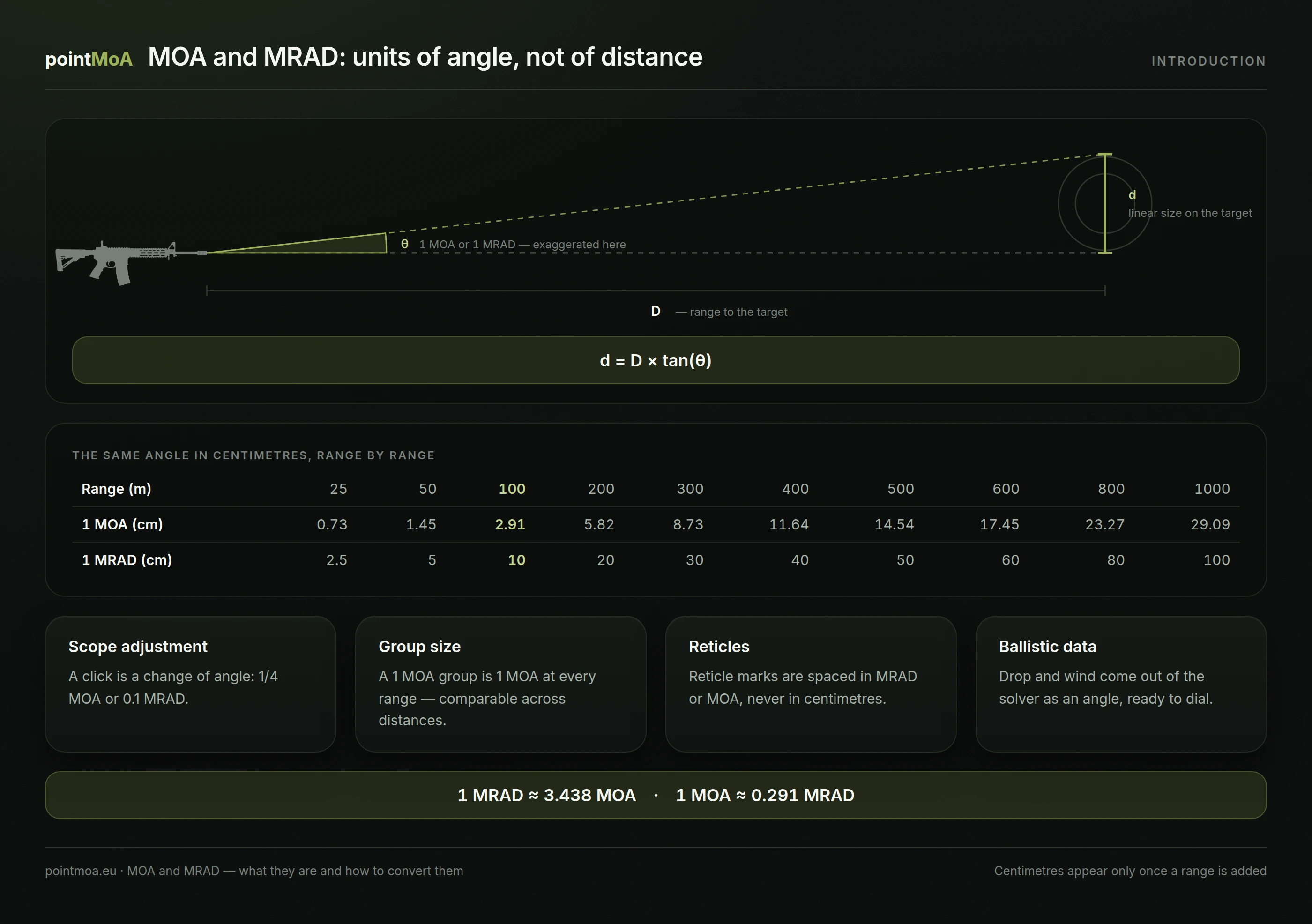
One thing matters above all: MOA and MRAD are not units of distance. They are units of angle. Centimetres appear only once you combine the angle with a specific range.
What is MOA?
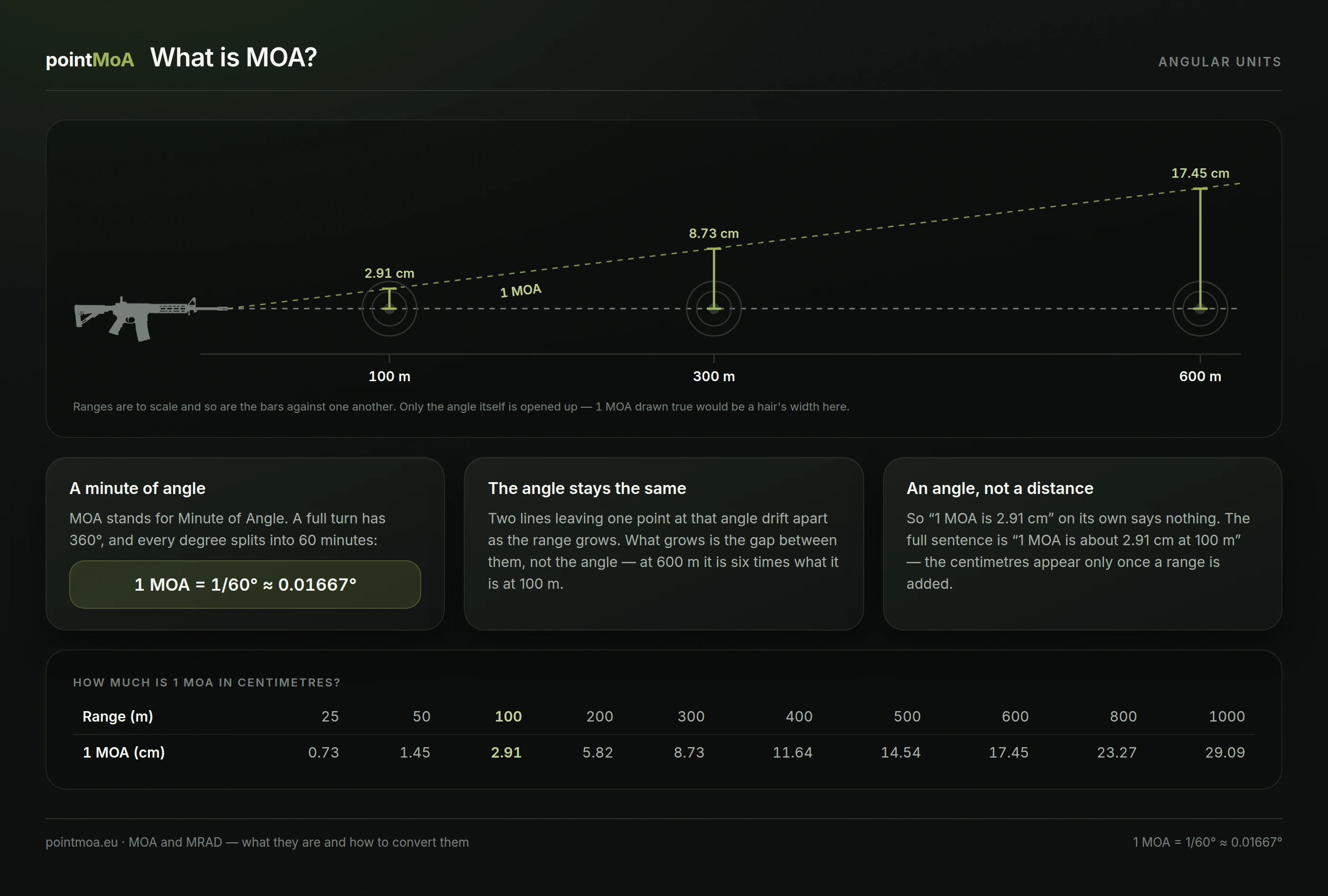
MOA stands for minute of angle.
A full turn is 360°, and each degree divides into 60 minutes. One minute of angle is therefore:
1 MOA = 1/60° ≈ 0.01667°
MOA is a very small angle. Picture two lines leaving a single point. If the angle between them is 1 MOA, they drift further apart as range grows. At 100 m the gap between them is small; at 1000 m it is ten times larger.
The angle itself never changes. That is the key to understanding MOA.
What is 1 MOA in centimetres?
To convert MOA into centimetres you need the range. The exact relationship comes from the tangent function:
d = D × tan(θ)
where:
- d — linear distance,
- D — range to target,
- θ — angle.
For 1 MOA that gives:
| Range | 1 MOA |
|---|---|
| 25 m | 0.73 cm |
| 50 m | 1.45 cm |
| 100 m | 2.91 cm |
| 200 m | 5.82 cm |
| 300 m | 8.73 cm |
| 400 m | 11.64 cm |
| 500 m | 14.54 cm |
| 600 m | 17.45 cm |
| 800 m | 23.27 cm |
| 1000 m | 29.09 cm |
The values grow linearly, so in practice one is enough to remember:
1 MOA ≈ 2.9 cm per 100 m.
Everything else follows from it. For example, 2 MOA at 300 m:
2 × 8.73 cm = 17.46 cm, or roughly 17.5 cm.
What is MRAD?
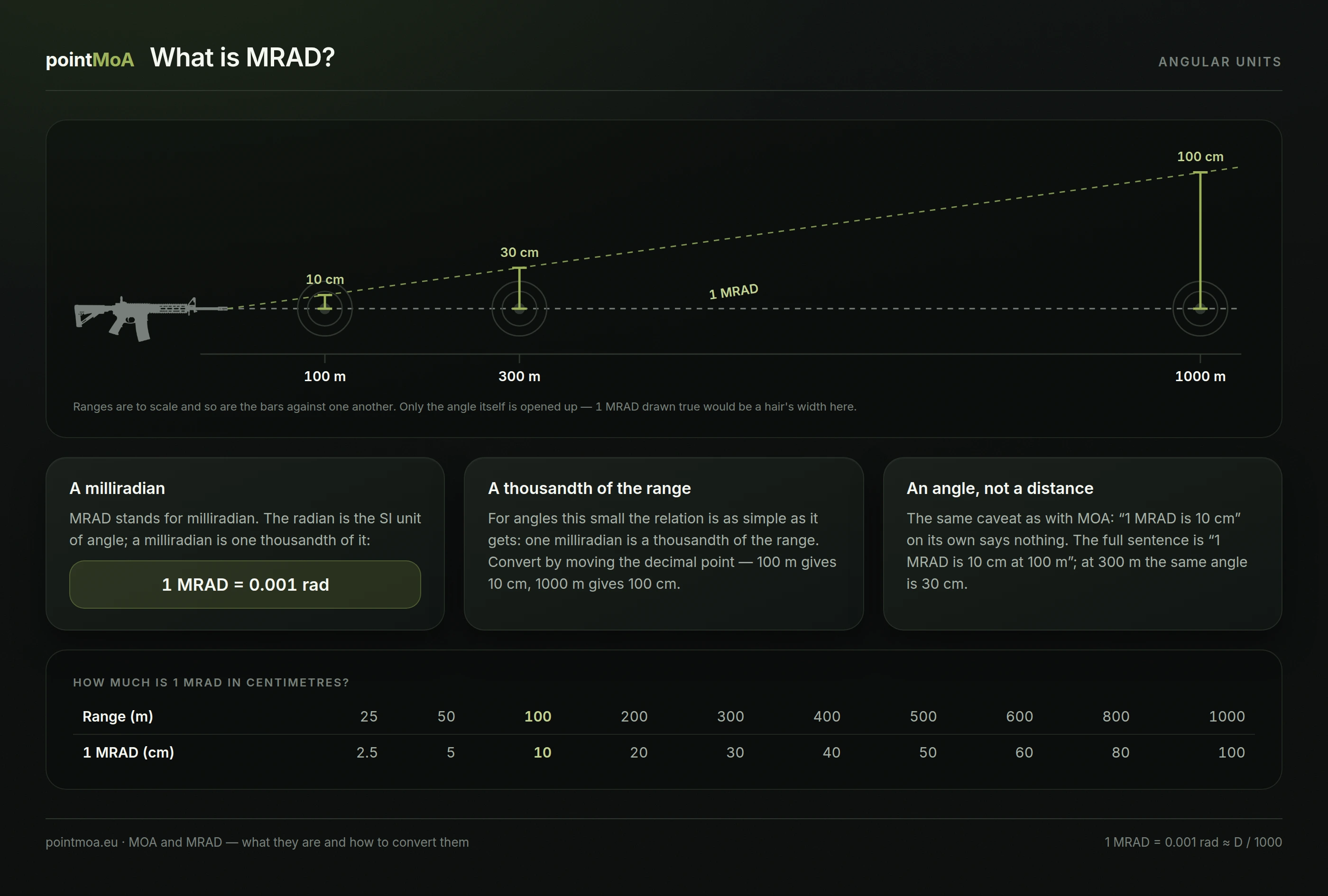
MRAD stands for milliradian.
The radian is the SI unit of angle. One milliradian is one thousandth of a radian:
1 MRAD = 0.001 rad
For angles this small the relationship between MRAD and distance is remarkably simple — one milliradian corresponds to one thousandth of the range:
1 MRAD ≈ D / 1000
At 100 m that works out as:
100 m / 1000 = 0.1 m = 10 cm
Hence 1 MRAD ≈ 10 cm at 100 m.
What is 1 MRAD in centimetres?
| Range | 1 MRAD |
|---|---|
| 25 m | 2.5 cm |
| 50 m | 5 cm |
| 100 m | 10 cm |
| 200 m | 20 cm |
| 300 m | 30 cm |
| 400 m | 40 cm |
| 500 m | 50 cm |
| 600 m | 60 cm |
| 800 m | 80 cm |
| 1000 m | 100 cm |
For a shooter working in metric units this is very convenient — the conversion amounts to moving the decimal point, with no arithmetic at all.
MOA and MRAD — what is the difference?
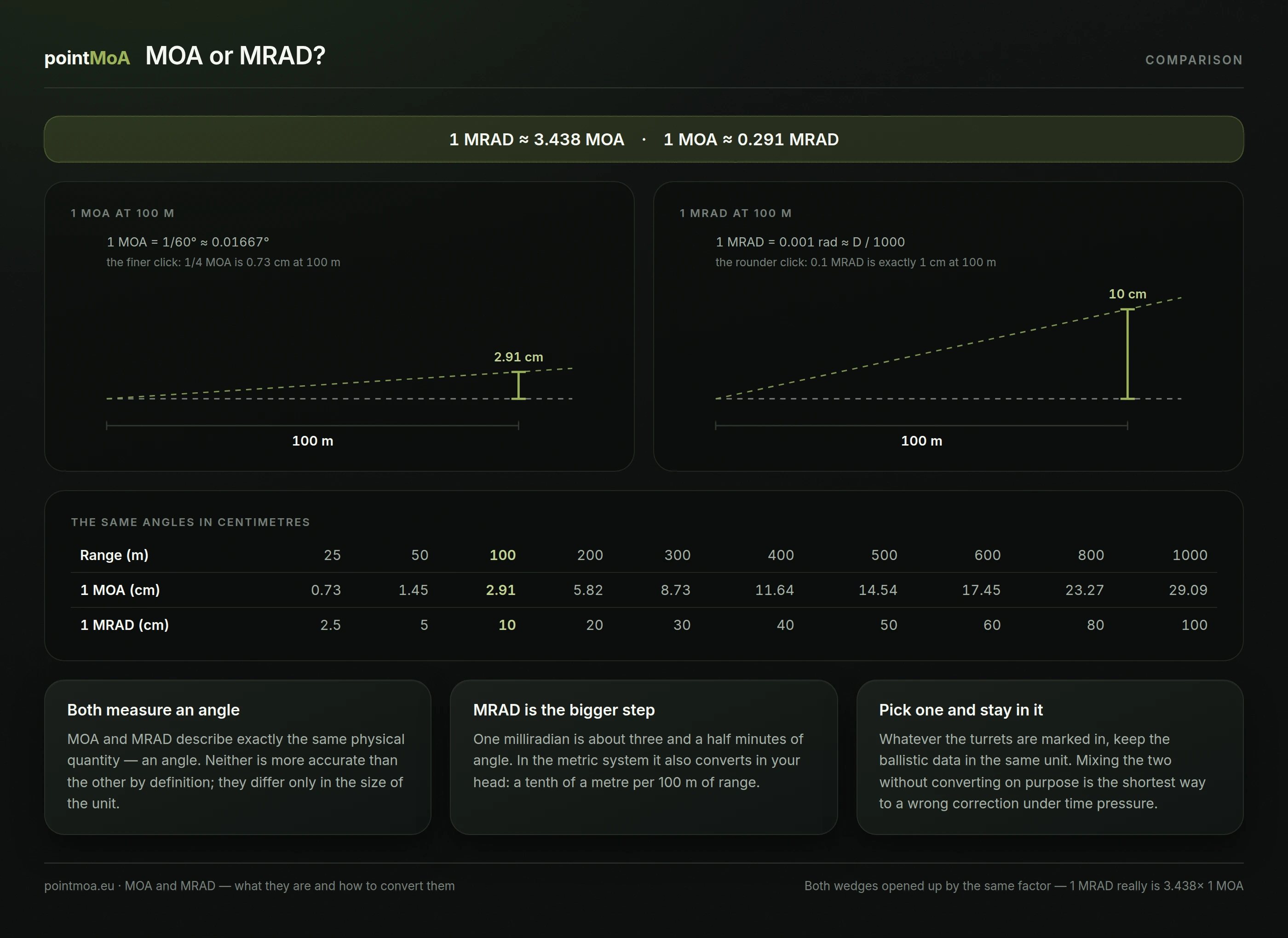
Both units describe exactly the same physical quantity: an angle. They differ only in the size of the unit.
1 MRAD ≈ 3.438 MOA
1 MOA ≈ 0.291 MRAD
In practice it is enough to remember that 1 MRAD ≈ 3.44 MOA. For instance, 2 MOA ≈ 0.582 MRAD, and 0.5 MRAD ≈ 1.72 MOA. These are two ways of writing down the same angular correction.
Why does the same angle give a different number of centimetres?
This is the single most important point.
Say the correction is 1 MRAD. At 100 m that comes to about 10 cm, at 300 m to 30 cm, at 600 m to 60 cm and at 1000 m to 100 cm.
That does not mean the correction grew from 10 cm to 100 cm. The correction is 1 MRAD throughout. All that changed is how it maps onto the target in linear terms.
MOA behaves in exactly the same way:
- 1 MOA at 100 m ≈ 2.91 cm,
- 1 MOA at 300 m ≈ 8.73 cm,
- 1 MOA at 600 m ≈ 17.45 cm,
- 1 MOA at 1000 m ≈ 29.09 cm.
This is what makes angular units so useful in shooting: they let you state a correction once, without tying it to a single range.
It has a practical consequence when zeroing. If you are hitting 3 cm low at 100 m, that is an error of roughly 1 MOA — and the same 1 MOA correction fixes it at 300 m too, where it works out as 8.7 cm.
MOA and MRAD as a measure of precision
Angular units also suit describing the precision of a rifle and its ammunition.
If a group measures 2.91 cm at 100 m, its angular size is about 1 MOA. If a group measures 8.73 cm at 300 m, that is also about 1 MOA — physically larger, angularly identical.
The same goes for MRAD: a 10 cm group at 100 m and a 30 cm group at 300 m are both about 1 MRAD.
That makes it possible to compare precision achieved at different ranges, instead of setting centimetres against each other that say nothing on their own.
Before you convert anything to MOA, though, you have to measure it — and that is a separate skill. How to do it properly, and how extreme spread differs from mean radius, is covered in the guide to measuring groups. The conversion itself, with worked examples and the usual pitfalls, is in How to calculate group size in MOA.
MOA and MRAD in scope adjustment
Angular units also define the value of a single turret click.
A scope may adjust 0.1 MRAD per click. One click therefore corresponds to 0.1 MRAD, which is:
- at 100 m: 0.1 × 10 cm = 1 cm,
- at 300 m: 0.1 × 30 cm = 3 cm.
The common value on MOA scopes is 1/4 MOA per click:
- at 100 m: 0.25 × 2.91 cm = 0.73 cm (about 7.3 mm),
- at 300 m: 0.25 × 8.73 cm = 2.18 cm.
The principle is identical in both cases: a click defines a change in angle, and the matching shift in centimetres depends on the range.
If you would rather not work that out at the firing line, the portal has a dedicated tool — the click calculator turns a miss measured in centimetres into the number of clicks on each turret.
Where does "1 MOA = 1 inch" come from?
The popular claim that "1 MOA is 1 inch at 100 yards" comes from American shooting practice. Precisely, 1 MOA at 100 yards works out as 1.047 inches — the value was rounded to one inch and stuck.
"1 MOA = 1 inch" should not be treated as a definition. The definition is far simpler: 1 MOA = 1/60 of a degree, and any value in inches or centimetres is only the result of converting that angle for a given range.
The rounding itself is harmless enough — the difference is just under 5 %. The problem is that scopes are calibrated differently: some in true MOA, some in the rounded IPHY (inch per hundred yards, also called "shooter's MOA"). At 100 yards you will not see it. With a correction of 30 MOA at long range it becomes several centimetres — and that is where "unexplained" dispersion comes from.
For anyone working in metric units the useful figure is 1 MOA ≈ 2.91 cm at 100 m anyway.
Milliradians and the military "mil"
One more trap in the naming. Milliradian is often shortened to "mil", but in military usage "mil" sometimes means a unit that divides a full turn into 6400 increments rather than 2π × 1000 ≈ 6283 milliradians.
The difference is about 2 %: one NATO mil is roughly 0.98 MRAD, or 9.8 cm at 100 m instead of 10 cm. On the range it is irrelevant, but it is worth knowing which unit is meant when reading older military tables or equipment descriptions. Sporting and hunting scopes use milliradians.
MOA or MRAD?
Both units are correct, and neither is inherently more accurate. The difference comes down to scale and convenience.
| MOA | MRAD | |
|---|---|---|
| Definition | 1/60° | 0.001 rad |
| At 100 m | 2.91 cm | 10 cm |
| At 300 m | 8.73 cm | 30 cm |
| At 600 m | 17.45 cm | 60 cm |
| At 1000 m | 29.09 cm | 100 cm |
| Conversion | 1 MOA ≈ 0.291 MRAD | 1 MRAD ≈ 3.438 MOA |
For anyone working purely in metric units, MRAD is very convenient — the conversion to centimetres happens in your head. MOA requires remembering 2.91 cm per 100 m, but it offers a finer increment: a typical 1/4 MOA click is 0.73 cm at 100 m, whereas a 0.1 MRAD click is a full 1 cm. For the same number of clicks, an MOA scope adjusts slightly more precisely.
Consistency matters most. If your scope adjusts in MRAD, keep your ballistic data in MRAD; if it adjusts in MOA, work in MOA. Mixing the two systems without a deliberate conversion is the quickest route to a wrong correction under time pressure. The ballistic calculator reports corrections in both units, so the choice belongs to your equipment rather than to the table — what data it needs from you, and which input wrecks the answer hardest, is covered in the calculator guide.
The values worth memorising
MOA:
- 1 MOA ≈ 2.91 cm at 100 m
- 1 MOA ≈ 5.82 cm at 200 m
- 1 MOA ≈ 8.73 cm at 300 m
- 1 MOA ≈ 17.45 cm at 600 m
- 1 MOA ≈ 29.09 cm at 1000 m
MRAD:
- 1 MRAD ≈ 10 cm at 100 m
- 1 MRAD ≈ 20 cm at 200 m
- 1 MRAD ≈ 30 cm at 300 m
- 1 MRAD ≈ 60 cm at 600 m
- 1 MRAD ≈ 100 cm at 1000 m
The governing rule is this:
MOA and MRAD are units of angle. Centimetres only appear once range is taken into account.
That is why "1 MOA is 2.9 cm" is wrong. Correctly stated, it is 1 MOA is about 2.9 cm at 100 m — and likewise 1 MRAD is about 10 cm at 100 m.
This relationship between angle and range is exactly what makes MOA and MRAD so useful. They let you describe corrections, group size and reticle subtensions independently of the distance to the target.