What Are POA and POI? Point of Aim vs Point of Impact
POA is where you aimed, POI is where the bullet went. Behind those two abbreviations sit three different points, and confusing them costs clicks dialled the wrong way.
POA — point of aim — is where you put the sight. POI — point of impact — is where the bullet actually went. Two sentences, and you have the definition.
The trouble starts one step later: POI covers two different points, and neither of them has to sit where POA is.
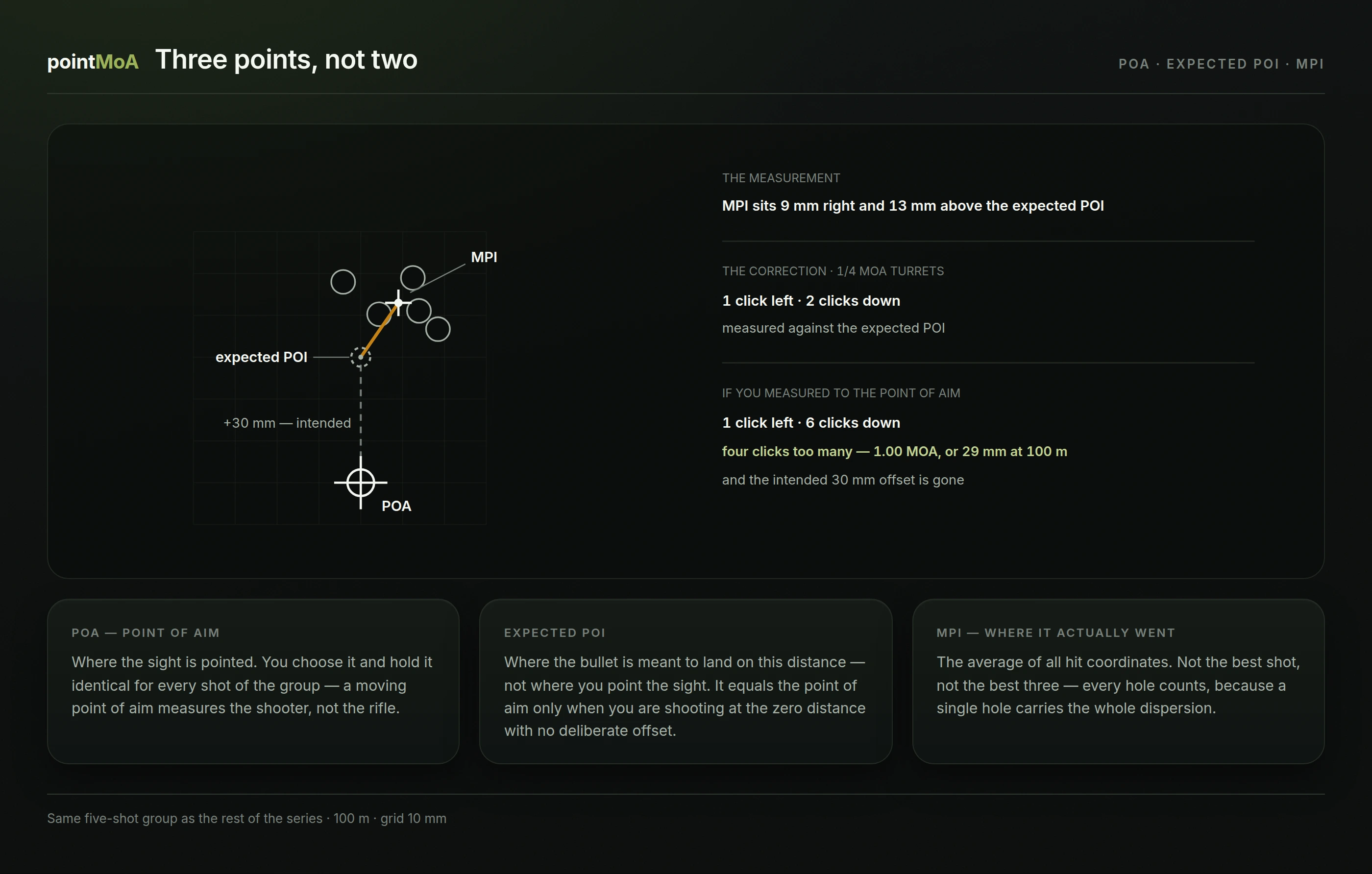
Two abbreviations, three points
The first is the point of aim (POA). You choose it and you hold the same one for every shot of the group. A point of aim that wanders measures your discipline, not the rifle.
The second is the expected point of impact (POI) — where the bullet is meant to land at this particular distance. It coincides with the point of aim only when you are shooting at the zero distance with no deliberate offset. Everywhere else it sits somewhere else, and on purpose.
The third is the mean point of impact (MPI) — the group centre, the plain average of every hit coordinate. That one is a measurement.
The confusion comes from "POI" doing both jobs at once: sometimes it means "where the bullet should go", sometimes "where it went". While the two sit in the same place, nobody minds. Once they part company, clicks start going the wrong way.
A group has a point of impact; a shot does not
A single hole is not the rifle's point of impact. It is one draw from the distribution that rifle produces, and it carries all of the dispersion — the rifle's, the ammunition's and yours.
So the point of impact is taken from a series, as the average of every hit coordinate. Not the centre of the best three, and not the prettiest hole.
How many shots that series needs before the centre means anything is worked out separately in the zeroing guide, which carries the table of centre error for three, five, ten and twenty shots. The short version: three is not enough, five is a sensible compromise.
The offset is a vector, not a number
The distance from the group centre to the expected point of impact has two components: windage and elevation. Each goes to a different turret, so a single figure — "the group sits two inches off" — is good for conversation and nothing else.
The sign convention is worth keeping in your head, because it is the single most common reason for dialling the wrong way:
- group right of the expected POI → correct left,
- group high → correct down.
You always dial against the error. The marking on the turret (UP, R) says
which way the point of impact will move, not which way the group has
strayed.
Turning a linear offset into clicks needs the distance, because the turret adjusts an angle. Where that conversion comes from is in MOA and MRAD and in the zeroing guide; the portal also has a click calculator for it.
The expected POI is not always the point of aim
This is the section the article was written for.
Say you want your zero further out than the range you are standing on, so on this range the group is supposed to sit 30 mm (1.2 in) above the point of aim. That figure is your decision — it comes from the bullet's path, not from the target. Where to get it is covered in the zeroing guide.
You fire five shots. The group centre lands 9 mm right and 13 mm above that expected point of impact. With 1/4 MOA turrets at 100 m the correction is 1 click left and 2 clicks down.
Now the same thing measured — by reflex — to the point of aim: the group centre sits 9 mm right and 43 mm above it, which comes to 1 click left and 6 clicks down.
Four clicks of difference. That is exactly 1.00 MOA, or 29 mm at 100 m — and that was precisely the deliberate offset you have just thrown away. The rifle is now zeroed on this range and no longer zeroed where it was supposed to be.
Hence the rule: the correction is measured to the point where the bullet is meant to land at this distance, not to the point you are looking at.
A tight group can still miss
Group size and zero are measured separately because they answer two different questions. Group size says how repeatably the rifle shoots. The zero says where it does it. There is no single number for both.
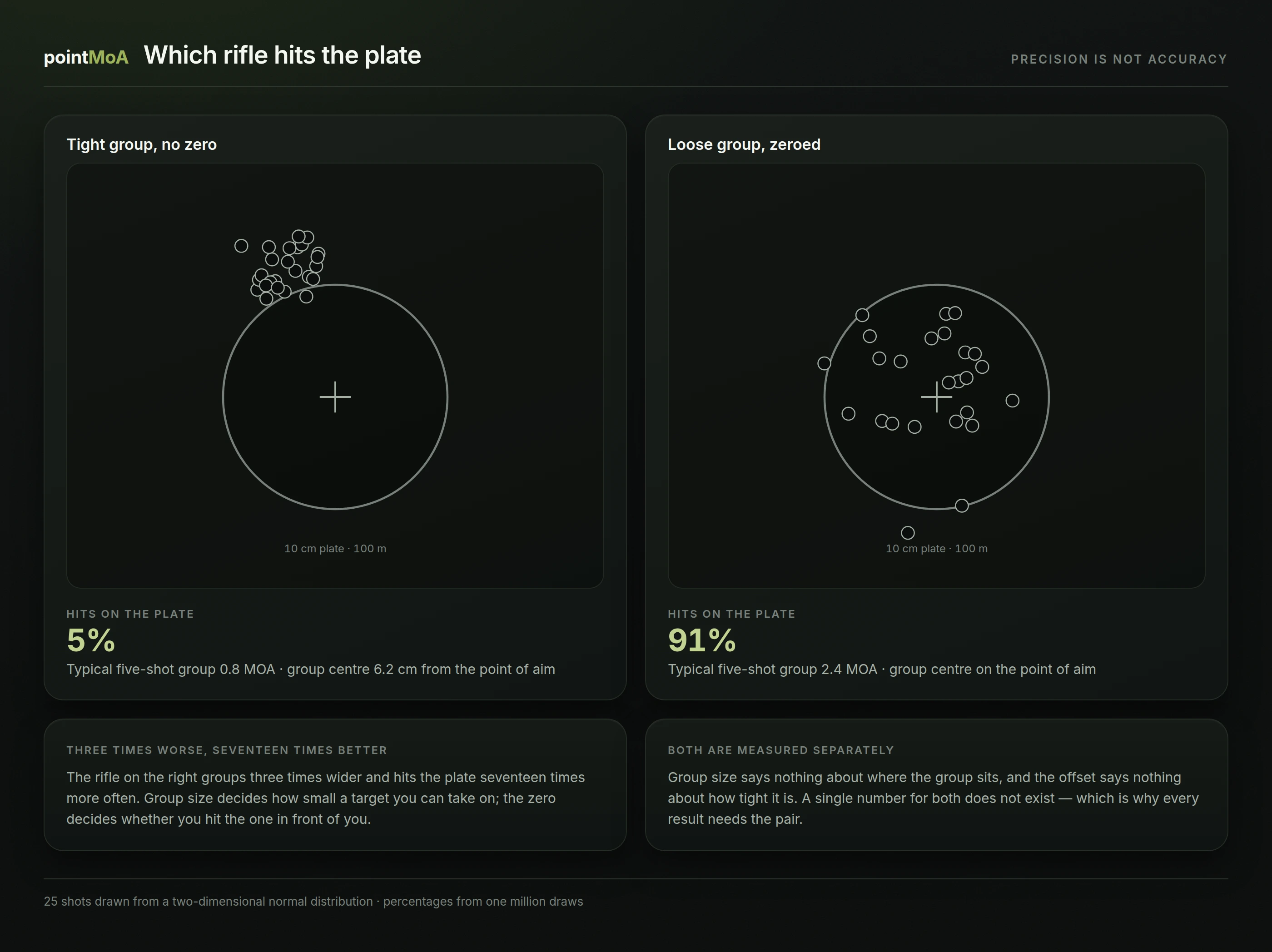
Take two rifles shooting at a 10 cm plate at 100 m. The first groups a typical 0.8 MOA, but its centre sits 6.2 cm from the point of aim. The second groups 2.4 MOA and is zeroed.
The first hits the plate 5% of the time. The second — 91%, seventeen times more often, while losing on group size by a factor of three.
This is not an argument against precision. Group size decides how small a target you can take on at all, and it wins back its advantage as the distance grows. But for the target actually standing in front of you, the zero decides first.
How to measure group size itself, and which measure to pick, is in the guide to measuring groups.
When a POI shift is real
"I changed ammunition lots and my POI moved half an inch" is a sentence that gets said a lot, and usually does not mean what it was meant to mean.
The group centre moves on its own. Two five-shot groups fired from the same, entirely unchanged rifle have centres 6.1 mm apart on average, and land more than a centimetre apart about one time in eight. With three-shot groups — 7.9 mm on average, and more than one time in four. Only at ten shots does a centimetre become a signal: it happens once in seventy tries.
(Computed for a rifle grouping like the one on the left of the chart above, by the same method as the simulation in the guide to measuring groups. A rifle that shoots wider wanders proportionally further.)
One practical conclusion: a POI shift is established from two series, not from two three-shot groups. If the difference fits inside what the sample alone can produce, there is nothing to correct.
When a shift is real, look for the cause in order of frequency: a change of ammunition lot or type, powder temperature, the optic taken off and put back on, a suppressor, cheek weld with the parallax not set, cant, barrel condition. The full list, with what each one does, is in the zeroing guide.
How pointMoA works it out
The zeroing assistant in the app does exactly what this article describes. The order is worth knowing:
- The mean point of impact from every marked hole: a plain average of the coordinates, with no fliers discarded.
- The error as the difference between the MPI and the expected point of impact — not the point of aim. The expected POI is a separate input: it comes from the trajectory, from the same distance, or from an offset you type in.
- The POI shift required, as the opposite of the error.
- The correction angle from exact geometry, separately for windage and elevation.
- The clicks, by dividing that angle by the value of one click and rounding to the nearest whole one.
- The turret direction according to what you recorded for your own optic — the app does not assume which way yours turns.
- The residual after rounding, shown plainly so you can see what is left — not so you chase it.
It checks one more thing along the way: whether the computed correction fits inside the remaining adjustment range, rather than the catalogue total. Those are two different numbers and they get mixed up regularly.
The dispersion about the mean point of impact is a separate calculation — the app fits P50 and P90 ellipses to it, describing the size and shape of the group rather than its position.
The short version
- POA is the point of aim, POI the point of impact.
- "POI" covers two points: the expected point of impact and the mean point of impact. The correction is measured to the first and taken from the second.
- The expected POI equals the POA only at the zero distance with no deliberate offset.
- The offset has two components, windage and elevation. You dial against the error.
- Group size and zero are different quantities. A rifle three times worse but zeroed hits seventeen times more often.
Frequently asked questions
What is the difference between POI and MPI? POI is where the bullet is supposed to land — an intention. MPI is the centre of what actually landed on the paper — a measurement. Zeroing is the business of bringing the second to the first.
Can POI be established from one shot? For a coarse correction, just to get on the paper — yes. For computing a correction — no, because a single hit carries the whole dispersion of the setup, so a correction taken from it largely corrects an accident.
Why does my rifle miss even though the group is tight? Because those are two independent things. A tight group means the setup does the same thing every time — not necessarily the thing you want. An offset is cancelled by the turrets; dispersion is not.
Is a POI offset quoted in MOA? It can be, and often is, because it is the same kind of angle as group size — 6.2 cm at 100 m is 2.13 MOA. The conversion works the same way in both directions and is covered in how to calculate group size in MOA. Just remember that offset and dispersion are different quantities, so always say which one you are quoting.
Does POI change with distance? Yes, and that is normal. The bullet travels an arc, so its position relative to the line of sight depends on the distance. A zero is one point on that curve, not a property of the rifle.
Is a centimetre of POI shift reason enough to dial? It depends how many shots you measured it from. Two five-shot groups from the same rifle land more than a centimetre apart about one time in eight, for no reason at all. From two three-shot groups — more often than one time in four.
In the pointMoA app you mark the hits on a photo of the target and set the point of aim; the mean point of impact, its distance from the expected point of impact and the click count for both turrets appear straight away — together with the residual left over by rounding.