.223 / 5.56 Ammo: Bullet Grain Weight and Barrel Twist Rate
How to choose .223 / 5.56 ammunition for your barrel twist rate. Bullet grain weight explained: 55, 62 and 77 gr, stability and ballistic differences.
On a box of .223 ammunition you will see one of a handful of numbers: 55, 62, 69, 75 or 77 gr. The shop assistant will tell you the heavier ones are "better for distance", the forum — that 55 gr is for training and 77 gr for precision. Both answers are true and both are useless until you answer the question that comes first: what your barrel will stabilise.
Because the most expensive 77 gr bullet fired from a 1:12 barrel will drill an oval in the target.
What a grain is
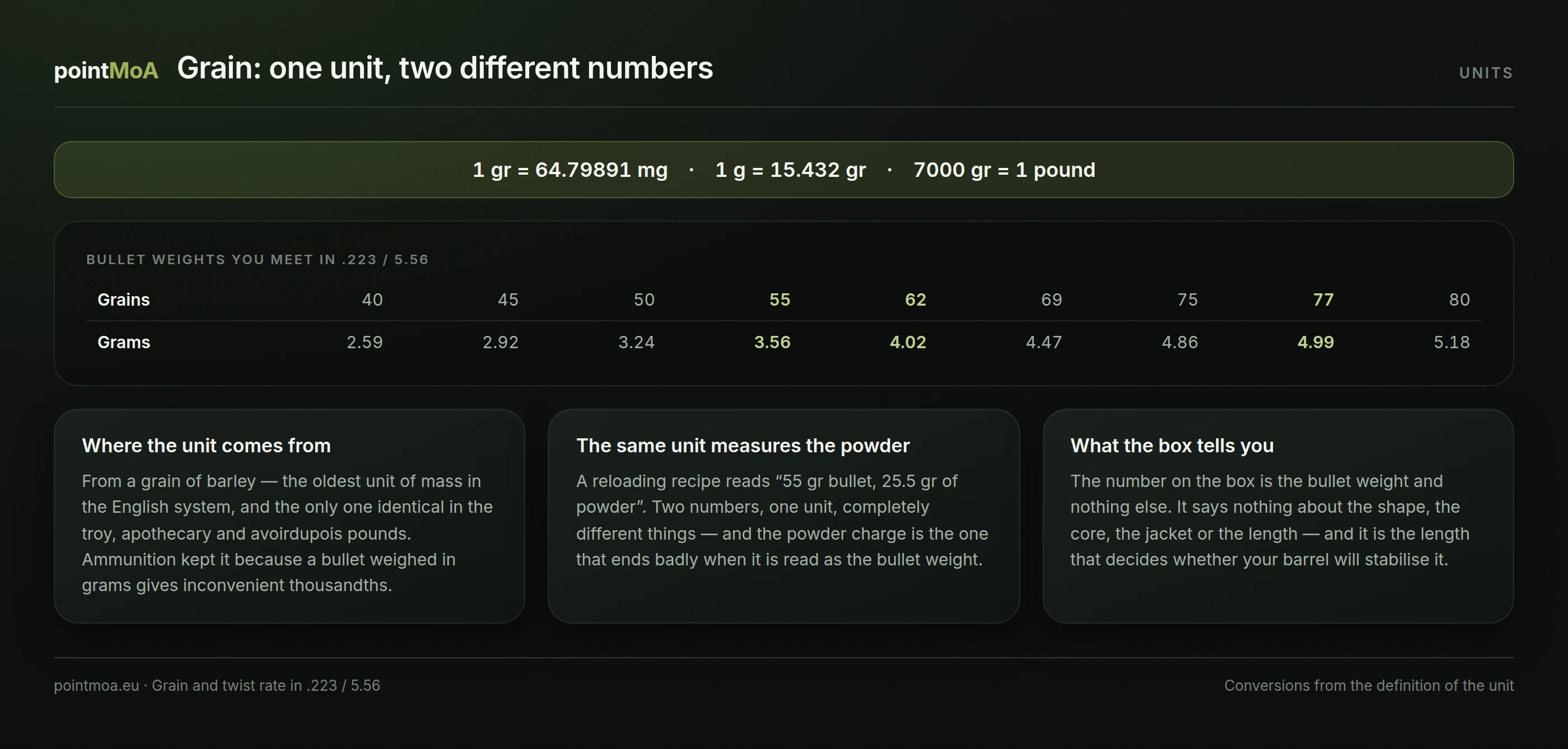
The grain is the oldest unit of mass in the English system — literally a grain of cereal. Today it has an exact definition:
1 gr = 64.79891 mg, that is 1 g = 15.432 gr, and 7000 gr = 1 pound.
Ammunition stayed with this unit because bullet weights come out as convenient two-digit numbers in it. A 55 gr bullet weighs 3.56 g, a 62 gr one 4.02 g, and a 77 gr one 4.99 g. In grams the same values would sound like readings from a pharmacy scale.
One thing needs stressing before we go on: powder is measured in grains too. A handloading recipe reads "55 gr bullet, 25.5 gr of powder". Two numbers in the same unit describe two entirely different things — and confusing them in the direction where the powder charge becomes the bullet weight ends with a blown-up gun. On a box of factory ammunition the weight quoted always refers to the bullet.
.223 Remington vs 5.56 × 45 NATO
Before twist — the chamber, because with heavy bullets one is tied to the other.
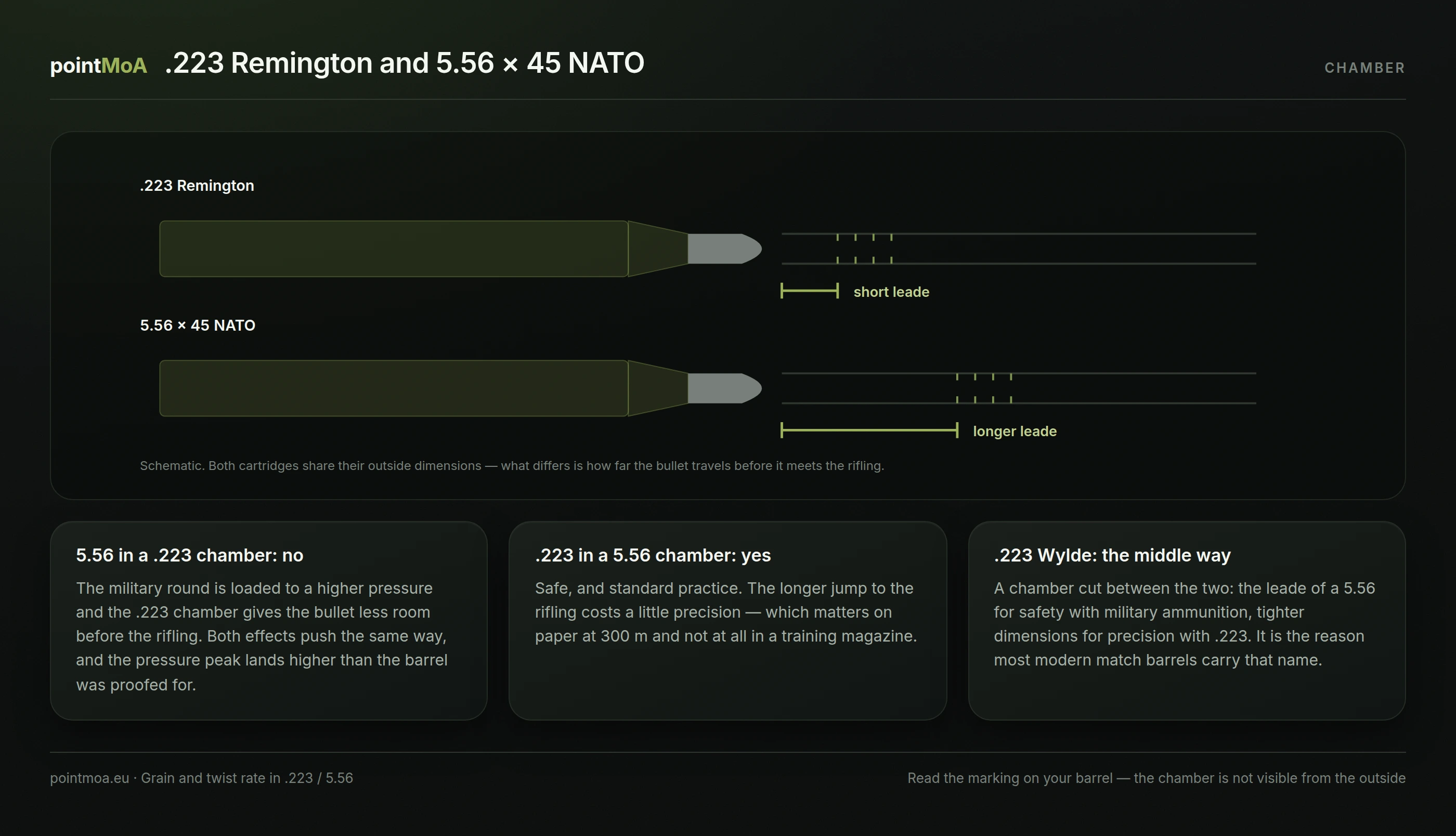
The cartridges have the same external dimensions and will fit both chambers. What differs is what you cannot see:
- The leade — the stretch the bullet travels from the case to its first contact with the rifling. In a .223 chamber it is shorter, in 5.56 — longer.
- Pressure — the 5.56 military round is loaded hotter. SAAMI and NATO figures cannot be set side by side directly, because they are measured at a different point on the case and by a different method; that is one of the reasons so many contradictory values circulate online.
Two rules follow from this, worth knowing by heart:
5.56 ammunition is not fired from a .223 chamber. The higher pressure and the shorter leade add up, and the pressure peak lands higher than the barrel was tested for.
.223 ammunition can be fired from a 5.56 chamber. Safely, at the cost of a little grouping — the bullet has a longer jump to the rifling.
The third option is .223 Wylde: a chamber cut in between, with the leade of a 5.56 and tighter dimensions for grouping. Hence that name on most modern sporting barrels.
What ties this to grains is one thing: heavier bullets are longer. Loaded to the same overall cartridge length, they sit deeper in the case or protrude closer to the rifling — and in a short leade they can touch it before the shot is even fired. That is why with 75–77 gr ammunition the chamber stops being a detail.
Barrel twist rate and .223 / 5.56 ammunition
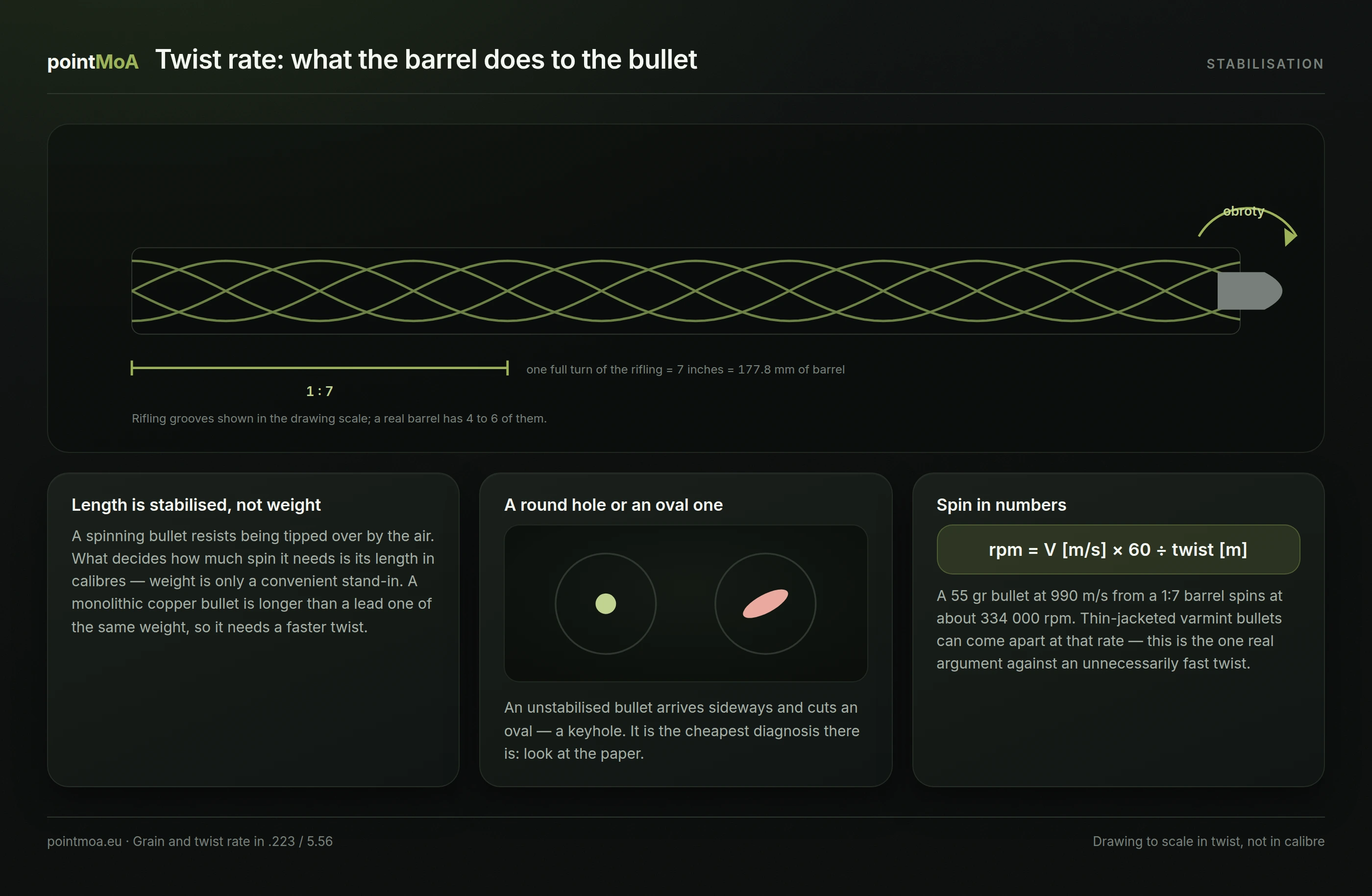
Twist is quoted as a ratio: 1:7 is one full turn of the rifling in 7 inches (177.8 mm) of barrel, 1:12 — in 12 inches (304.8 mm). The smaller the second number, the faster the twist and the more spin it gives the bullet.
A spinning bullet behaves like a gyroscope: it resists being tipped over by air resistance. If there is too little spin, the bullet begins to yaw, and it leaves an oval in the target instead of a round hole. It is the cheapest diagnosis there is — all it takes is a look at the paper.
It is length that gets stabilised, not weight
"Grains → twist" tables are convenient and they are everywhere, but they describe the effect, not the cause. How much spin is needed is decided by the length of the bullet measured in calibres, and weight is only a convenient stand-in for it — for classic lead-core bullets with a copper jacket the two are governed by the same relationship.
The stand-in stops working when the construction changes:
- monolithic (copper) bullets are longer at the same weight, because copper is lighter than lead — they need a faster twist than the grains would suggest;
- tracer bullets are long by design, because part of their volume is taken up by the tracer compound;
- bullets with a long boat tail also come out longer than their stubby counterparts.
Then there are conditions. A slower bullet spins less, so a short barrel acts like a slower twist. Cold, dense air stabilises worse than warm, thin air — a load that flies properly in summer can start to yaw in a frost at sea level.
Spin in numbers
The spin rate follows directly from muzzle velocity and twist:
rpm = V [m/s] × 60 ÷ twist [m]
For a 55 gr bullet travelling at 990 m/s from a 1:7 barrel (0.1778 m) that gives about 334,000 revolutions per minute. It is the one number that says anything about the myth of "over-stabilisation": a normal bullet is not harmed by that regime, but a thin-jacketed varmint bullet at maximum velocity can come apart in flight under it.
Matching bullet grain weight to barrel twist rate
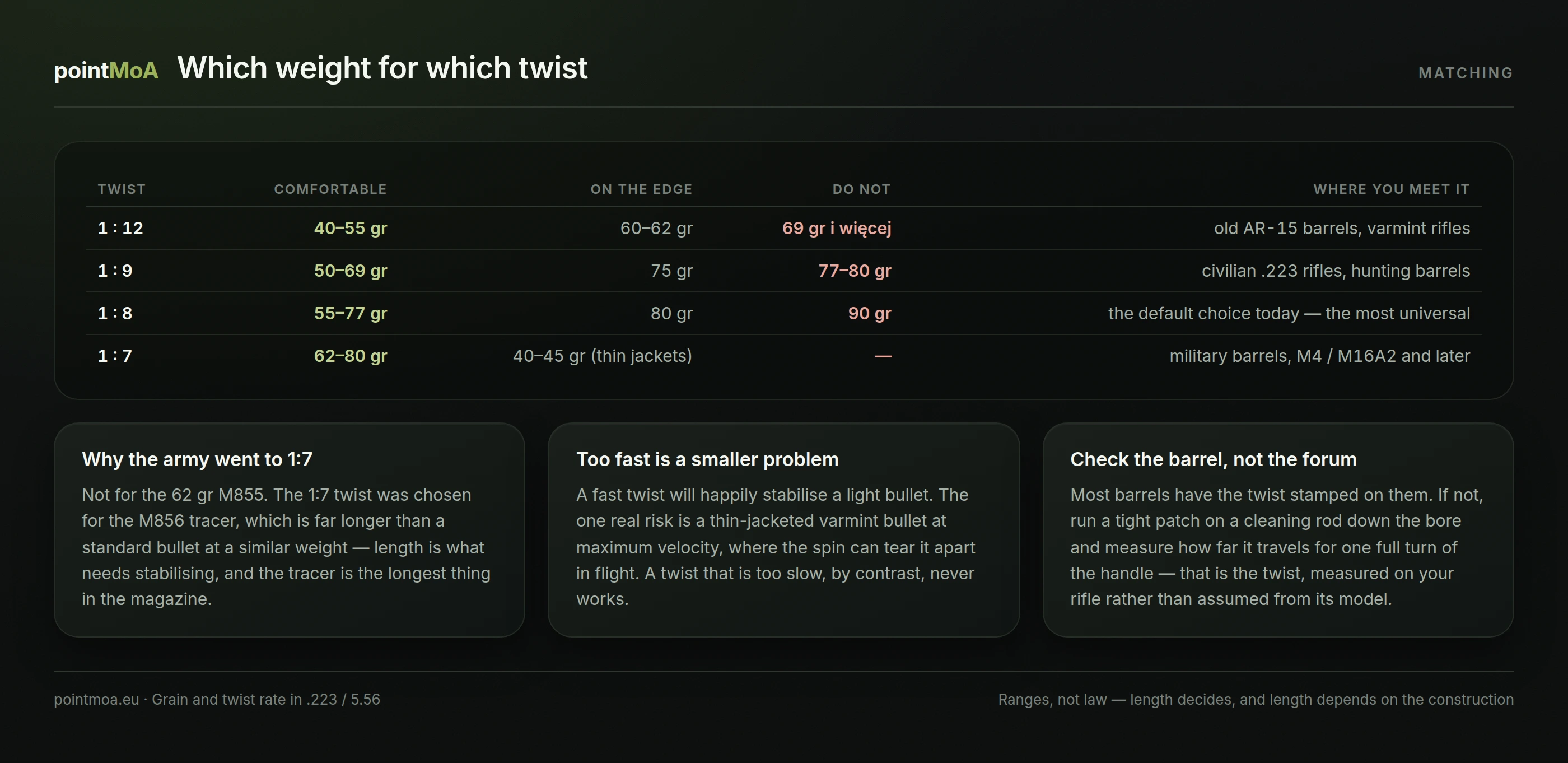
| Twist | Safe | Borderline | No |
|---|---|---|---|
| 1 : 12 | 40–55 gr | 60–62 gr | 69 gr and up |
| 1 : 9 | 50–69 gr | 75 gr | 77–80 gr |
| 1 : 8 | 55–77 gr | 80 gr | 90 gr |
| 1 : 7 | 62–80 gr | 40–45 gr* | — |
* with a thin jacket and at maximum velocity.
Military history explains these numbers better than any theory. The M16A1 had a 1:12 twist for the 55 gr M193 bullet. The M16A2 got 1:7 — and, contrary to popular belief, not because of the 62-grain M855, for which 1:9 would have been enough. The deciding factor was the M856 tracer: at a similar weight it is considerably longer, and it is length that gets stabilised.
If you are buying a barrel today and have no particular reason to do otherwise, 1:8 is the default choice: it will stabilise everything from 55 to 77 gr, which is practically the whole shelf in the shop.
Check the twist of your barrel instead of assuming it. It is usually stamped on the outside near the chamber. If it is not — push a tight patch through the bore on a cleaning rod and measure how far the rod travels for one full turn of the handle. That is an answer measured on your own rifle, not read off the model description.
What the extra grains buy in flight
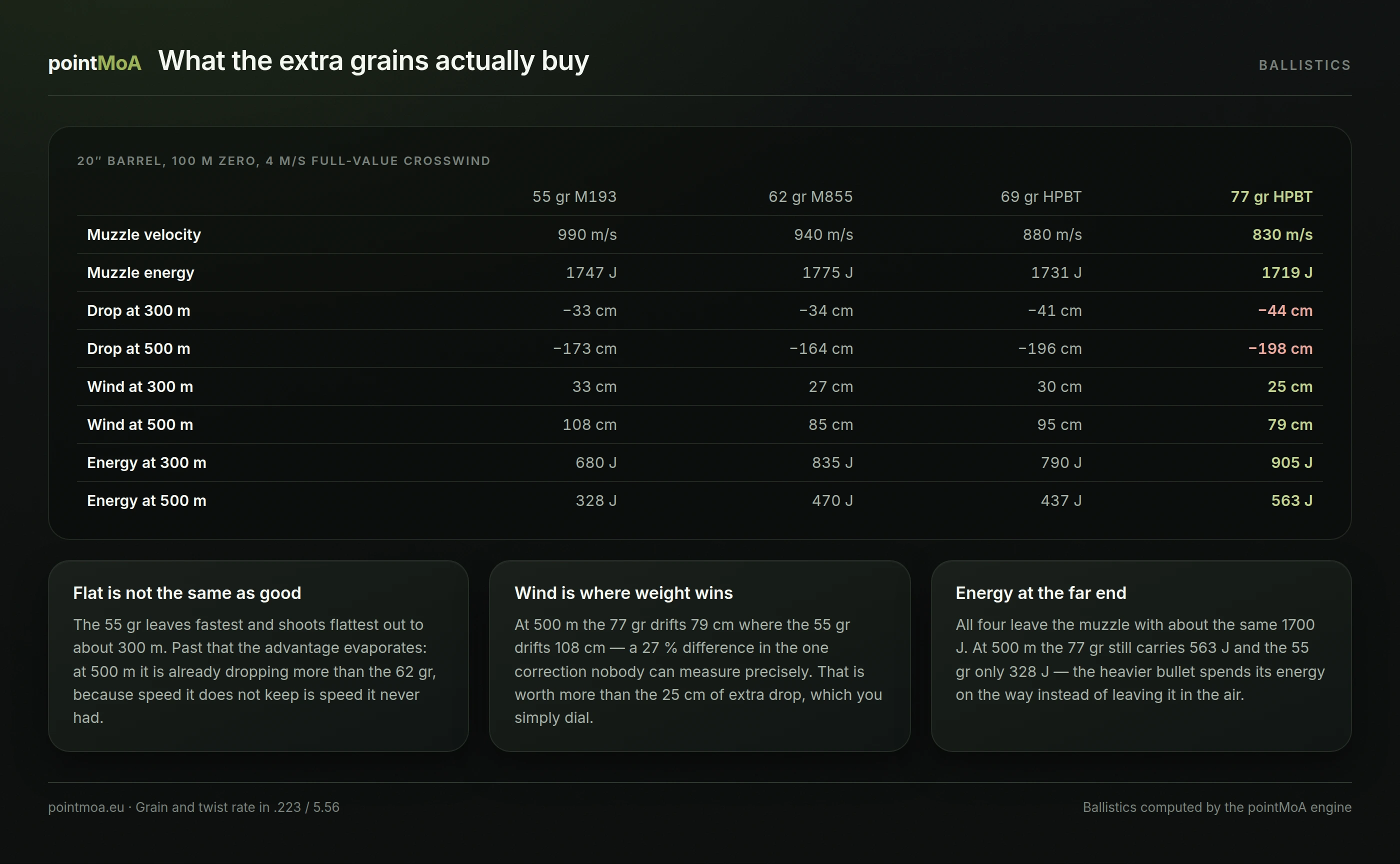
So far, theory. Now numbers — computed with the same engine that sits under the portal's ballistic calculator, under one set of conditions for all four loads: 20″ barrel, 100 m zero, sight height 65 mm, 15 °C, 1013 hPa, a 4 m/s wind straight from the side.
| 55 gr M193 | 62 gr M855 | 69 gr HPBT | 77 gr HPBT | |
|---|---|---|---|---|
| Muzzle velocity | 990 m/s | 940 m/s | 880 m/s | 830 m/s |
| Muzzle energy | 1747 J | 1775 J | 1731 J | 1719 J |
| Drop at 300 m | −33 cm | −34 cm | −41 cm | −44 cm |
| Drop at 500 m | −173 cm | −164 cm | −196 cm | −198 cm |
| Drift at 300 m | 33 cm | 27 cm | 30 cm | 25 cm |
| Drift at 500 m | 108 cm | 85 cm | 95 cm | 79 cm |
| Energy at 300 m | 680 J | 835 J | 790 J | 905 J |
| Energy at 500 m | 328 J | 470 J | 437 J | 563 J |
Three conclusions you cannot see from the grains on the box alone:
Flat is not the same as good. The 55 gr bullet leaves fastest and out to some 300 m has the flattest trajectory. Beyond that the advantage disappears: at 500 m it already drops more than the 62 gr, because velocity it cannot hold on to is velocity it never really had.
Wind is heavy-bullet territory. At 500 m the 77 gr drifts 79 cm where the 55 gr drifts 108 cm — 27 % less in the one correction nobody will ever measure exactly. Drop you dial from a table; wind you guess. Which is why 25 cm of extra drop is a fair price for 29 cm less drift.
Energy stays with the heavier bullet. All four start with a similar 1700 J. At 500 m the 77 gr still carries 563 J, the 55 gr — 328 J. The lighter bullet hands its energy to the air along the way.
The table above is an illustration, not data for your rifle. Muzzle velocity depends on the barrel and the ammunition lot, so for aiming substitute your own numbers — ideally measured with a chronograph.
Barrel length
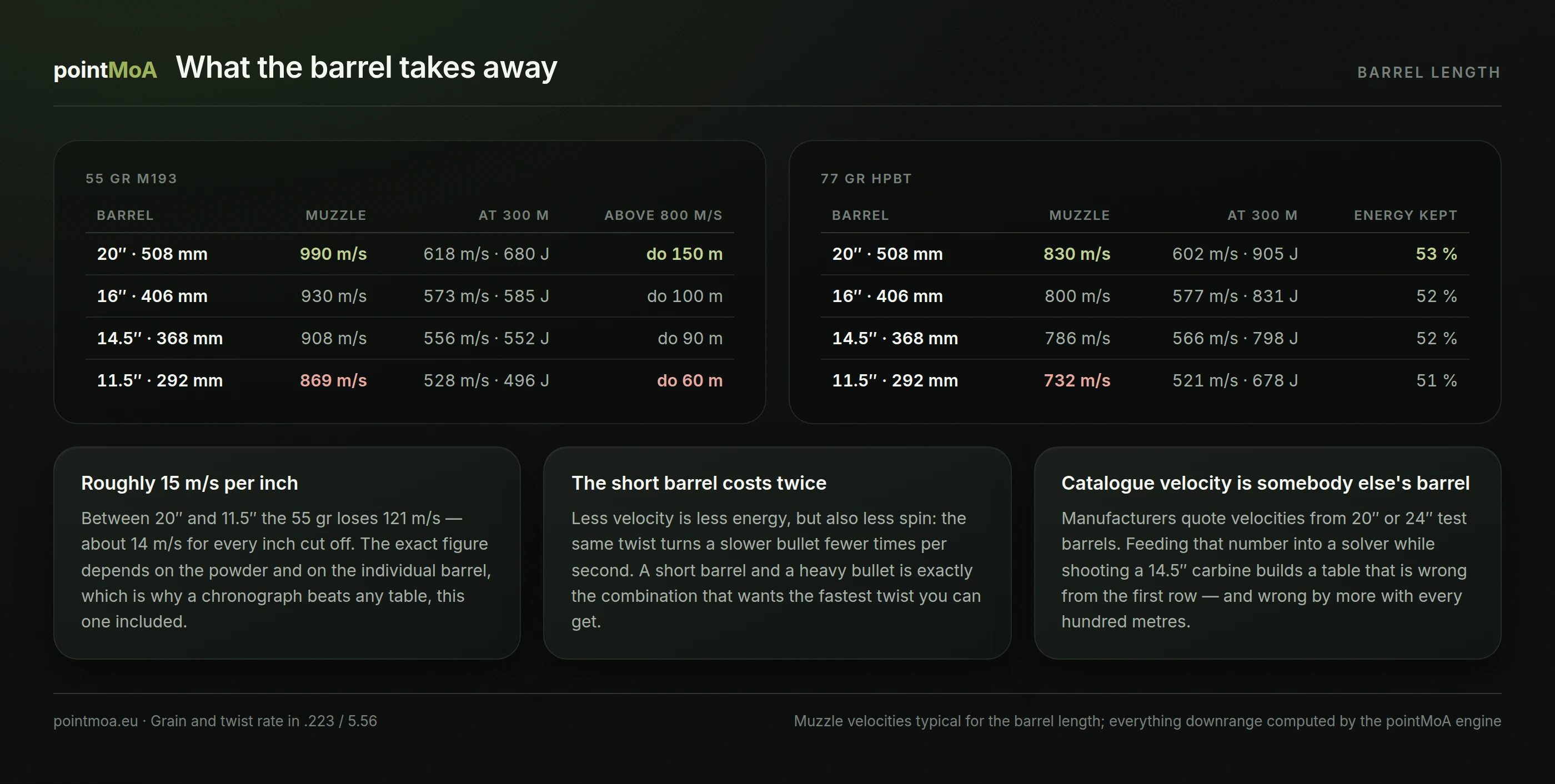
Between a 20″ barrel and an 11.5″ one the 55 gr bullet loses 121 m/s — roughly 14 m/s for every inch cut off. The exact figure depends on the powder and the particular barrel, so one afternoon of measuring with a chronograph is worth more than any table, this one included.
There are three consequences:
- Energy. 55 gr from an 11.5″ barrel has 1346 J at the muzzle instead of 1747 J — 23 % less before the bullet has had a chance to do anything.
- Thresholds. Bullets of the M193 type only fragment above a certain velocity — the accepted figure is around 800 m/s. From a 20″ barrel M193 stays above that threshold out to some 150 m, from 11.5″ — out to 60 m. Same ammunition, same target, different barrel.
- Spin. A slower bullet spins less, so a short barrel behaves like a slower twist. A short barrel and a heavy bullet is exactly the combination that wants the fastest twist money can buy — hence 1:7 on military carbines.
And the thing that ruins more ballistic tables than anything else: the catalogue velocity comes from somebody else's barrel. Manufacturers measure on 20″ or 24″ barrels. Typing that number into a calculator for a 14.5″ carbine gives a table that is wrong from the first row — and increasingly wrong with every hundred metres.
What to choose for what
- 40–45 gr — varminting and short-range shooting. A very flat initial trajectory, but wind kills them and they lose energy fast. With a 1:7 twist and maximum velocity watch out for thin jackets.
- 55 gr — training ammunition, the cheapest and available everywhere. Works from any barrel, 1:12 included. Out to 300 m there is no reason to look for anything else.
- 62 gr M855 — military, with a hardened steel core. Before you buy it, check the rules of your range: many facilities ban steel-core ammunition, and it must never be used on steel targets anywhere.
- 69–77 gr — precision, wind and longer distances. Requires a 1:8 twist or faster. This is where the match loads live to which .223 owes its reputation as an accurate calibre.
- 77 gr from a short barrel — makes more sense than it seems: the heavier bullet loses proportionally less to the shortened barrel and copes better with what is left.
The five mistakes that cost the most
- Confusing bullet grains with powder grains. The only mistake on this list that can end in hospital.
- Buying 77 gr for a 1:12 barrel. Oval holes in the target and the conviction that "the rifle is inaccurate".
- Computing ballistics from the catalogue velocity. A table from a 24″ barrel on a 14.5″ carbine is off by tens of centimetres exactly where it hurts.
- Changing ammunition without re-zeroing. A different load means a different point of impact — sometimes by several centimetres at 100 m. How to check and correct the zero is covered in a separate article.
- Assuming heavier is always better. At 100 m you will not see the difference, and you pay three times as much per round.
Summary
- The grain is a unit of mass: 1 gr = 64.8 mg, 15.432 gr = 1 g. Powder is measured in the same unit — never confuse the two numbers.
- The choice starts with the barrel twist, not the bullet weight. 1:12 up to 55 gr, 1:9 up to 69 gr, 1:8 up to 77 gr, 1:7 for everything heavy. Check the twist of your barrel instead of assuming it.
- It is the length of the bullet that gets stabilised, and weight is only a stand-in for it. Copper and tracer bullets need a faster twist than the grains suggest.
- 5.56 not in a .223 chamber; .223 in a 5.56 — yes. With 75–77 gr bullets the chamber stops being a detail.
- A heavier bullet buys wind resistance and energy at distance, and pays for it with drop up close. A lighter one the other way round.
- A short barrel takes velocity away twice: from the energy and from the spin. The shorter it is, the faster the twist you need.