.22 LR ammo: Standard Velocity or High Velocity for target shooting?
Which .22 LR ammo should you choose for targets? Compare SV, HV, Subsonic and Match labels, semi-auto reliability and a practical way to compare groups.
Ask about .22 LR ammunition and you will soon hear two rules: use Standard Velocity for targets, and High Velocity for semi-autos. Then you find a pistol that runs happily on SV and a rifle that groups well with HV. So which rule should you follow?
For deliberate target shooting, a suitable Standard Velocity load is a sensible starting point. The letters do not guarantee accuracy; they simply lead you to a range of ammunition that includes many target loads. With a semi-auto, there is another requirement: it must feed, fire and cycle reliably. You are choosing a particular load for your firearm, rather than picking the winning abbreviation.
What do SV, HV, Subsonic and Match mean?
The labels describe different things. SV and HV refer to velocity, Subsonic relates velocity to the speed of sound, and Match identifies the product's intended use. A single load can carry more than one of these descriptions.
| Label | What it describes | What it does not guarantee |
|---|---|---|
| SV — Standard Velocity | Standard velocity within a product family | The smallest groups from every barrel |
| HV — High Velocity | Higher velocity within a product family | Better accuracy or reliable operation in every firearm |
| Subsonic | A load intended to achieve velocity below the speed of sound | The same result in every barrel and temperature |
| Match | Ammunition intended for competitive, precision shooting | A particular group size in your firearm |
These are not four separate bins. Match ammunition can be subsonic and have a velocity similar to SV. A Subsonic label, on its own, does not make a load Match ammunition.
Avoid drawing one rigid SV/HV boundary across every brand. Compare the actual m/s or fps figures and the conditions used to obtain them. The name helps you find the product; the specification helps you understand it.
Standard Velocity vs High Velocity: a catalogue example
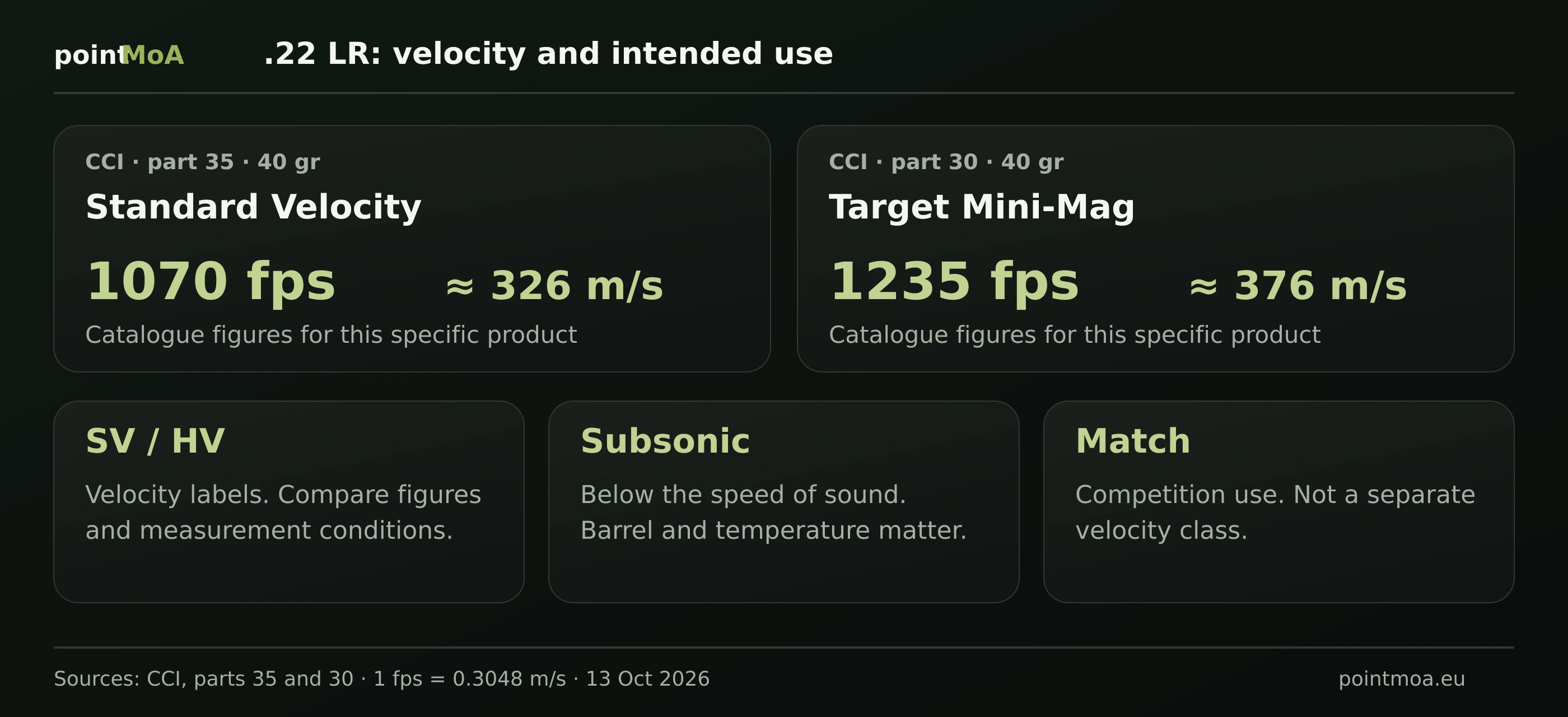
Two CCI products illustrate the difference without changing bullet weight:
| Product | Bullet weight | Listed muzzle velocity | Converted to m/s |
|---|---|---|---|
| CCI Standard Velocity, part 35 | 40 gr | 1070 fps | about 326 m/s |
| CCI Target Mini-Mag, part 30 | 40 gr | 1235 fps | about 376 m/s |
Conversion: 1 fps = 0.3048 m/s. Figures come from the CCI Standard Velocity and CCI Target Mini-Mag product pages. CCI lists target shooting as the use for both.
This compares two specific loads, rather than readings from your firearm. They differ in other respects too: Standard Velocity uses a lead round nose bullet, while this Mini-Mag uses a copper-plated round nose. Their shared 40 gr weight does not turn the comparison into an experiment that changes velocity alone.
Is Standard Velocity always subsonic?
Do not treat the two labels as interchangeable without checking the figures. The speed of sound in air depends on temperature. Actual bullet velocity depends on the load and measurement conditions, including the barrel. Near the boundary, a load that is subsonic in one set of conditions can behave differently in another.
If that distinction matters to you, check the manufacturer's information and measure velocity in your firearm. The sound of the shot alone is not a reliable way to settle the question.
Which .22 LR ammo should you use for targets at 25 or 50 metres?
Start with two or three specific target loads before buying a large supply. SV is a reasonable place to begin for deliberate practice. If you want to know whether a Match load is worth the extra cost, include it in a comparison under the same conditions.
Higher muzzle velocity is not a quality rating. A velocity table cannot tell you how tightly a load will group in your barrel. Nor can the word Match tell you whether the difference will be visible with your position, sights and current shooting ability.
Do not rule out HV just because you shoot paper. The Mini-Mag above is marketed for targets. If it gives repeatable results and runs reliably, it belongs in the comparison. There is simply no reason to assume that extra velocity will improve group size by itself.
With a pistol at 25 m, assess performance in the conditions you normally practise in. For a careful rifle comparison at 50 m, use repeatable support and record the conditions. In either case, one attractive group is not enough to declare a winner.
Does a semi-auto .22 LR pistol or rifle need HV ammo?
Not every semi-auto requires High Velocity ammunition. ELEY describes contact as a subsonic .22 LR load designed for semi-automatic platforms. That alone shows that Subsonic and semi-auto are compatible descriptions.
It does not promise that contact will work in every model. Check your firearm's manual and confirm operation at the range. The CCI rimfire selection guide also explains that operation with lower-velocity loads depends on the firearm's design.
A load that groups well but repeatedly fails to feed or eject has a drawback you should record. Reliability matters in practice and competition. Equally, a malfunction does not automatically prove that SV is underpowered: firearm or magazine condition can also be involved.
With a manually operated rifle, ammunition does not have to cycle the action. Compatibility, reliable ignition, feeding, extraction and consistent groups still matter.
How to compare .22 LR ammunition in your firearm
You can start with a few boxes and an honest record of the results. Write down the complete product name and lot number. Those details will be more useful at your next purchase than remembering the colour of the box.
- Keep distance and shooting method consistent. An unsupported group and a supported group are not a fair comparison. Use the same firearm and target.
- Use equal shot counts in the groups you assess. Several ten-shot groups per product are an example of a practical starting point, rather than a laboratory standard or a guarantee of a clear answer.
- Separate settling shots from assessed groups when changing loads. Lubricant differences and barrel condition can complicate the first group. There is no universal settling-shot count; record your approach and apply it consistently. Avoid switching products after every shot.
- Keep every assessed target. Measure group size and group centre, and note operating problems and shooting conditions.
- Repeat promising comparisons on another day. You can reverse product order so the same load does not always get the warm-up or the fatigue.
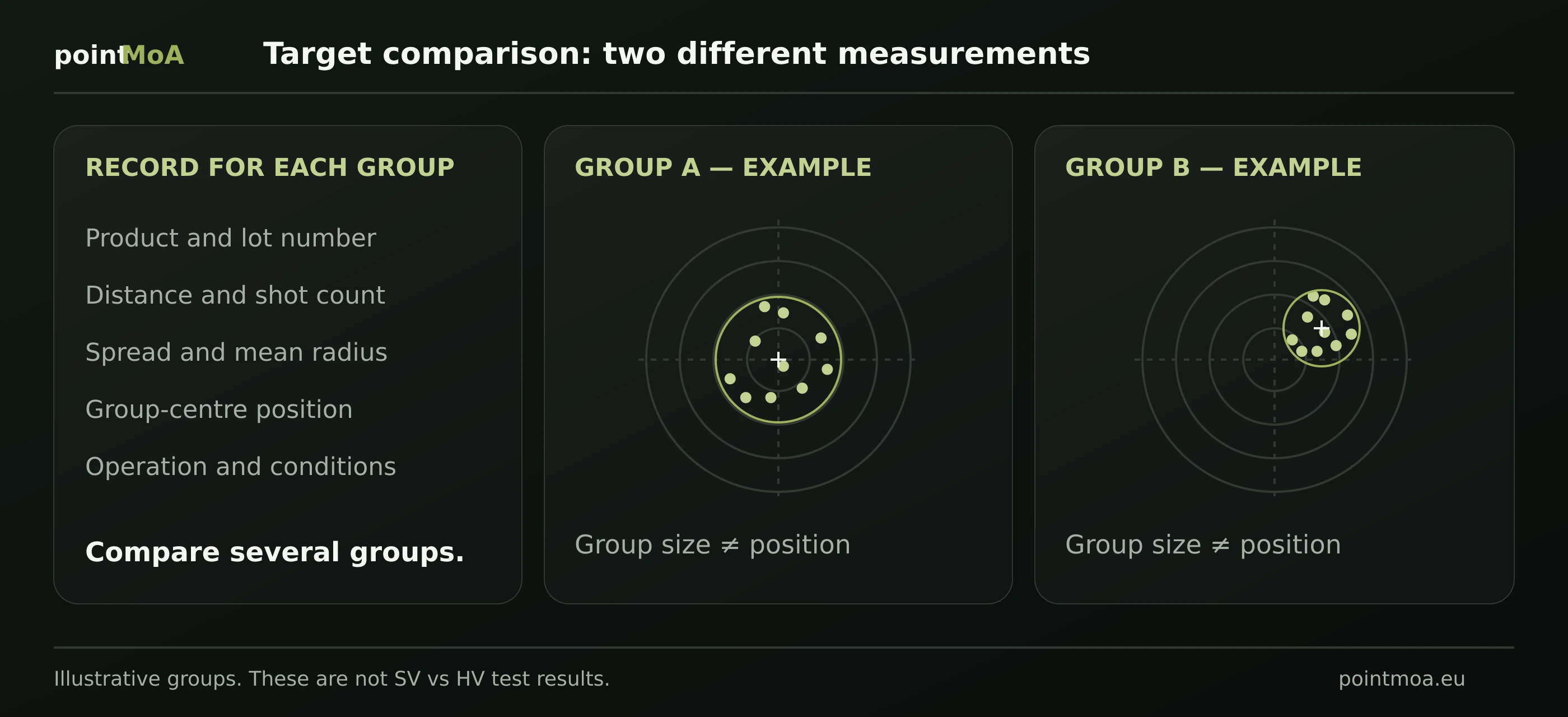
Useful measurements include extreme spread and mean radius. Extreme spread is the largest distance between impacts. Mean radius uses the distances of all impacts from the group centre. The shot-group measurement guide explains how they differ.
If a different load moves the group across the target, that does not necessarily mean its grouping has deteriorated. Consider point of aim and point of impact separately. In the pointMoA app, you can keep target photos and measured groups with ammunition information, making it easier to compare range visits without relying on memory.
What should you buy for practice?
For deliberate target shooting, choose an SV or Match load that has worked well in your firearm. For semi-auto practice, choose a product that combines adequate grouping with reliable operation. Depending on the firearm, that might be SV, a load labelled Subsonic or HV.
Paying more makes sense when it buys a visible, repeatable benefit. If two products perform similarly in your practice, consider cost and availability. The winner from someone else's target is a candidate to try, rather than a settled answer for your barrel.
Frequently asked questions
What is a good starting point for .22 LR target rifle ammunition?
Try several specific SV or Match products compatible with your rifle's manual. Compare groups at the same distance. With a semi-auto, also check reliable cycling.
Is High Velocity more accurate than Standard Velocity?
Higher velocity alone does not guarantee smaller groups. The complete load, barrel and conditions matter. Compare products, rather than SV and HV labels in isolation.
Will Subsonic ammunition cycle a .22 LR pistol?
It can, but not every load will work in every pistol. Some subsonic products are designed for semi-autos. Check the firearm manufacturer's guidance and test your chosen load.
Does 40 gr describe the powder charge?
No. On the box it describes bullet weight: 40 grains is about 2.59 g. Weight is separate from velocity and the Match label.
Should I record the ammunition lot number?
Yes, particularly when comparing groups. It identifies the purchase behind the result and tells you whether another box comes from the same lot. A brand name alone does not identify the ammunition tested.
Sources
-
CCI Standard Velocity, part 35: weight, construction, velocity and intended use.
-
CCI Target Mini-Mag, part 30: the second product in the comparison.
-
CCI — Choose The Right Rimfire Load: matching ammunition to the purpose and firearm.
-
ELEY contact: an example of a subsonic load intended for semi-autos.
-
ELEY — lubrication and barrel condition: comparing results after a product change.
-
NASA — Speed of Sound: the effect of temperature on the speed of sound.
Sources checked on 13 October 2026. Target groups are illustrative; they are not measurements of the products mentioned in this article.