115 vs 124 grain 9mm ammo: differences and what to choose for practice
115 or 124 grain 9mm ammo? Compare bullet weight, velocity, recoil and accuracy, then learn how to test both loads in your own pistol.
Two boxes of 9mm ammunition sit next to each other. Same manufacturer, same bullet type. One says 115 gr, the other 124 gr. Which one goes in your range bag? Ask a few shooters and you will often hear a different answer from each.
Either weight can work well for target practice. The number tells you the bullet's weight, but your results depend on the complete load and your pistol. It cannot pick the more accurate ammunition for you. You can, however, make a useful comparison without buying a case of each.
What do 115 and 124 grain mean in 9mm ammo?
A grain, abbreviated gr, is a unit of mass. It is not a gram and, on a box of factory ammunition, it does not describe the powder charge. It refers to the bullet: the projectile that leaves the barrel.
The unit conversion gives:
| Weight on the box | Bullet mass in grams |
|---|---|
| 115 gr | about 7.45 g |
| 124 gr | about 8.04 g |
The difference is roughly 0.58 g, or 7.8%. Small in your hand, but enough to matter alongside velocity and the rest of the load.
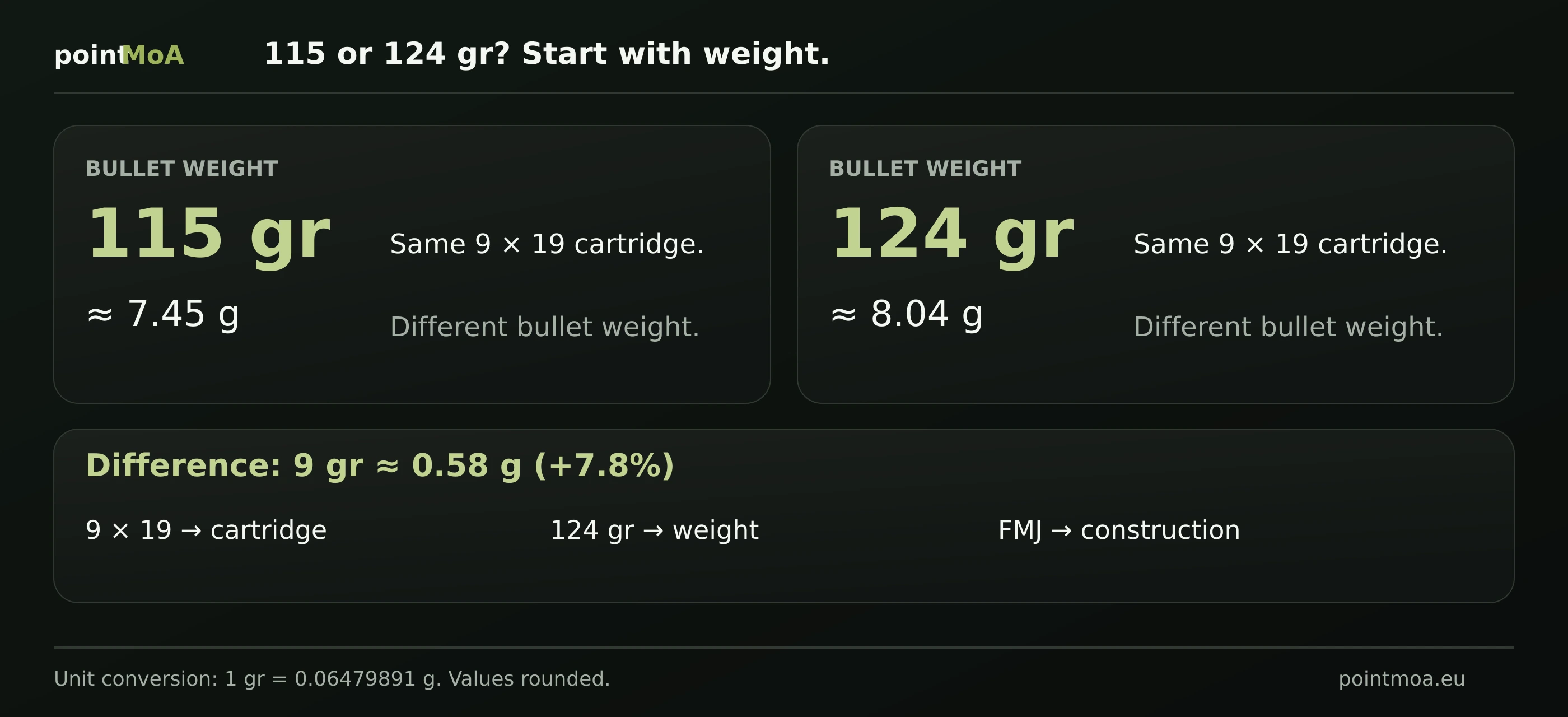
A manufacturer may list slightly different, rounded gram values. The commercial grain designation is not a weighing certificate for every bullet in the box.
Here, 9mm means 9mm Luger, also called 9 × 19 or 9mm Parabellum. Other cartridges with “9mm” in their name are not interchangeable just because they share those two characters. Match the full designation to your firearm's chamber.
115 vs 124 grain: muzzle velocity and energy
In comparable factory loads, the lighter bullet often starts faster. The heavier one may leave the barrel at a lower velocity. “Often” matters: different products also differ in their loading, so a weight comparison does not isolate a single variable.
Consider these two Sellier & Bellot products:
| 9mm Luger load | Published bullet mass | Muzzle velocity | Muzzle energy |
|---|---|---|---|
| FMJ 115 gr, V310452 | 7.50 g | 390 m/s | 570 J |
| FMJ 124 gr, V310492 | 8.00 g | 360 m/s | 518 J |
These are figures for two specific loads, not averages for all 115 and 124 grain ammunition. They come from the manufacturer's test conditions, using a 150 mm test barrel; your pistol may produce different velocities. Source: Sellier & Bellot handgun ammunition catalogue.
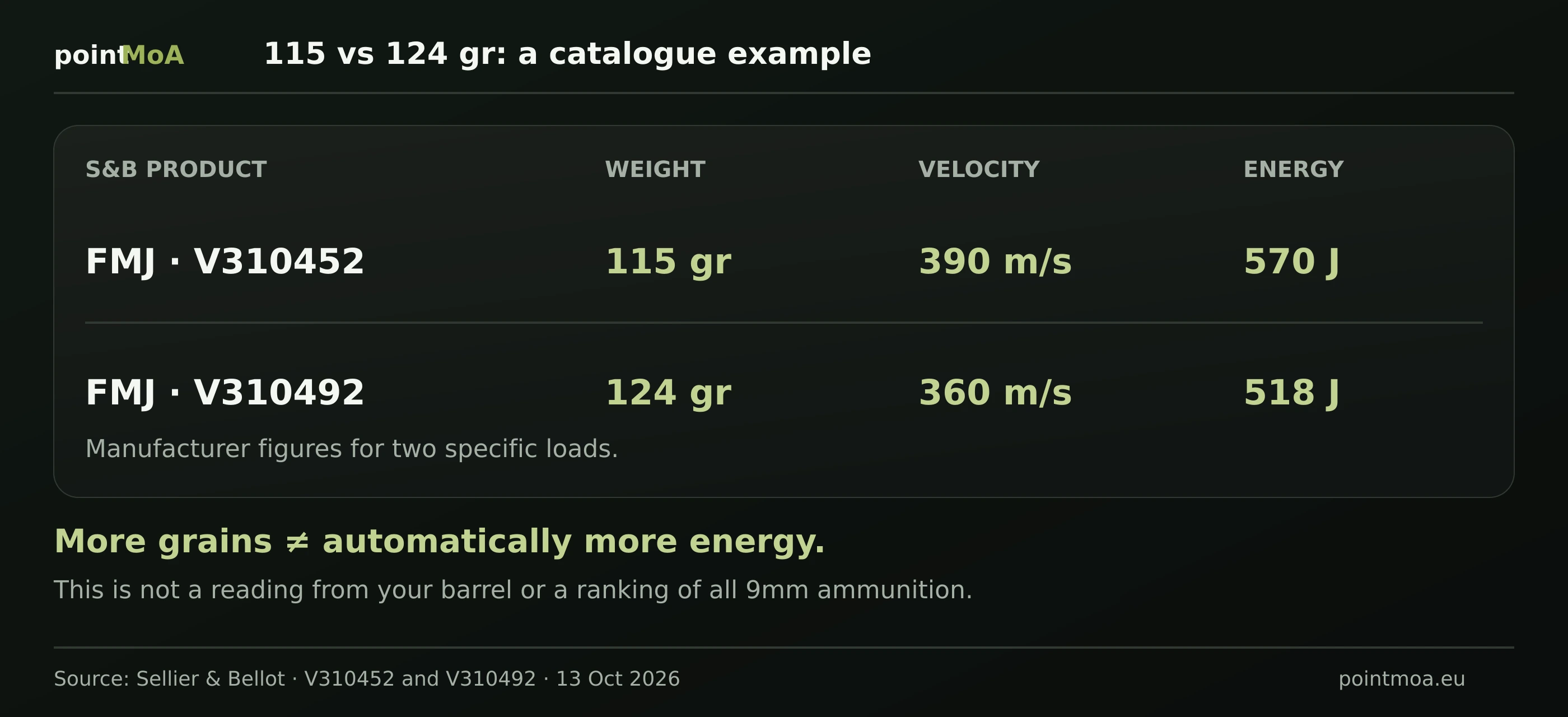
At ordinary pistol practice distances, velocity alone is rarely a useful reason to choose one box. Group consistency, point of impact and reliable cycling tell you more. If you need your actual velocity, measure it with a chronograph. A catalogue figure is a reference, not a reading from your barrel.
Does 115 or 124 grain 9mm have less recoil?
You will hear confident answers in both directions. One shooter calls 115 grain snappy; another finds a particular 124 grain load more noticeable. Both may be describing their own equipment honestly.
Bullet weight alone does not determine recoil. Velocity, propellant gases, firearm weight and the operating mechanism also matter. The bullet's energy in joules is not a chart of felt recoil.
During a comparison, notice how comfortably you return to the aiming point as well as how the shot feels. If one load is more comfortable and delivers equally good hits, that is useful information for your choice. It does not need to become a rule for every pistol.
Is 124 grain more accurate than 115 grain?
There is no universal winner. A pistol may group better with a particular 124 grain load or a particular 115 grain load. Changing brand, bullet construction or ammunition lot can change the result even when the weight stays the same.
Keep these two observations separate:
- Group size: how close the hits are to one another.
- Point of impact: where the group lands relative to your aiming point.
A new load may produce a tighter group somewhere slightly different from the old one. That does not make it less accurate. Before adjusting the sights, check that the shift repeats across several strings. Our guide to point of aim and point of impact explains the distinction between grouping and zero.
How to compare 115 and 124 grain ammo at the range
Start with a box of each and record the full product names. You are testing load A against load B. Even within one product family, this does not isolate the effect of bullet weight alone.
- Keep the conditions consistent. Use the same pistol, distance, target and support. For group testing, shoot at a comfortable, repeatable pace.
- Shoot several comparable groups. Three ten-shot groups per load are a reasonable starting point, not a guarantee of a conclusive result.
- Alternate the loads. A, B, A, B helps avoid giving one load all the warm-up and the other all the fatigue.
- Measure and record every group. Include extreme spread, mean radius and group-centre position. Keep more than your best target.
- Record function and feel. Feeding or ejection problems, and how comfortably you return to the target, belong in the comparison too.
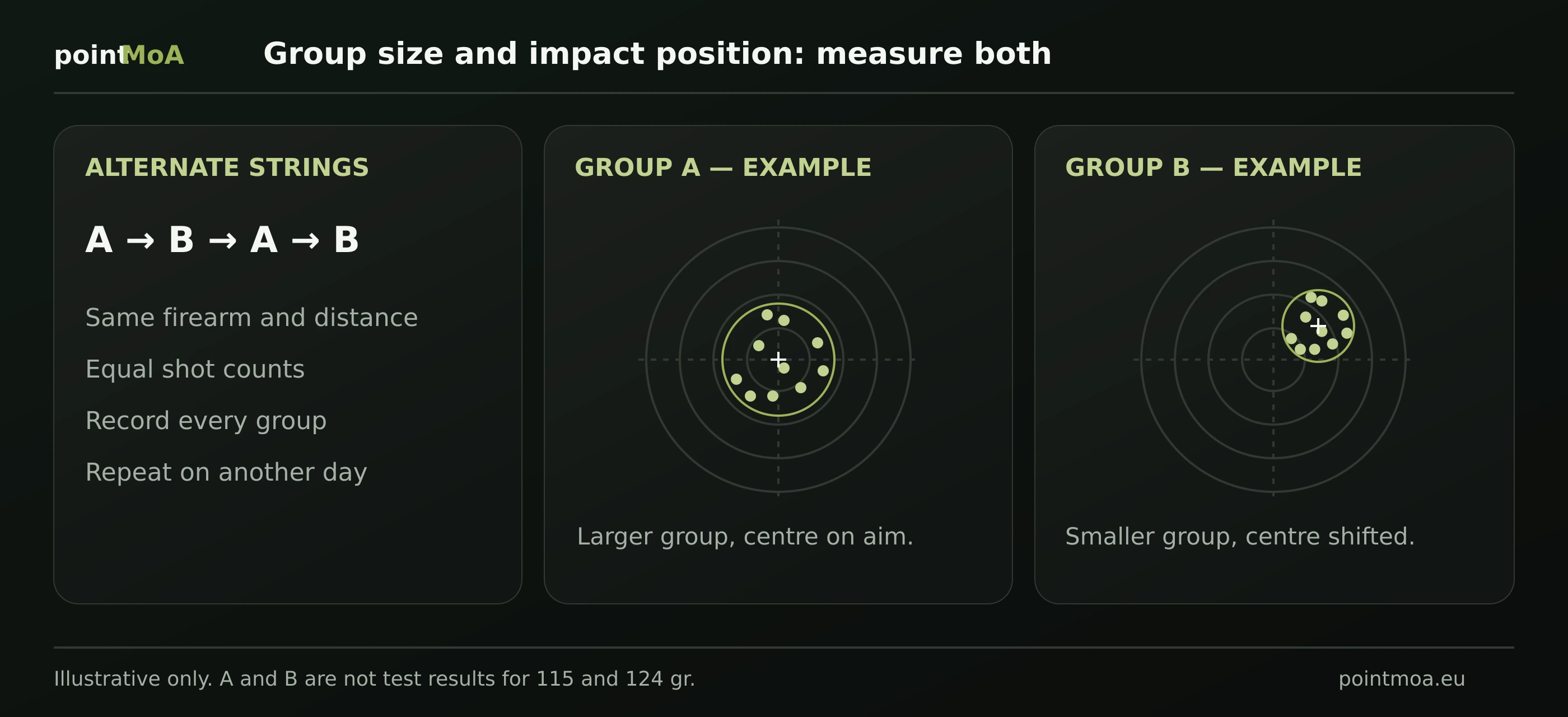
If the difference is small, repeat the comparison on another range visit. A single excellent group may simply be a fortunate one. See our guide to measuring shot groups for the measurement method and the effect of shot count.
In the pointMoA app, you can mark hits on a target photo and save the result with ammunition information. That gives you measurements to compare instead of a memory that one box “seemed better”.
Which should you buy for regular practice?
Choose a load that runs reliably, groups well enough for your training goal and fits your budget. If both do that, the larger grain number is not a reason to pay more on its own.
Competition may add other requirements. If your discipline uses a minimum power factor, check the rules and measured velocity. A 124 grain label does not guarantee that you meet it.
Also check FMJ or TMJ on the box. Construction is separate from weight; our guide to FMJ, TMJ and HPBT explains what the letters mean.
Frequently asked questions
Does 115 gr mean 115 grams?
No. It means 115 grains, about 7.45 grams of bullet mass. A gram is abbreviated g; a grain is gr.
Is 124 grain always more accurate?
No. Compare specific loads in your firearm using several groups with the same shot count.
Should I check my zero after changing bullet weight?
Yes, check where the groups land. Do not assume beforehand that you will need a sight adjustment or that the shift will go in a particular direction.
Is 124 grain 9mm subsonic?
The weight does not tell you. That depends on actual bullet velocity relative to the speed of sound in the conditions. Check the specific product description.
Should a beginner start with 115 or 124 grain?
Either can work if the load meets the firearm manufacturer's recommendations and the range rules. Buy a small amount first and check function and results before committing to a larger supply.
Sources and data
- Sellier & Bellot — handgun ammunition catalogue: products V310452 and V310492, checked on 13 October 2026.
- Product specifications: V310452, 115 gr and V310492, 124 gr, both with a 150 mm test barrel.
- Speer — Lawman: training ammunition and TMJ construction.
Grain-to-gram conversions use the unit definition: 1 gr = 0.06479891 g. The target comparison is illustrative, not measured data or a manufacturer's test.