FMJ, TMJ and HPBT: what do ammunition abbreviations mean?
What is FMJ, how does TMJ differ, and what does HPBT mean? Learn to read bullet construction labels and choose ammunition for target practice.
A box of ammunition gives you a cartridge name, a bullet weight and a few letters: FMJ, TMJ or HPBT. You know the cartridge, perhaps the grains too, but the abbreviations leave room for guesswork. Is TMJ better than FMJ? Does a hole in an HPBT bullet's tip make it an expanding bullet?
These labels describe bullet construction. They are not a quality scale, cannot pick the most accurate load for your firearm, and do not replace the manufacturer's full description. Understanding them does make comparing boxes much easier.
FMJ vs TMJ vs HPBT at a glance
| Label | Full name | What it describes |
|---|---|---|
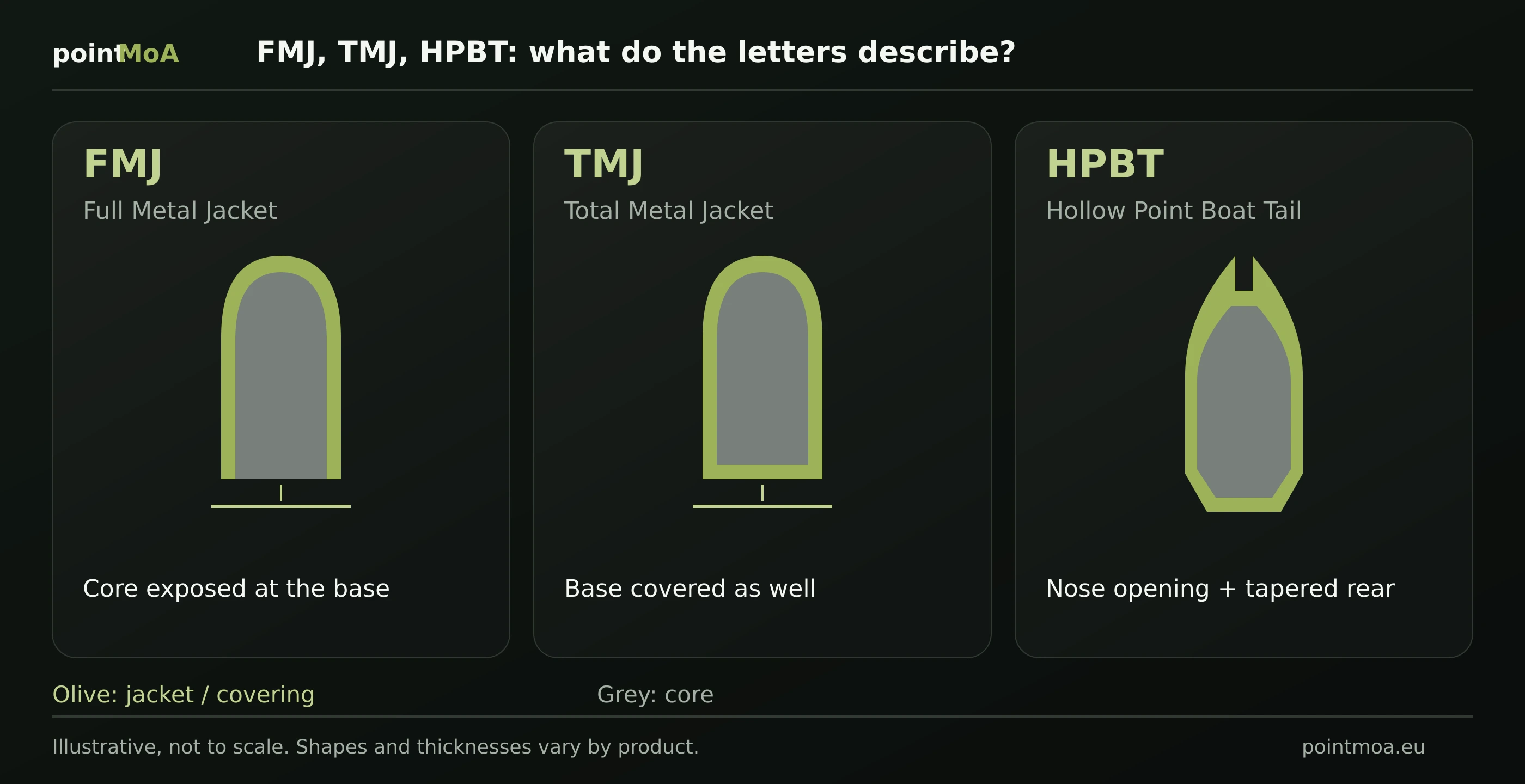
| FMJ | Full Metal Jacket | A jacket over the sides and nose; a conventional design leaves the core exposed at the base |
| TMJ | Total Metal Jacket | Metal also covers the base of the core |
| HPBT | Hollow Point Boat Tail | An opening in the nose and a tapered rear section |
There is a useful distinction here: FMJ and TMJ describe how the core is covered; HPBT describes features of the nose and base. They are not three stages of the same technology.
What does FMJ mean?
FMJ stands for Full Metal Jacket. In a conventional design, a metal jacket covers a lead core at the front and sides, leaving some lead exposed at the base.
That last detail can be surprising. “Full” does not mean every surface of the core is enclosed. TMJ is one label used for a fully covered core.
You will often see FMJ on ammunition sold for routine practice. The letters do not specify manufacturing tolerances, the core material or the quality of the complete cartridge. They do not settle whether a particular range permits the load either.
FMJ does not mean steel core. Jacket construction and core material are different details. Check the specific product description, especially when a range restricts ammunition types.
FMJ vs TMJ: why does the covered base matter?
TMJ means Total Metal Jacket: the metal covering includes the core's base. From the outside it may resemble an FMJ bullet; a cross-section reveals the difference.
Speer describes its Lawman TMJ bullets as completely enclosed, keeping propellant gases from contacting exposed lead at the base. That is why TMJ comes up in discussions of indoor practice. See the manufacturer's description for the specific product family.
It does not follow that every TMJ cartridge is entirely lead-free. The enclosed core may still contain lead, and primer composition is a separate property. TMJ, Lead Free and product names for special primer formulations are not interchangeable labels.
Will TMJ produce smaller groups than FMJ? Covering the base does not guarantee that. For your choice, consider the load's performance in your firearm, its reliability and the range rules.
What about CMJ and plated bullets?
You may also see CMJ, “plated” or similar descriptions. These can refer to bullets with a covered core, but terminology and construction vary between manufacturers. Similar names do not guarantee identical covering thickness or performance.
When comparing two product families, read their specifications. The box has room for a short label; the details belong in the documentation.
What does HPBT mean?
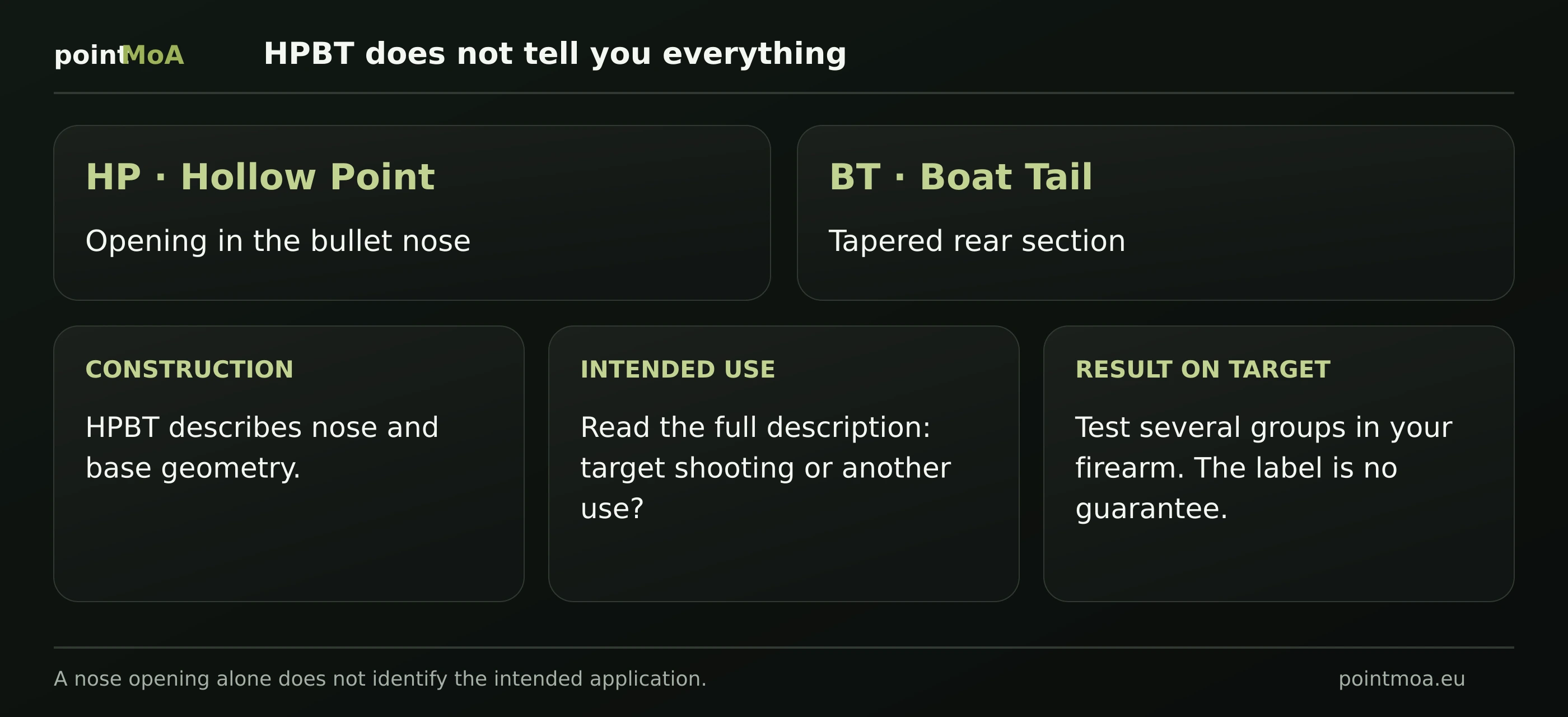
HPBT stands for Hollow Point Boat Tail. It combines two features:
- HP — Hollow Point: an opening at the front of the bullet.
- BT — Boat Tail: a tapered rear section.
The label is common in precision rifle ammunition. A boat tail is intended to reduce aerodynamic drag, but the shape alone does not specify a load's accuracy or ballistic coefficient.
Is every HPBT bullet designed to expand?
No. A nose opening alone does not identify the intended use. Sierra distinguishes target MatchKing bullets from hunting GameKing bullets; hollow-point designs appear in both families. Read the full name and application instead of treating every HP bullet as the same solution.
This matters when two boxes share both a weight and the HPBT label. Similar markings do not mean the products were designed for the same purpose.
How to read an ammunition label
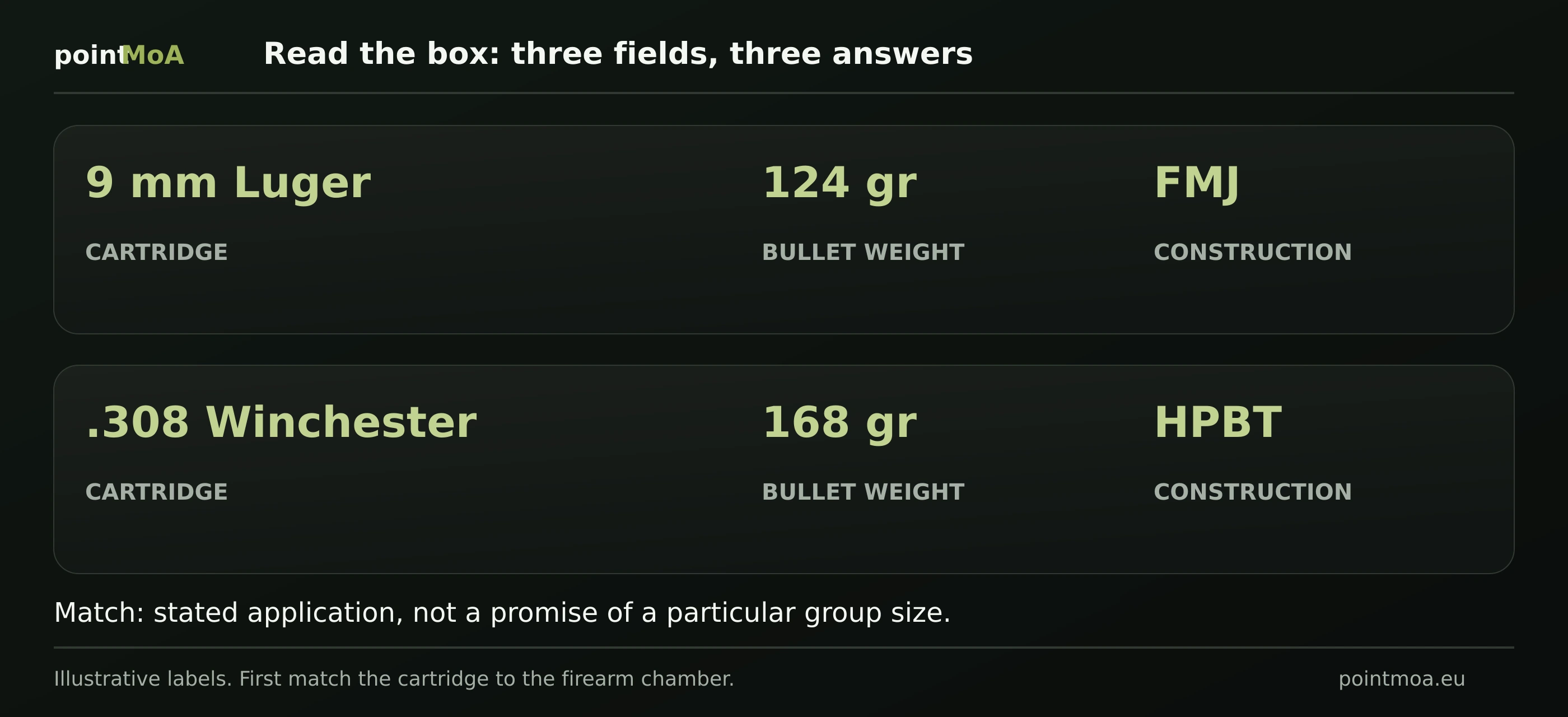
Take 9mm Luger · 124 gr · FMJ:
- 9mm Luger identifies the cartridge. Match this to your firearm's chamber first.
- 124 gr gives bullet weight, not cartridge weight or powder charge.
- FMJ describes bullet construction.
Read .308 Winchester · 168 gr · HPBT the same way. Match indicates the product's stated target-shooting purpose; it does not promise a particular group size from every barrel.
In the product specifications, also look for muzzle velocity and test-barrel length. For rifle loads, note the ballistic coefficient and its drag model, such as G1 or G7. Do not enter a G1 value as G7 because the number looks plausible: the calculator will interpret it as different input.
Some loads have an additional pressure designation such as +P. This is separate from bullet weight or FMJ construction. Check your firearm's manual for ammunition compatibility.
Which construction should you choose for target practice?
For pistol practice, start with specific FMJ or TMJ products that suit your firearm and range. Then compare reliability, grouping, comfort and cost. For 9 × 19 bullet weights, see our separate guide to 115 vs 124 grain 9mm.
For precision rifle shooting, you can compare a practice load with a specific Match load, including HPBT. Check the manufacturer's guidance and your barrel's results before buying a large supply. With .223, twist rate and bullet construction also matter.
Test complete loads, not abbreviations. Several comparable groups, equal shot counts and a record of every result tell you more than one excellent group from an expensive box. Our shot-group measurement guide explains the method. In pointMoA, you can keep target photos and measured results with ammunition information.
Frequently asked questions
Is TMJ better than FMJ?
It covers the core's base differently. That is a construction difference, not a universal ranking of quality or accuracy.
Does FMJ always have a steel core?
No. FMJ describes the jacket. Check the manufacturer's description for the core material.
Is HPBT exclusively target ammunition?
No. The abbreviation describes geometry. The full product description tells you its intended use.
Is TMJ lead-free ammunition?
Not necessarily. A lead core can be fully enclosed. Check bullet material and primer composition separately.
Does Match guarantee smaller groups?
Not in every firearm. It states the product family's intended use, which you should verify with several groups on target.
Sources
- Speer — Lawman: TMJ core coverage and the separate Clean-Fire family.
- Sierra — Bullet 101: FMJ, Hollow Point and Boat Tail designs, plus MatchKing and GameKing families.
- MFS Ammunition — Glossary: expanded FMJ, TMJ and HPBT labels.
Sources checked on 13 October 2026. Cross-sections are illustrative; they show the differences discussed here, not a specific product's dimensions.