Astigmatism and red dot sights — why the dot falls apart
The dot in your red dot looks like a star, a comet or several dots at once. Where that comes from, how to tell whether the problem sits in your eye or in the sight, and what actually helps: brightness, dot colour, corrective lenses, prism sights and holographic sights.
You buy a red dot, switch it on, and instead of a dot you see a star. Or a comet with a tail. Or several dots side by side. A friend looks through the same sight and says the dot is as round as the catalogue picture.
The sight is fine. A warranty claim will come back marked "no fault found", because on a measuring bench that dot really is round. What smears it is your eye — most often astigmatism.
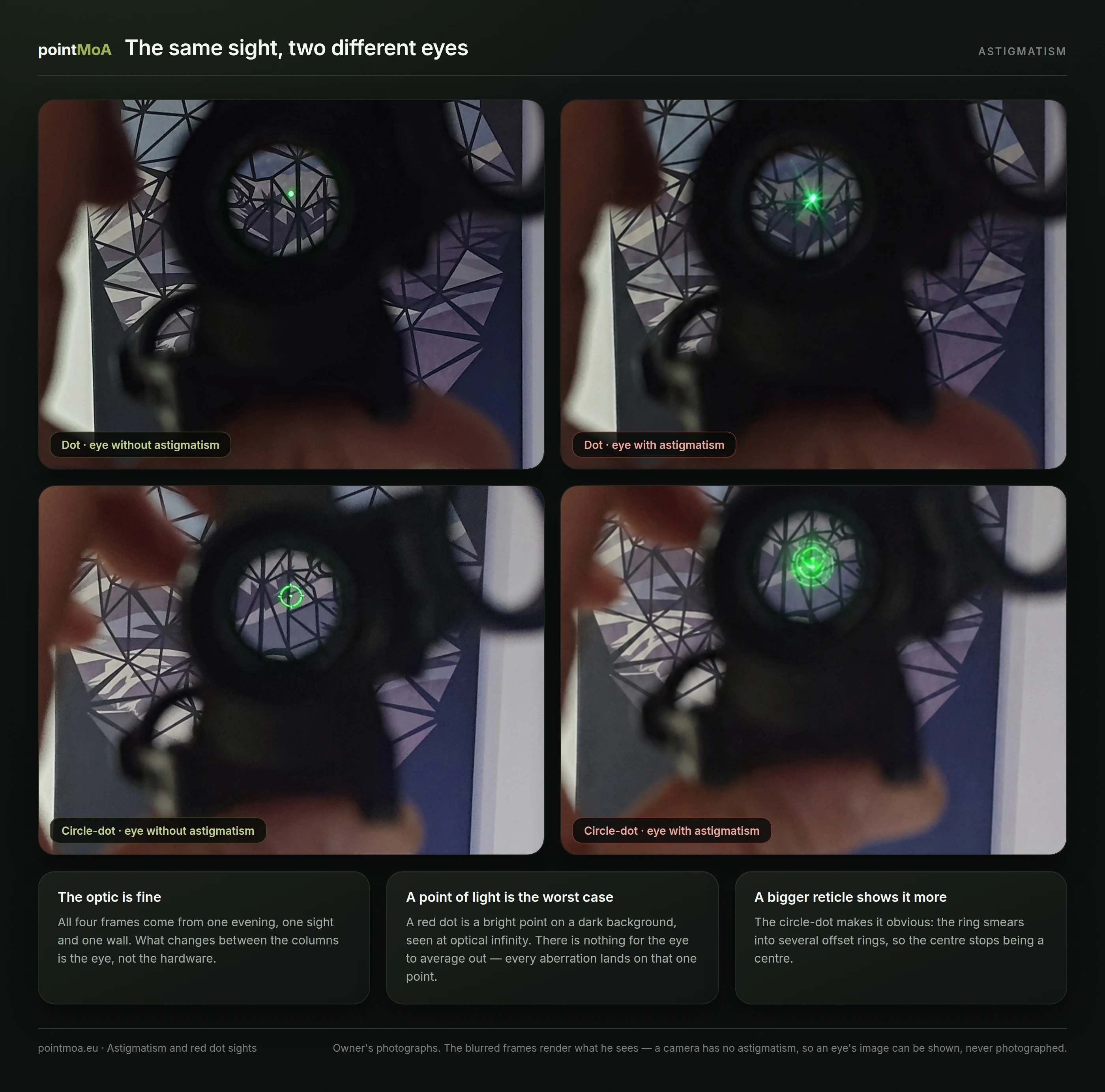
What astigmatism is
A healthy cornea is a section of a sphere: the same radius of curvature in every direction. An astigmatic cornea is closer to the back of a spoon — one axis is more strongly curved than the one at right angles to it.
The consequence is that rays leaving a single point do not converge back into a single point. They form two short lines instead, sitting at different distances from the retina and perpendicular to each other. In optics that figure is called Sturm's conoid; in practice it means a point of light is never a point. It is always a line, a smear or a star — and the direction of that smear is set by the axis of the defect.
Astigmatism is described by two numbers: the cylinder power in dioptres and
the axis in degrees. On a prescription it looks like cyl −0.75 ax 170°.
Most people carry 0.25–0.5 D without ever noticing: text reads fine, number
plates read fine, the world is in order.
Until the first evening with a red dot.
Why a dot is such a merciless test
A red dot shows a bright point on a dark background, and a point seen as though it sat at infinity. That is the worst possible test for an eye:
- A point has nothing to average out. A letter has edges, a target has texture, and the brain reconstructs a sensible image from blurred edges. A point is one pixel — every aberration lands on it with nowhere to hide.
- The contrast is extreme. A glowing diode against a night range or a dark treeline. Every streak around it is perfectly visible.
- There is nothing to focus. The reticle leaves the sight as a collimated beam. There is no ring to turn, no plane the reticle "sits" on — only your eye and what it does with that beam.
That is why somebody who sees beautifully through a rifle scope, and has never complained about their vision, sees a comet through a red dot.
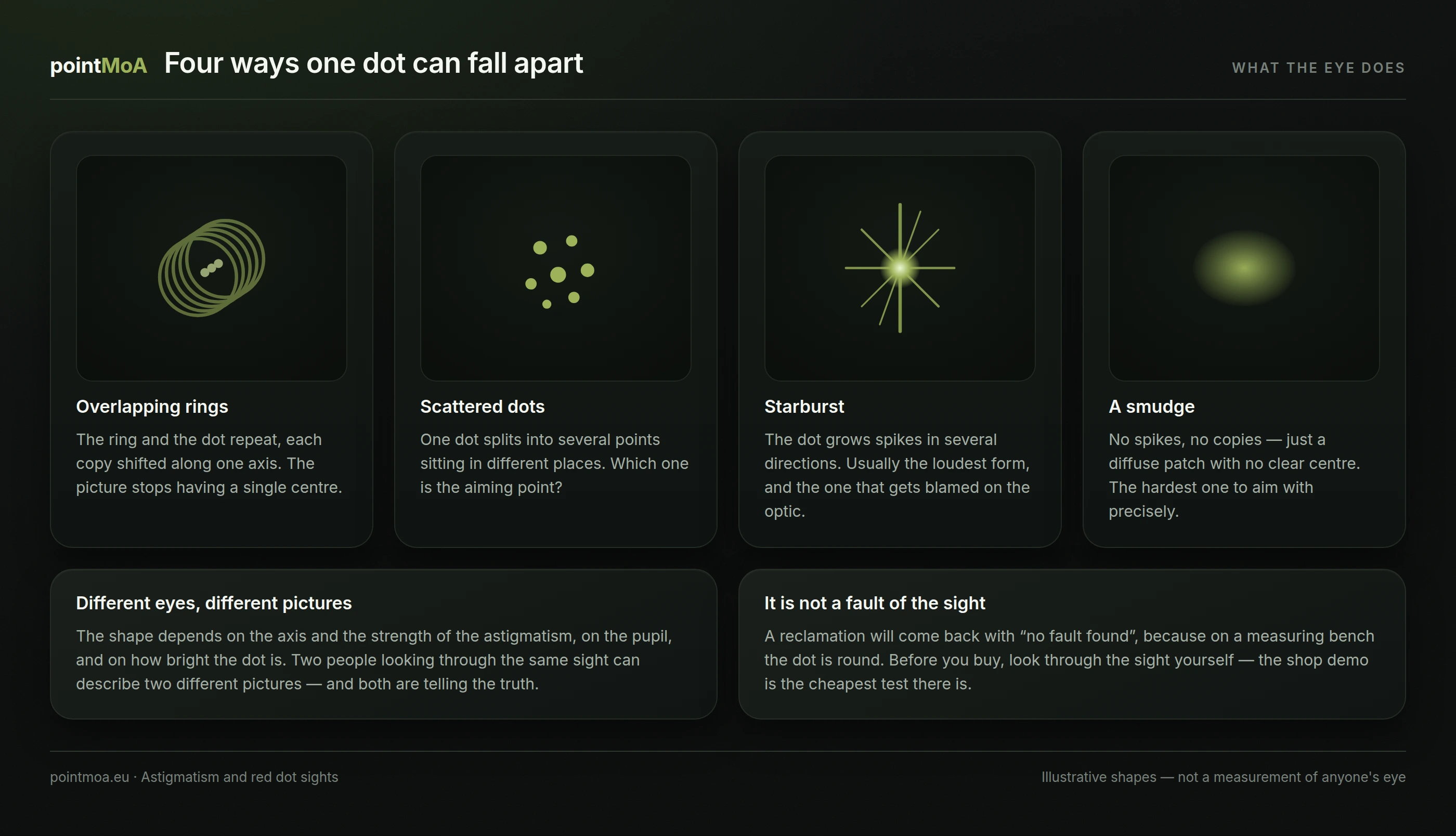
Why a rifle scope does not do this
The answer lies in where the reticle is made.
In a rifle scope and in a prism sight the reticle is etched into glass and sits in the focal plane. The eyepiece has a diopter adjustment, so the image of the reticle can be moved until it falls sharp for your eye. That ring corrects sphere — short or long sight. It will not correct a cylinder, but that is still one problem fewer.
Magnification adds to it. The blur circle on your retina has its own size regardless of what you are looking at. When the image of the target and the reticle grows three times, that same blur covers three times less of the picture. The blur does not disappear — it stops dominating.
A red dot has neither. There is a diode, a mirror coated to reflect its colour, and a collimated beam heading straight into your eye.
How to tell whether the problem is your eye
Before you go looking for the receipt, five tests. They take five minutes and need nothing but a sheet of paper.
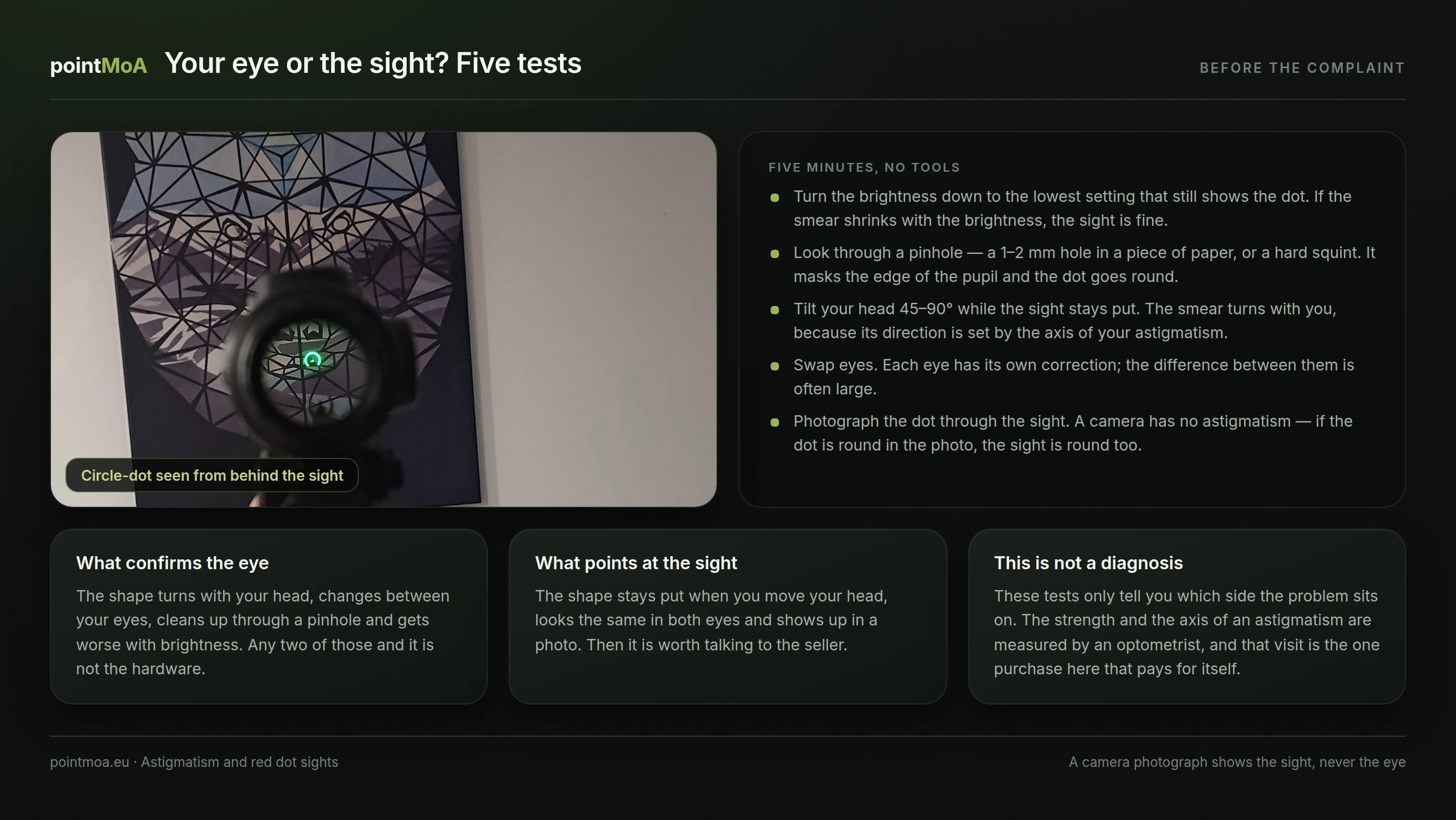
- Turn the brightness down. Set the lowest level at which the dot still reads against the target. If the smear shrinks with the brightness, the sight is fine — and you have just found the cheapest remedy in this article.
- Look through a pinhole. A 1–2 mm hole in a sheet of paper held to the eye masks the edge of the pupil and passes only a narrow beam through the middle of the cornea. Dot goes round? That is astigmatism, not the sight.
- Tilt your head. Hold the sight still, tilt your head 45–90° and watch the smear. It turns with you, because its direction is set by the axis of your defect — the sight has not moved.
- Swap eyes. The two eyes often differ, sometimes a lot. A round dot in one eye and a smeared one in the other settles the question by itself.
- Take a photograph. A camera has no astigmatism. If the dot is round in a photo through the sight, it is round. Watch the camera's focus, though — a phone likes to lock onto the housing instead of the dot, and then the blur in the picture is the camera's, not yours.
All of this only tells you which side the problem sits on. The power and the axis of an astigmatism are measured by an optometrist, and that is the one expense in this article that pays for itself whatever you buy next.
What actually helps
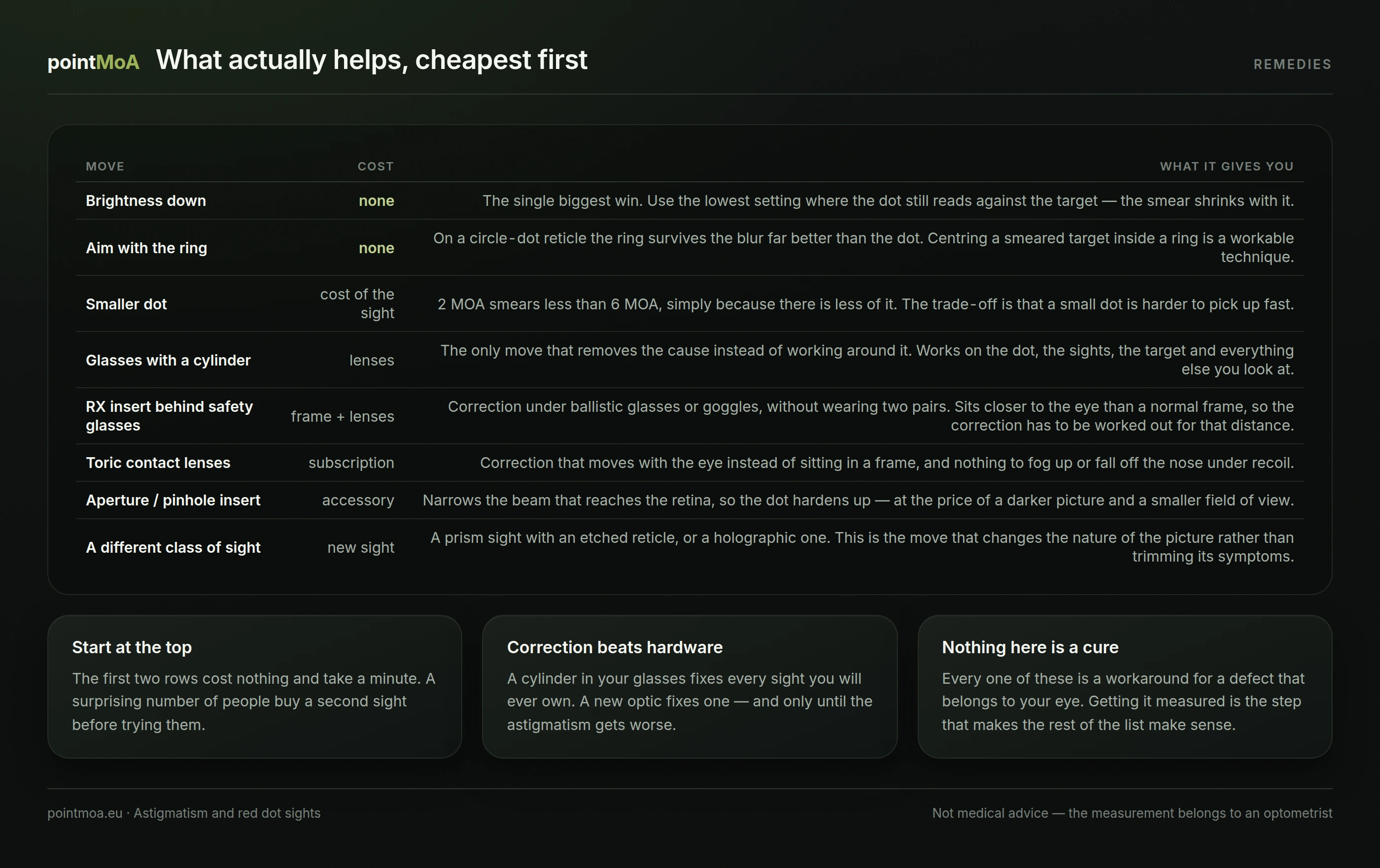
Brightness down
The simplest and most effective move there is. The size of the blob grows with the amount of light entering the eye, so every step down is a smaller smear. Most people run their sight two or three steps too bright, because that is where they set it in the shop, under a fluorescent tube.
The rule is simple: the lowest level at which the dot still reads against the target. Not the most comfortable one — the lowest one.
Aim with the ring, not the dot
If your sight has a circle-dot reticle, you have a technique in reserve that few people mention: a ring survives blur far better than a point. It has a circumference, it has two edges, and even smeared it leaves a legible geometric centre. Centring the target inside the ring is often more precise than aiming with a smeared dot — and with a large ring (68 MOA, close to two metres at 100 m) that is the technique the manufacturer intended anyway.
Reticle sizes are quoted in MOA and MRAD — if those abbreviations mean nothing to you, start with the article on MOA and MRAD.
A smaller dot
2 MOA smears less than 6 MOA, simply because there is less light to smear. The price is real, though: a small dot is harder to pick up in a hurry, especially under stress and on the move. If you are choosing between sizes, do not buy the smallest one "because it is sharper" — check that you still find it in the window in a fraction of a second.
Correction: glasses, inserts, contact lenses
This is the only route that removes the cause instead of working around it. A cylinder in your lenses fixes everything at once: the dot, the iron sights, the target, the scoreboard and the drive home from the range.
Three options, each with its own catch:
| Option | Upside | Catch |
|---|---|---|
| Ordinary prescription glasses | simplest, you already own them | it gets crowded under safety glasses; two pairs fog and slide |
| RX insert behind ballistic lenses | correction under one protective lens, nothing sticking out | it sits closer to the eye than a normal frame — the power must suit that distance |
| Toric contact lenses | correction that moves with the eye, nothing to fog up | a toric lens has to hold its orientation; dust, wind and squinting do not help |
Two things worth remembering about glasses on a range. First, correction does not replace protection — the lens has to meet a protective standard (EN 166 in Europe, ANSI Z87.1 in the United States), and ordinary prescription glasses usually do not. Second, the effective power of a lens depends on its distance from the eye, so an insert sitting close to the eye and a frame on your nose are not the same dioptres. An optician will work that out if you tell them what it is for.
An aperture
The same principle as the pinhole test: the narrower the beam entering the eye, the less the edge of the cornea contributes and the harder the dot becomes. There are pinhole inserts and adjustable irises made to sit behind a sight. They work — but you pay in a darker picture and a smaller field of view, so they are a poor fit for anything dynamic.
Dot colour: red or green
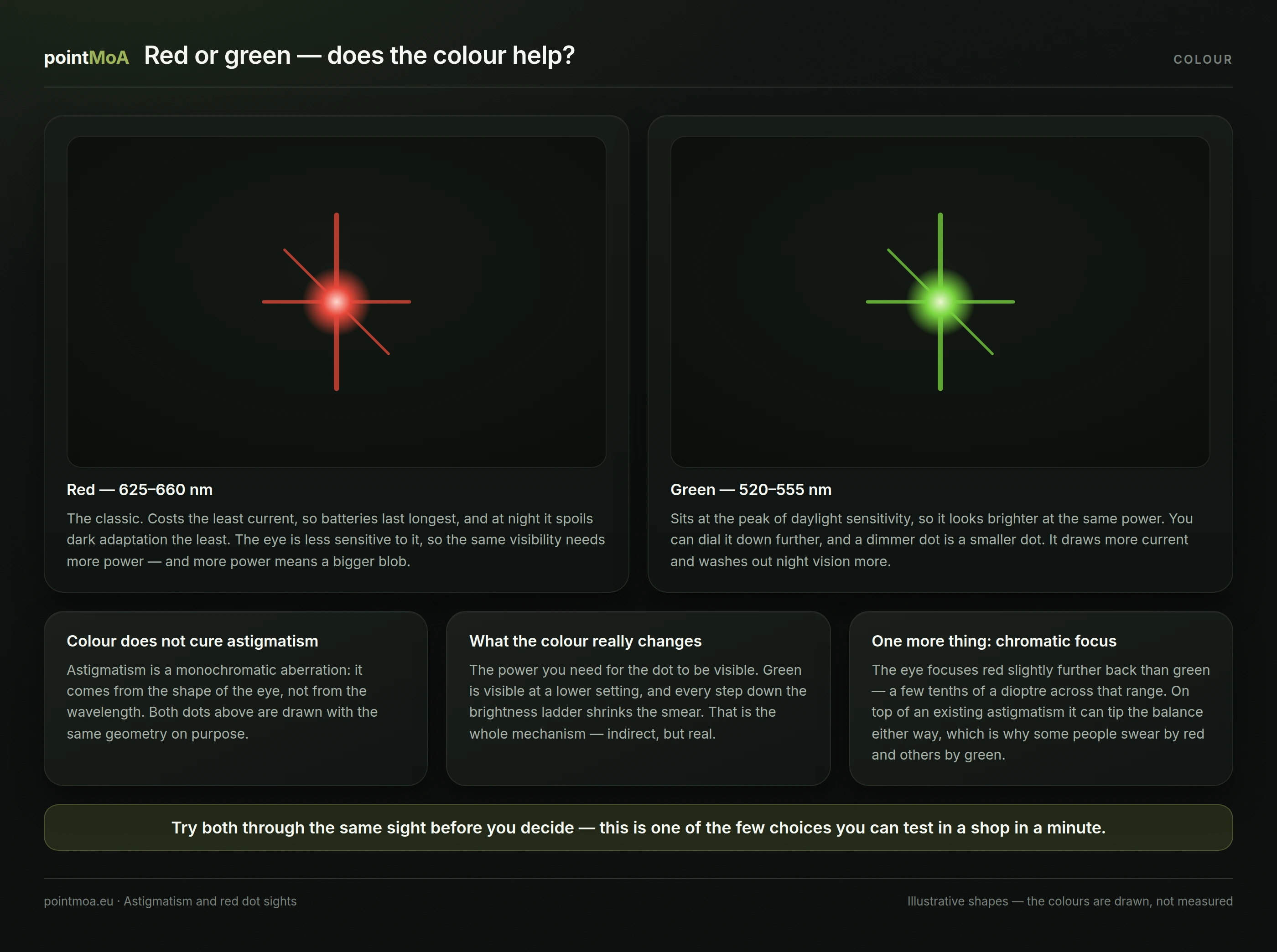
Start with what colour does not do: it does not remove astigmatism. Astigmatism is a monochromatic aberration — it comes from the shape of the eye, not from the wavelength. A green dot will smear exactly like a red one if both are equally bright.
What colour does change is two things that reach the picture indirectly, but really.
The sensitivity of the eye. In daylight the eye is most sensitive around 555 nm, which is green. A green dot of the same power therefore looks markedly brighter than a red one — which means you can dim it and still see it. Every step down is a smaller blob. The whole mechanism comes down to green letting you work lower on the brightness ladder.
Chromatic focus. The eye has its own chromatic aberration: it focuses red slightly further back than green. Across the range from green to red that is a few tenths of a dioptre — not much, but added to an existing defect it can tip the balance. That is why some astigmatic shooters swear by red and others by green, and both are right about themselves.
Red has current and darkness on its side: a red diode draws less energy (hence those fabulous battery lives quoted in years) and disturbs dark adaptation less.
The practical conclusion is single and no amount of theory replaces it: look at both through the same sight, preferably after dark. It is a choice you can settle in a shop in a minute.
Prism sights
If correction is not an option, or is not enough, what changes is not a setting but the class of sight. A prism sight is the closest thing here to a rifle scope.
Instead of a lens erector it uses a prism, which makes it shorter at the same magnification. What matters most, though, is what is inside: a reticle etched into glass, sitting in the focal plane, with optional illumination.
What that means for an astigmatic eye:
- the reticle is not a point of light but a black pattern with defined edges — and an edge survives blur incomparably better than a point;
- the eyepiece has a diopter adjustment, so the reticle can be brought into focus for your eye (sphere — the ring will not correct a cylinder);
- 3× or 5× magnification reduces the share of the picture taken up by the blur circle;
- the illumination can be switched off — a black etched reticle keeps working with no battery at all.
The price is equally concrete: a short, unforgiving eye box. The mount has to be repeatable, because with the head in the wrong place the picture disappears. Add more weight, a narrower field of view and the tunnel effect at magnification — this is kit for deliberate shooting rather than running.
Holographic sights
A holographic sight builds its picture in a completely different way. Instead of a diode bounced off a mirror there is a laser diode illuminating a recorded hologram of the reticle; the reticle image is reconstructed from that recording. The window is usually large and rectangular, and the classic reticle is a 68 MOA ring with a 1 MOA dot in the middle.
Many astigmatic shooters describe a holographic reticle as easier to live with than a red dot. That is worth treating as widespread experience rather than a law of physics: the blur is still yours and still works. What helps is the design of the reticle — if the 1 MOA dot smears into a star, the big ring around it stays legible and still gives a reference. It is the same trick as "aim with the ring, not the dot", built into the product.
The bill is paid in watts: a laser draws far more current than a diode, so battery life is counted in hundreds of hours instead of tens of thousands. Add a higher price, more weight and a narrow market — there are literally two manufacturers of this class of kit. It is also worth knowing that holography has a history in this industry: the well-publicised thermal drift case around EOTech sights ended in a 2015 settlement in the United States and an equipment replacement programme.
Red dot, holographic or prism — what to choose
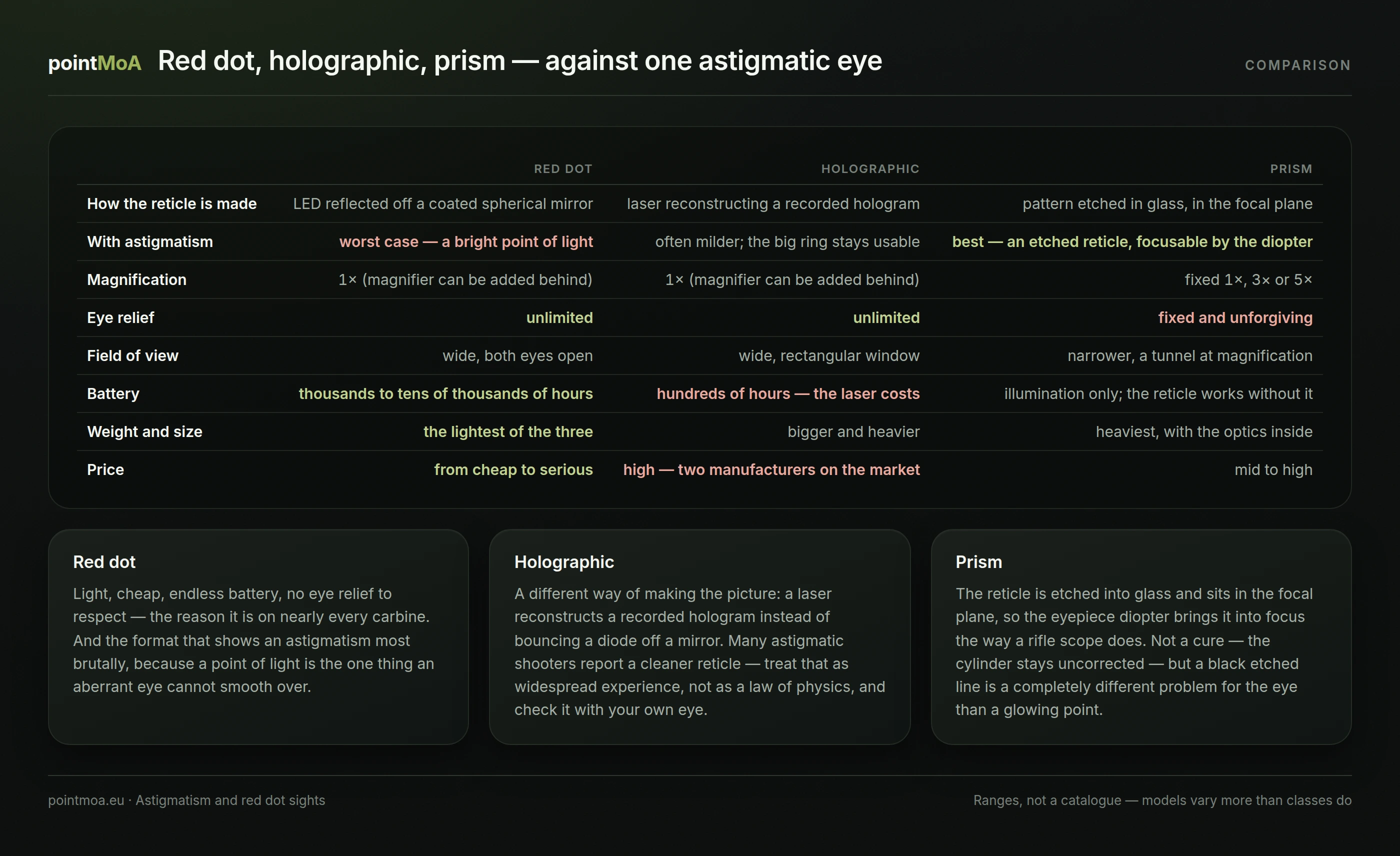
The short version:
- Mild astigmatism and you like red dots — stay with one. Turn the brightness down, consider a smaller dot and get your correction checked. That closes the case in most instances.
- The dot is unusable but you want to stay at 1× — a holographic sight or a red dot with a large ring. A big reticle forgives what a small one does not.
- A strong defect and deliberate shooting — a prism sight. An etched reticle and a diopter buy you something no brightness setting can.
- One sight for everything — a 1–6× or 1–8× variable (LPVO). It has a diopter, it has an etched reticle and at 1× it still works up close, though it costs you in weight and money.
The order matters. Free things first (brightness, ring, other eye), then cheap ones (the correction you should have anyway), and only then hardware. The reverse order ends with a drawer full of sights and the same eye you started with.
What astigmatism does not ruin
This is worth saying plainly, because the first evening with a smeared dot can be demoralising.
Astigmatism does not take shooting away from you. It does not hit a rifle scope the same way, it does not ruin iron sights (they blur too — they just have edges rather than points), it does not change ballistics and it has no influence on where the bullet goes. It changes one thing: what the aiming point looks like. The rest is a question of choosing kit and technique.
I know how this conversation ends, because it repeats in every club: the shooter with a smeared dot blames the sight first, then themselves, and finally goes to an optometrist and comes back with a solution that was available from the start.
Summary
- A smeared dot is usually astigmatism, not a faulty sight. A point of light on a dark background is the sharpest eye test you own.
- Five tests (brightness, pinhole, head tilt, other eye, photograph) settle in five minutes which side the problem is on.
- Brightness down and aiming with the ring cost nothing and do the most.
- Correction removes the cause and works on every sight you will ever own. An insert behind safety glasses solves the two-pairs problem at the same time.
- Colour does not cure astigmatism — it only lets you go lower on brightness (green) or run longer on a battery without ruining your night vision (red).
- Prism means an etched reticle and a diopter; holographic means a big ring and a different character of image; red dot means light weight, price and battery life.
- Astigmatism is not diagnosed on the internet or on a range. This article is not medical advice — the power and axis are measured by an optometrist.