Polish Shooting Licence Exam: Patent Strzelecki Guide
The Polish shooting licence exam (patent strzelecki): eligibility, theory, practical tests and thresholds under PZSS rules effective from 1 July 2025.
The shooting licence (patent strzelecki) is a document issued by PZSS — the Polish Shooting Sport Association — certifying the qualifications to practise sport shooting. It is earned at an exam made up of a ten-question test and a practical part, after one month of membership in a club holding a PZSS licence. The fee is 400 PLN and follows directly from the Act. The patent is awarded for an indefinite period and separately for each of three disciplines: pistol, rifle and smoothbore shotgun.
This article describes the exam according to the PZSS rules in force since 1 July 2025. It also adds something the rules do not contain: the shooting-test thresholds converted to angular measure and the computed chance of passing them — because the three tests differ in difficulty six-fold, and you cannot see that from the centimetres alone.
As of 17 September 2026. Acts and rules get amended. Before the exam, check the current wording on the PZSS website — where they differ, the source document prevails, not this article.
What the patent is for
The patent on its own is not a firearms permit. The Weapons and Ammunition Act (ustawa o broni i amunicji) lists, as a valid reason for owning firearms for sporting purposes, three things at once: documented membership of a shooting association, the sporting qualifications under art. 10b, and a licence from the relevant Polish sports federation (art. 10 ust. 3 pkt 3 of the Act).
The patent is the second of those three. It gives you the right to:
- apply — through your club — for a competitor's licence, that is the third;
- apply for a judge's, coach's or instructor's licence, if you meet their separate requirements;
- apply for a firearms permit for sporting purposes.
The patent is awarded for an indefinite period, but the competitor's licence is issued for a calendar year, and it is the licence that has to be renewed.
Who may take the exam
The conditions from the rules; all of them must be met together:
- Aged 18 or over.
- Polish citizenship or permanent residence in Poland.
- Membership of a club holding a valid PZSS club licence for at least one month, counted from the date of registration in the PZSS system. The federation cannot extend this period — art. 10b ust. 2a of the Act expressly forbids it.
- Completed initial training at your home club, concluded with a passed mock exam.
- Registration for the exam in the PZSS system, in person.
- A licence application submitted to the examination board on the day of the exam.
An exception applies to sport-shooting judges and coaches without a club: they may be admitted on a referral from the PZSS Board of Judges (Kolegium Sędziów) or Sporting Director, and are then exempt from the initial training.
Initial training
It is run by your home club, following the minimum syllabus in the annex to the rules. The legal and regulatory part is taught by judges of at least the second class, and firearm construction and the practical sessions by instructors or coaches holding a valid PZSS licence who are on your club's staff.
Two things worth knowing in advance:
- A club can train only in the disciplines it holds a club licence for. If you want a shotgun patent and the club has no shotgun licence, you will not pass it at that club.
- The licence application can be submitted only for the disciplines passed at the mock exam.
The licence application
It is generated in the PZSS system. To be valid it must carry three signatures and opinions:
- your own handwritten signature;
- a doctor's opinion that there are no medical contraindications to practising shooting, with the doctor's signature;
- a certification from the head of your home club — that you are a member of the club and that you have completed the initial training with a passed mock exam.
If any of these is missing, you are not admitted to the exam, and the rules treat that as attendance with a negative result. The next registration is then a registration for a resit.
Polish shooting licence exam — registration, fee and exam day
Registration goes exclusively through the PZSS system, which is also where the fee is paid, via the built-in payment service. Regionalisation applies: you take the exam in the voivodeship where your home club has its seat.
| Item | How it works |
|---|---|
| Exam fee | 400 PLN — the amount set in art. 10b ust. 2 of the Weapons and Ammunition Act |
| Discounts | the PZSS Board may set reduced fees in specific cases |
| Withdrawal | until 23:59 on the day before the exam |
| Absence without withdrawal | negative result, fee forfeited |
| Examination board | at least four people, including a secretary trained by the PZSS Licensing and Patent Committee (KLP) |
| Proceedings | recorded with video recording equipment |
| Issue of the decision | within 30 days of the complete set of documents reaching the PZSS Office |
The decision awarding the patent is issued electronically, with a qualified signature, in the PZSS system. A physical licence card is optional and costs extra.
The theory part
It comes first and it is short: a ten-question test, 20 minutes. Two questions from each of five areas:
- the Weapons and Ammunition Act and the regulations issued under it;
- safety rules for handling firearms;
- the rules and regulations in force in sport shooting;
- the construction, operating principles and technical data of sporting firearms;
- the provisions of substantive criminal law on offences involving firearms.
The pass rule is asymmetric, and that is the most important thing about the whole test:
- to pass you need at least 9 correct answers out of 10;
- but the first four questions — on the Act and on safety — must all be correct. One slip in those four means failing the theory, even with a clean sweep of the other six.
Answers go on the examination sheet; marking answers on the question papers themselves is prohibited. The same sheet later serves as the individual record of the practical part.
Without a pass in theory there is no practical part. A resit then starts again from the test.
The practical part
Two separate checks, carried out for each discipline separately:
First — safety and handling. The board assesses your knowledge of the range rules, safety procedures and the sequence of actions: what you do on picking up the firearm, how you check the chamber, how you use the safety flag, what you do in the event of a stoppage, how you put the firearm down. On top of that: stance, breathing, work on the sights and on the trigger.
Second — the shooting test. The organiser indicates before the exam which tests will apply and publishes this together with the date. If more than one is indicated for a given discipline, the choice is yours — but within a single exam you take only one test per discipline.
| Test | Distance | Position | Shots | Threshold |
|---|---|---|---|---|
| no. 1 — pistol | 25 m | standing | 5 | 4 hits inside a 15 cm circle |
| no. 2 — rimfire rifle | 50 m | prone | 5 | 4 hits inside a 5 cm circle |
| no. 3 — PCC / Mini Rifle carbine | 25 m | standing | 5 | 4 hits inside a 10 cm circle |
| no. 4 — shotgun, TRAP | ≥ 10 m | — | 5–10 | at least 2 clays hit |
| no. 5 — shotgun, reactive targets | ≥ 10 m | standing | 5 | at least 4 targets hit |
| no. 6 — shotgun, Brenneke slug | 25 m | standing | 5 | at least 4 shots on the target |
Each test with a rifled firearm has a time limit of 5 minutes. With the pistol you may hold the gun with both hands; with the rifle, prone, you may use a rest.
How well you really have to shoot
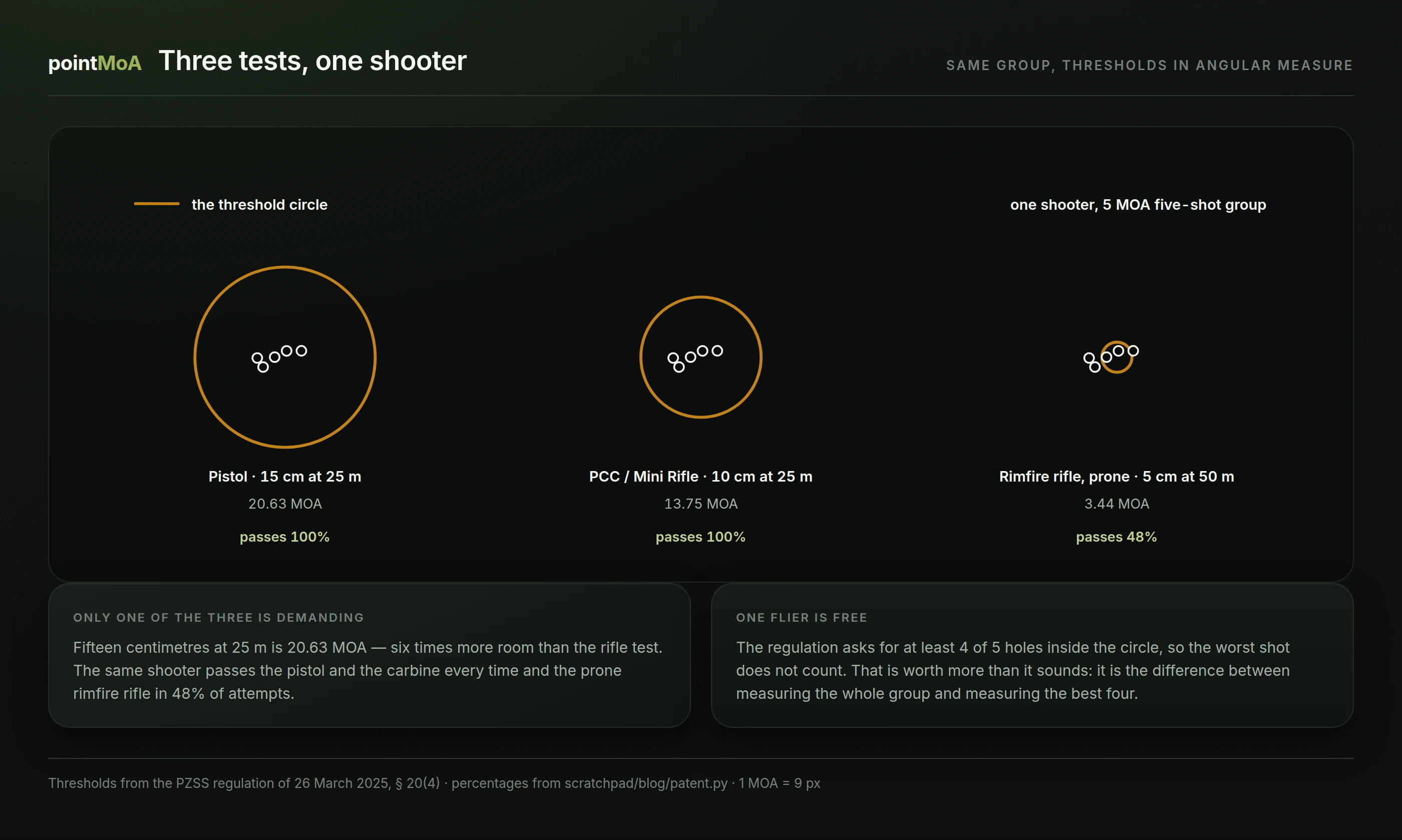
The rules give the thresholds in centimetres at different distances, so they cannot be compared by eye. Converted to angular measure, the picture becomes unambiguous:
| Test | Threshold | At a distance of | In angular measure |
|---|---|---|---|
| pistol, no. 1 | 15 cm | 25 m | 20.63 MOA |
| PCC / Mini Rifle carbine, no. 3 | 10 cm | 25 m | 13.75 MOA |
| rimfire rifle, no. 2 | 5 cm | 50 m | 3.44 MOA |
To find out what that means for a particular shooter, we computed it by simulation: 40,000 random draws of five-shot groups for each level of dispersion, from each group taking the smallest circle enclosing the best four — because the rules count four out of five, not all five.
We express grouping as the typical extreme spread of a five-shot group, that is the number you have on your own targets (how to measure it):
| Your 5-shot group | Pistol, 15 cm/25 m | Carbine, 10 cm/25 m | Rifle, 5 cm/50 m |
|---|---|---|---|
| 2 MOA | 100% | 100% | 100% |
| 3 MOA | 100% | 100% | 97% |
| 4 MOA | 100% | 100% | 77% |
| 6 MOA | 100% | 100% | 27% |
| 9 MOA | 100% | 99.9% | 4.7% |
| 13 MOA | 100% | 94% | 0.8% |
| 20 MOA | 93% | 48% | 0.1% |
And the other way round — what grouping it takes to pass repeatably:
| Test | Pass half the time | 9 times in 10 | 99 times in 100 |
|---|---|---|---|
| pistol, 15 cm at 25 m | 29.7 MOA (21.6 cm) | 20.9 MOA (15.2 cm) | 16.5 MOA (12.0 cm) |
| carbine, 10 cm at 25 m | 19.8 MOA (14.4 cm) | 13.9 MOA (10.1 cm) | 11.1 MOA (8.1 cm) |
| rifle, 5 cm at 50 m | 5.0 MOA (7.3 cm) | 3.5 MOA (5.1 cm) | 2.7 MOA (3.9 cm) |
The practical conclusion is a single one: of the three rifled-firearm tests, the one that is genuinely demanding is the rifle test prone. Pistol and carbine are passed by anyone who keeps four out of five shots on a sheet of A4 at 25 m. Rimfire rifle at 50 m requires a group of around 4 cm — which means equipment that can do it, and training that will repeat it.
Three caveats to these numbers, all of them material:
- The simulation assumes dispersion with no preferred direction and no zero error. Real groups are often worse, and at the exam you shoot somebody else's firearm, under pressure and without warm-up shots.
- The rules do not say whether the circle floats freely or is centred on the point of aim. The numbers above are for a circle laid over the group. With the stricter reading — a circle on the point of aim — the same shooter with a 3 MOA group passes the rifle test 68% of the time, not 97%. The difference is large enough that it is worth asking the board before you shoot.
- One flier is free. Four hits out of five count, so the worst shot does not spoil the result. That changes the arithmetic more than you might think.
Preparing for the patent strzelecki theory exam
The material is finite and public. A plan that makes sense:
- Start with the Weapons and Ammunition Act and with the safety rules. Those are the first four questions of the test, and every one of them is critical. The rest of the material can wait — this cannot.
- Learn from the legal basis, not from the answers alone. The question at the exam may be worded differently from the one you know; the provision underneath does not change.
- Test yourself with a test, not by reading. Recognising the correct answer in a list is not the same as recalling it.
- The last week for the rules and firearm construction. Those are areas 3 and 4 — important, but not critical in the sense in which the first four questions are critical.
How to prepare for the practical part
The board assesses habits, not knowledge about habits. A habit is built through repetition on the range, not at home before the exam.
- The sequence of actions on picking up the firearm — remove the magazine, check the chamber, control shot — has to be automatic, in that order, every time.
- The muzzle always pointed at the backstop. It is the most common thing that trips up a candidate whose mind is elsewhere.
- Commands — learn to react to them reflexively, including the ones that interrupt firing.
- A stoppage — know what you will do before it happens.
- Shooting against the clock. Five minutes is plenty, but only when you do not have to think about handling.
If you are aiming at the rifle patent, treat test no. 2 as a sporting task: shoot prone with a rest at 50 m and measure your groups, instead of assuming it will be enough. The table above says exactly which number is enough.
The most common mistakes
- Registering before the month of membership is up. The registration will go through; the exam will not take place.
- An incomplete application. A missing doctor's or club head's signature means non-admission counted as a negative result — with the fee forfeited.
- Absence without withdrawing by 23:59 the day before. The same: negative result and the fee forfeited.
- Choosing an exam outside your voivodeship. Regionalisation by the seat of your home club applies.
- Learning "the questions" instead of the provisions — costly on the first four questions, where there is no margin for error.
- Assuming the rifle test is a formality. It is the only one that genuinely weeds people out.
- Entering all three disciplines "just in case" without preparing for each. You get the patent only for those you pass — which is no loss in itself, but a resit costs money.
Checklist
A week before:
- club membership past the one-month mark and visible in the PZSS system;
- initial training completed, mock exam passed for the disciplines you are applying for;
- application generated, signed, with the doctor's opinion and the club head's certification;
- registration and fee in the system, date and venue confirmed;
- checked which shooting tests apply at this exam.
On the day of the exam: an identity document, the original licence application, hearing protection and safety glasses, and if you are shooting your own equipment — the firearm, ammunition and a check that everything works.
What next after passing
The board forwards the documents to the PZSS Office; the decision awarding the patent appears in the system within 30 days at most of their delivery. The natural next step is an application for a competitor's licence through your club, and then — if that is your goal — an application for a firearms permit for sporting purposes.
If you failed: a resit no earlier than after 5 days. If you failed only the practical part of one discipline, you resit only that part, and the patent is extended once you pass. If you failed the theory, you start from there.
You also have a right to an explanation: the chair of the board is obliged to show you your examination sheet and to explain the reason for the negative result exhaustively. If you find the explanation insufficient, you may submit written objections to the PZSS Licensing and Patent Committee (Komisja Licencyjno-Patentowa) — you get a reply no later than within two weeks.
The essentials in six sentences
- The patent is the qualification under art. 10b of the Act, not a firearms permit; a sporting permit also needs club membership and a competitor's licence.
- You can take the exam after one month in a club with a PZSS licence — the federation may not demand a longer period.
- The test is 10 questions in 20 minutes, the threshold is 9 correct, but the first four must all be correct.
- The practical part is safe handling plus a shooting test, separately for each of the three disciplines.
- The test thresholds differ six-fold: 20.63 MOA for pistol and 3.44 MOA for rifle prone.
- The fee is 400 PLN under the Act, the patent has no expiry date, and a resit is possible after five days.
Frequently asked questions
How much does the shooting licence exam cost? 400 PLN. The amount follows directly from art. 10b ust. 2 of the Weapons and Ammunition Act and constitutes revenue of the federation. The PZSS Board may set discounts in specific cases.
How long do you have to be in a club before the exam? One month, counted from registration in the PZSS system. The Act forbids the federation from requiring a longer period.
Do you have to take all three disciplines? No. The patent is awarded separately for pistol, rifle and smoothbore shotgun, for those you pass. The application can be submitted only for the disciplines your home club holds a licence for.
How many questions do you need to know for the test? The test has 10 questions, and 9 correct are needed to pass — with the proviso that the first four, on the Act and on safety, must be flawless. The question bank on the portal holds 350 questions written on the basis of the legal provisions, with the legal basis attached to every question about a provision.
How well do you have to shoot? For pistol and carbine — surprisingly poorly: the thresholds are 20.63 and 13.75 MOA. For rifle prone at 50 m you need a group below 3.5 MOA to pass nine attempts out of ten. That is about 5 cm at 50 m.
Does the patent have to be renewed? No, it is awarded for an indefinite period. What gets renewed is the competitor's licence — that one is issued for a calendar year.
When can you take a resit? No earlier than five days after the exam. If you failed only the practical part of one discipline, you resit that part alone.
The questions written for the portal are waiting in the Shooting Licence module: with flashcards you learn with the legal basis attached to questions about provisions, and with the mock exam you test yourself on a random set. Progress is counted in your browser — the portal does not know who is studying.
One caveat: the mock exam on the portal has twenty questions and allows at most one mistake, which is a different format from the real exam described above. It is for checking knowledge, not for simulating the pass rules.